Deep Learning vs Machine Learning: When Does Your Business Actually Need Deep Learning?
Deep learning or classic machine learning? A plain-words guide to which one your project needs, what each costs, and what to ask a partner first.

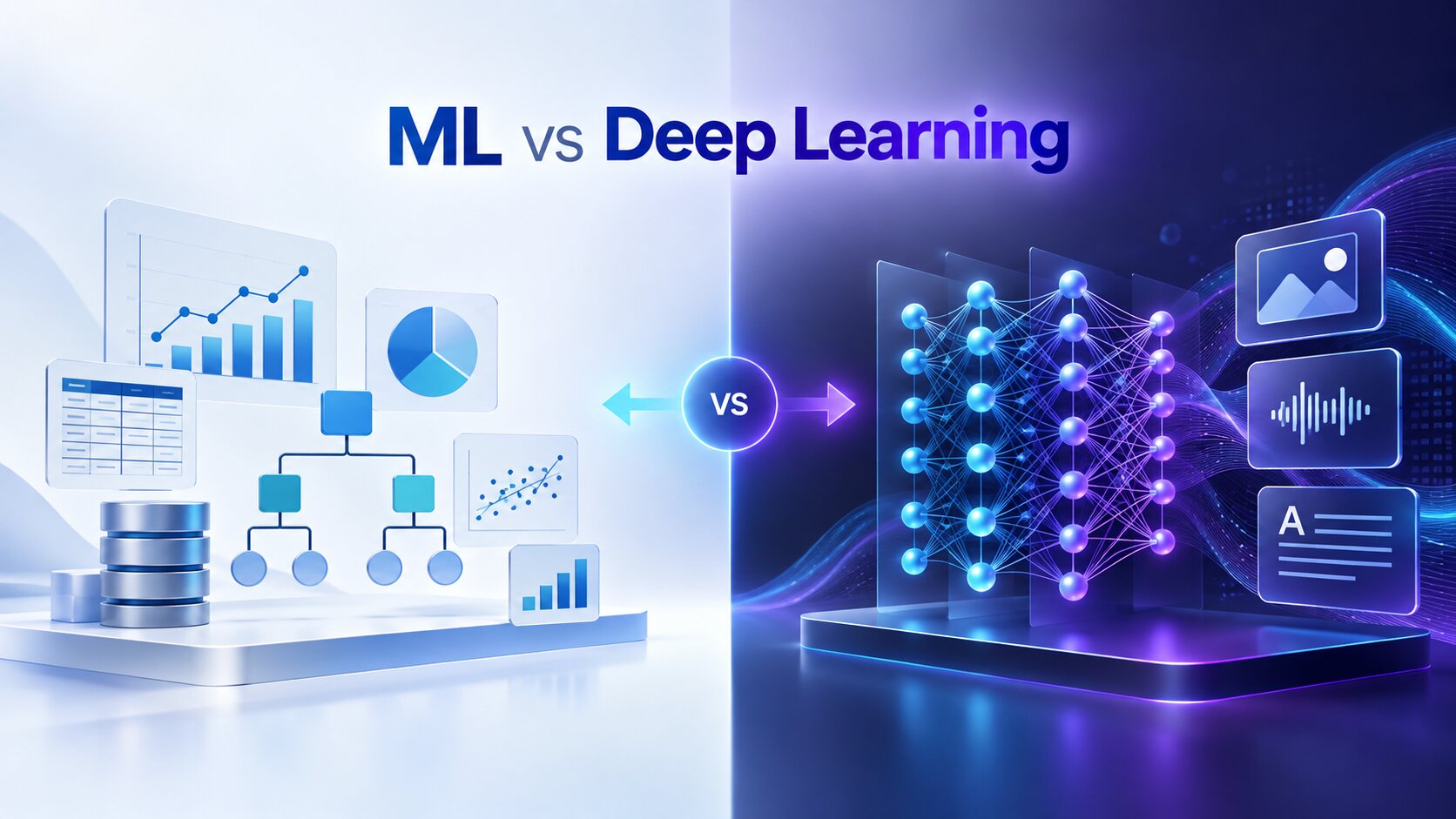
Your team has a churn problem, a spreadsheet of customer data, and a vendor telling you the answer is a neural network. It probably isn’t. A well-tuned classic machine learning model would likely do the job in a fraction of the time and budget.
The opposite mistake is just as common. A company tries to read scanned invoices or inspect product photos with rules and simple models, then wonders why accuracy never gets good enough to trust.
Knowing which side of that line your project sits on is the most useful thing a deep learning development company can tell you before any code is written. This guide explains the difference in plain words, shows when classic ML is enough, when deep learning earns its cost, and what to ask a partner before you sign.
Key Takeaways
- Deep learning is a subset of machine learning. The practical difference is who designs the features: your team in classic ML, the network itself in deep learning.
- For rows-and-columns business data, classic ML is usually the right call. A NeurIPS benchmark found tree-based models still beat neural networks on typical tabular datasets.
- Deep learning earns its cost when the input is images, video, audio, free text, or long sensor sequences.
- You rarely train from scratch in 2026. Transfer learning and fine-tuning cut the data and compute you need.
- Data readiness decides more projects than model choice. Gartner predicts 60% of AI projects without AI-ready data will be abandoned through 2026.
- A good partner will tell you when you don’t need deep learning at all.
Deep Learning vs Machine Learning in Simple Words
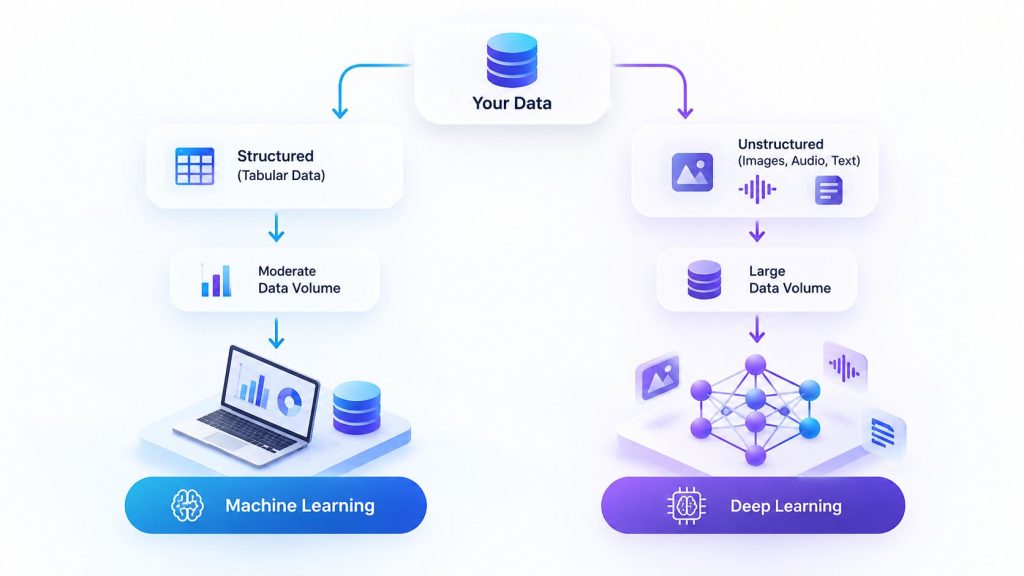
Machine learning is software that learns patterns from examples instead of following rules a programmer wrote by hand. Show it thousands of past loan applications and their outcomes, and it learns to estimate the risk of the next one.
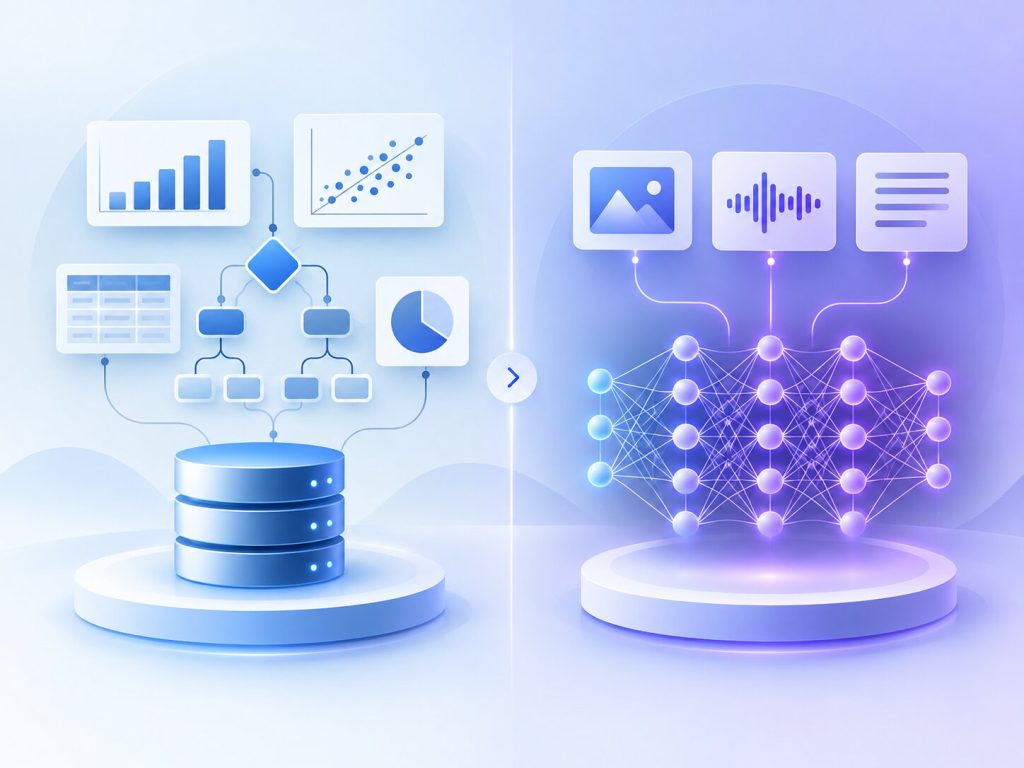
Classic machine learning covers methods like linear regression, random forests, and gradient-boosted trees. These models work on features a person prepared, such as “days since last purchase” or “average order value.” Your team decides what the model looks at.
Deep learning is a branch of machine learning that uses neural networks with many layers. The network learns its own features straight from raw data: pixels, sound waves, or words. Nobody tells it what an edge, a syllable, or a product defect looks like. It works that out, but it needs far more examples and computing power to get there.
Where does generative AI fit? Large language models and image generators are deep learning models that someone else has already trained. We cover that split in generative AI vs traditional AI.
| Factor | Classic Machine Learning | Deep Learning |
|---|---|---|
| Best input | Structured rows and columns | Images, video, audio, text, sensor streams |
| Data needed | Hundreds to tens of thousands of labeled rows | Thousands to millions of examples, fewer with transfer learning |
| Features | Designed by your team | Learned by the network |
| Compute | Standard CPUs | GPUs for training, often for serving too |
| Explainability | Easier to explain to auditors and customers | Harder, needs extra tooling |
| Time to a first version | Shorter | Longer |
When Classic Machine Learning Is Enough
McKinsey’s latest State of AI survey found that 88% of organizations now use AI in at least one business function. A large share of that everyday work is classic ML, and for good reason. Most business data lives in tables: your CRM, your ERP, your transaction history.
On that kind of data, bigger models don’t win by default. A widely cited NeurIPS benchmark tested neural networks against tree-based models across 45 tabular datasets. It found that tree-based models remain state-of-the-art on medium-sized data of around 10,000 samples, even before counting how much faster they are to train.
Classic ML is usually enough when:
- Your data is structured. Churn prediction, lead scoring, credit risk, demand forecasting, and pricing all start from rows and columns.
- You have limited labeled data. Thousands of examples, not millions.
- You must explain decisions. In lending, insurance, and healthcare, regulators and customers ask why. Simpler models answer more easily.
- You need low running costs. These models run on ordinary servers and respond in milliseconds.
One honest caveat: the gap is narrowing. A 2025 Nature paper introduced TabPFN, a pre-trained model for tables that outperformed tuned baselines on datasets of up to 10,000 samples. That is a ready-made model you apply, though, not a custom network you fund from scratch. The advice holds: start with the simplest model that meets your target.
This is the ground our machine learning development work covers, and it powers most of the predictive analytics businesses run today.
When You Actually Need Deep Learning
Deep learning stops being optional when the raw input is something a spreadsheet can’t hold. Look for these signs:
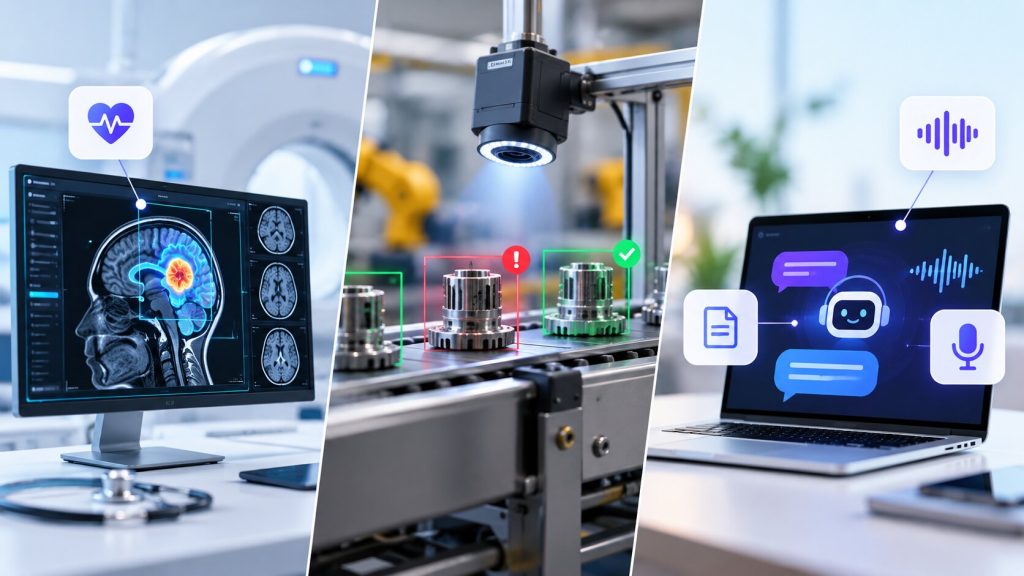
- Images and video. Spotting defects on a production line, reading medical scans, checking shelf stock from camera feeds, or pulling fields out of scanned documents.
- Text and language. Sorting support tickets by meaning, extracting clauses from contracts, or searching by intent instead of keywords. This is the core of natural language processing.
- Voice and audio. Turning calls into text, building voice interfaces, or listening for the sound of a failing machine.
- Large or sequential data. Sensor streams, clickstreams, and long time series where hand-built features miss the pattern.
- A ceiling you can’t break. Your classic model has stopped improving, more features don’t help, and you have plenty of data.
The good news is that you rarely start from zero. As TensorFlow’s transfer learning guide puts it, a pre-trained model is a saved network that was previously trained on a large dataset. You reuse what it already knows and fine-tune it on your own, much smaller, set of examples. That is why a visual inspection project can often begin with thousands of labeled images instead of millions.
A quick test helps. Could a person make this decision by looking at one row of a spreadsheet? Classic ML will probably do. Would they need to look at a picture, listen to a recording, or read a document? That is deep learning territory.
Real Use Cases by Industry
Most real systems use both. The split below shows where each one tends to pay off.
| Industry | Classic ML usually handles | Deep learning is worth it for |
|---|---|---|
| Healthcare | Readmission risk, appointment no-shows | Reading scans and pathology slides |
| Retail & eCommerce | Demand forecasting, customer segments | Visual search, style recommendations from photos |
| Finance & Insurance | Credit scoring, fraud flags on transactions | Claims document processing, call analytics |
| Manufacturing | Maintenance alerts from sensor readings | Visual quality inspection |
| Logistics | ETA prediction, route cost models | Damage detection from photos, reading shipping documents |
| Fitness & Wellness | Churn and engagement scoring | Form tracking from the phone camera |
Healthcare shows the pattern most clearly. The FDA’s list of AI-enabled medical devices now runs past 1,500 authorizations, and independent counts put radiology at roughly three-quarters of them. Medical imaging is where deep learning has proven itself beyond doubt.
We see the same split in our own projects. In our retail style analysis case study, computer vision and neural trait analysis turned a fashion catalogue into a style concierge, with 40% growth in digital sales and a 35% increase in user retention. Our adaptive fitness coaching build paired computer vision with predictive models and lifted member retention by 30%. Neither project used deep learning for everything. Each used it where the input was visual.
Cost and Data Requirements
Deep learning costs more than classic ML in four places, and model training is rarely the biggest one.
- Data. Labeled examples are the real expense. Gartner predicts that through 2026, organizations will abandon 60% of AI projects that aren’t supported by AI-ready data. In the same research, 63% of organizations either lacked the right data management practices for AI or weren’t sure they had them. Solid data engineering comes before any model.
- Compute. Deep learning trains on GPUs. Prices have dropped: in June 2025, AWS cut prices by up to 45% on its P4 and P5 NVIDIA GPU instances. Even so, experiments add up, and serving costs run for the life of the product.
- People. You need engineers who know neural architectures and the MLOps work that keeps models healthy in production.
- Upkeep. Models drift as your data changes. Budget for monitoring and retraining from day one.
Three habits keep the bill under control:
- Run a classic ML baseline first. If it delivers most of the business value, stop there.
- Start from a pre-trained model instead of training your own.
- Label a small pilot set, prove the idea works, then invest in more data.
For budget ranges by project type, see our guide to AI development cost in 2026.
How to Pick a Deep Learning Development Company
Skip the slide deck and ask these directly:
- Do you run a baseline first? A serious partner tests a simpler model before proposing a neural network. If they jump straight to deep learning, ask why.
- Can you show production work, not demos? Ask how they monitor models, how often they retrain, and what happened the last time the data changed.
- Which framework, and why? PyTorch leads new development. In the past month it drew about 59 million PyPI downloads against roughly 12 million for TensorFlow. TensorFlow still runs many enterprise systems and, through LiteRT, a lot of on-device AI. If your stack is built on it, you want a TensorFlow development company that can maintain and extend it, not one that pushes a rewrite.
- Who owns the data pipeline? Models fail when the data feeding them breaks. The same team should own both.
- Where does a human review the output? High-stakes predictions need a person in the loop.
- How is the work priced? Look for a short feasibility phase with a clear go or no-go, then milestones tied to results.
Our Take at VectovateAI
As an AI-native software development company based in Ahmedabad, we start our deep learning development services with a technical discovery and data feasibility audit. If a gradient-boosted model solves the problem, we say so and build that instead. When your project demands deep learning, our senior architects design the neural network, data pipeline, and MLOps monitoring in parallel—always keeping a human in the loop for high-stakes decisions.
Not sure which side you are on? A short ML consulting engagement is the low-cost way to find out. You can also see how we run projects end to end in our AI development process guide.
Final Thoughts
Deep learning is the right tool for pictures, sound, language, and very large data. Classic machine learning is the right tool for almost everything that fits in a table. The expensive mistakes come from mixing those two up.
The best deep learning solutions start with a clear question, a simple baseline, and data you can trust. A good deep learning development company helps you get those three right before it proposes a model.
Not sure whether your project needs deep learning or a simpler model? Book a Free AI Architecture Review with VectovateAI
Frequently Asked Questions.
Get all your answers here and if something remains ask our AI concierge or Book a call with our consultant.