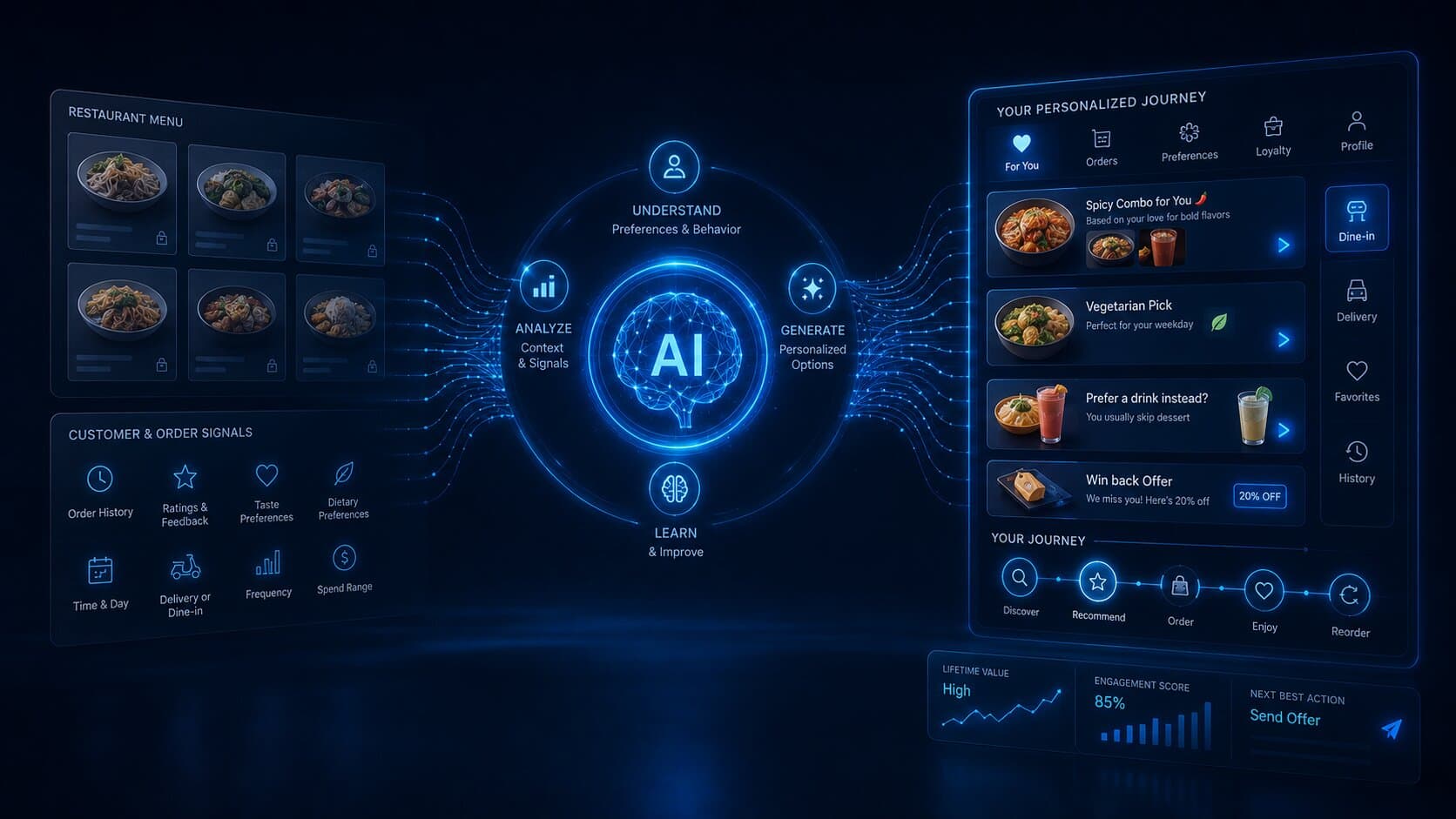
AI in Sports Analytics: Performance and Fan Engagement
AI now flags injury risk before it happens and cuts highlights in seconds. Here is how AI sports analytics drives performance, medicine, and fan engagement.

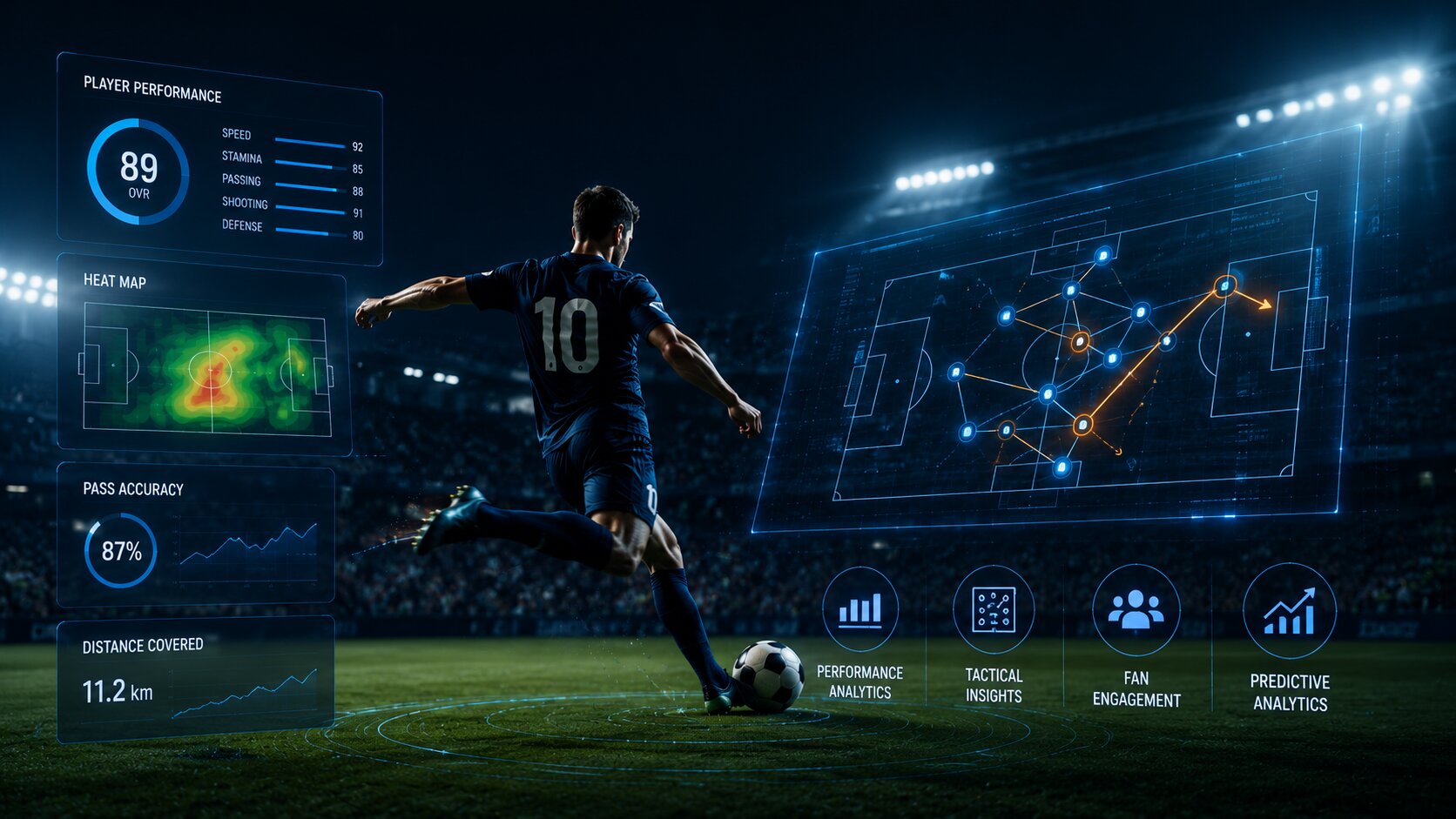
AI in sports is no longer a side experiment run by a handful of data-science teams. It has become the operating layer behind how athletes train, how coaches make in-game calls, and how fans experience every match.
From wearable sensors that flag an injury risk before it happens to AI models that cut a scoring-play highlight and push it to your phone within seconds, AI sports analytics now touches almost every part of the sports business.
The global AI in sports market is projected to reach $29.7 billion by 2032, growing at a compound annual rate of 30.1 percent. That kind of growth tells you this is a permanent change in how teams, leagues, and broadcasters operate.
Key Takeaways
- AI in sports analytics now drives player performance tracking, injury prediction, game strategy, scouting, and fan experience all at once.
- Computer vision and wearable sensors generate the raw player-tracking data that powers almost every downstream AI model, from Second Spectrum’s NBA tracking to NFL Digital Athlete.
- AI fan engagement tools, like automated highlight generation and AR broadcast overlays, are cutting production time by up to 90% while personalizing content for every viewer.
- Generative AI in sports and agentic AI are the biggest 2026 trends, moving teams from reactive dashboards to systems that recommend and act in real time.
- Governance and explainability matter as much as accuracy. A model that cannot explain a decision will not survive a locker room, a draft room, or a compliance review.
What Is AI in Sports Analytics?
AI sports analytics applies machine learning, computer vision, and predictive modeling to sports data. Coaches use it for training plans, medical staff use it to spot injury risk, and marketing teams use it to fill stadium seats. AI simply makes this process faster and available in real time.
Businesses and leagues now search for AI for sports analytics solutions to unify player data, fan behavior, and business operations into one intelligent system.
The foundation behind it all is player tracking data. Cameras, wearable sensors, and RFID chips capture positions, speeds, and biomechanical signals during every match, feeding performance models, injury-risk engines, and even broadcast graphics.
How Is AI Used in Sports Analytics Today?
How AI is used in sports shows up differently depending on who is using it. Here is a quick breakdown of the major use cases across the industry:
| Use Case | What It Does | Who Benefits |
|---|---|---|
| Player performance analysis | Tracks movement, speed, and technique in real time | Coaches, athletes |
| Injury prevention | Flags fatigue and biomechanical risk before injury occurs | Medical staff, teams |
| Game strategy | Analyzes formations, positioning, and opponent tendencies | Coaches, analysts |
| Scouting and recruitment | Evaluates talent using tracking and historical data | Front offices |
| Fan engagement | Personalizes highlights, stats, and broadcast overlays | Broadcasters, leagues |
| Business operations | Powers dynamic ticket pricing and sponsorship valuation | Finance, marketing teams |
Basketball and baseball currently lead adoption because of dense tracking infrastructure and decades of statistical history, while sports like rugby are still catching up on wearable sensor deployment.
AI in Sports Athlete Performance Analysis
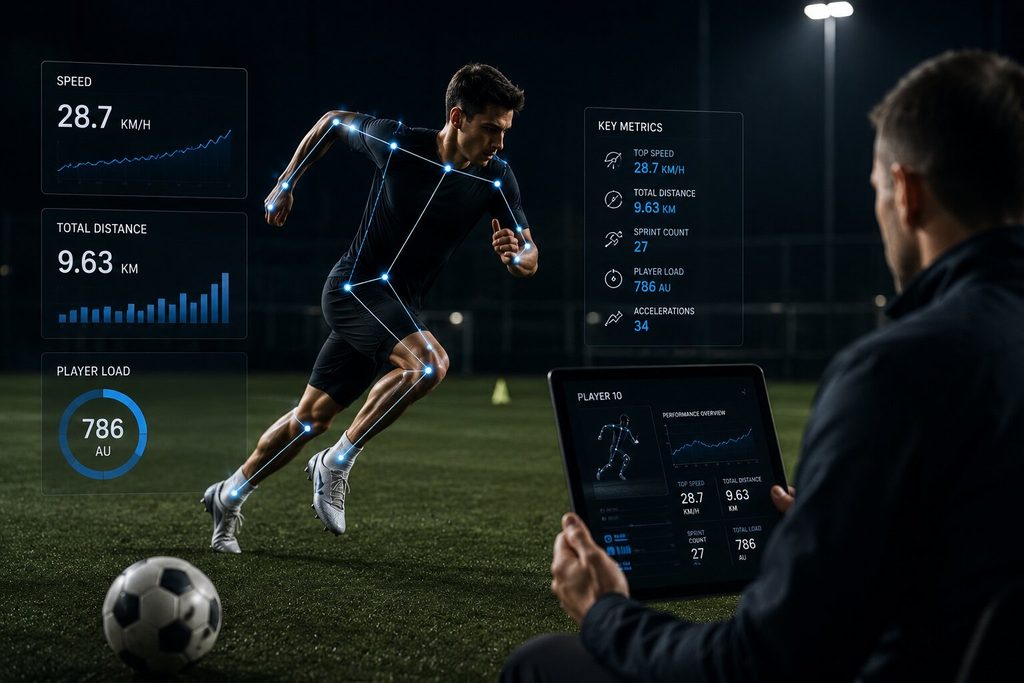
AI in sports athlete performance analysis has changed how coaches evaluate players. Instead of relying only on box scores and film review, teams now combine three data sources:
- Historical performance data to establish player baselines
- Wearable sensor data, including heart rate, GPS load, and joint stress
- Computer vision tracking that follows every player and the ball frame by frame
In the NBA, Second Spectrum tracks player and ball positions 25 times per second to calculate shot quality in real time. In tennis, Hawk-Eye calls lines with millimeter precision at every Grand Slam.
This detail helps coaches build training plans tailored to each athlete, and helps teams spot who’s trending toward a breakout season versus who’s nearing an injury risk zone.
Generative AI in Sports and the Rise of Agentic AI
Generative AI in sports is moving past chatbots into agentic systems that observe, decide, and act with minimal human input, recommending a lineup change or training-load adjustment instead of just reporting what happened.
Agentic AI in sports pulls from wearables, camera feeds, and historical data to act as a digital co-coach during the game itself.
Coaches and medical staff still make the final call. That mix of machine speed with human judgment is what’s driving adoption.
AI in Sports Medicine: Preventing Injuries Before They Happen

AI in sports medicine is arguably where the technology has the clearest, most measurable impact. The NFL’s Digital Athlete program fuses wearable sensor data, weather conditions, and play-level video into a single injury-risk model that flags players before a soft-tissue issue becomes season-ending. Built on AWS and deployed across all 32 clubs, the system blends biomechanical load data with tracking information to model fatigue and joint stress close to real time.
Reported results from similar systems are significant. One AI-powered injury prediction program reduced soft tissue injuries by 47% in its first season.
A few things make this work in practice:
- Wearables generate raw biometric signals like heart rate, load, and sleep quality
- Predictive models combine that signal with historical injury data and playing surface information
- Medical staff receive a risk score, not a black-box verdict, so they can validate it against clinical judgment
Explainability matters here more than almost anywhere else. A model that recommends benching an athlete needs to show its reasoning, because team doctors and player unions will challenge a decision they cannot understand.
AI Fan Engagement: From Passive Viewer to Active Participant
AI fan engagement has fundamentally changed what it means to watch a game. Broadcasts are no longer a single fixed camera feed; they are personalized, interactive layers built specifically for each viewer.
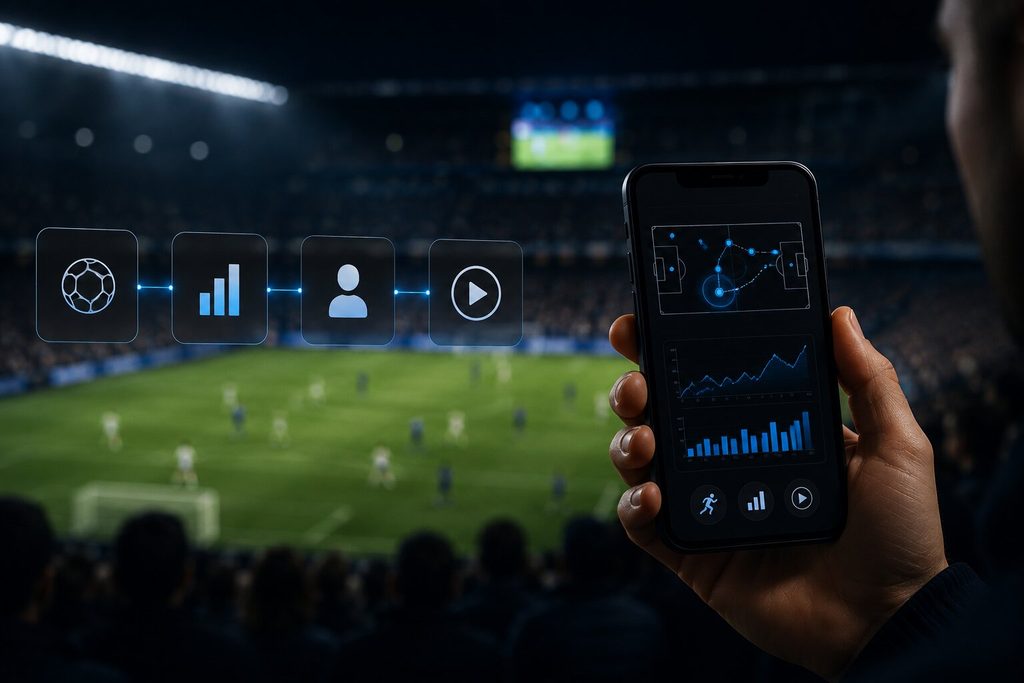
AI-powered fan engagement tools include:
- Automated highlight generation: AI in sports highlights is now the fastest-growing fan-facing use case. Platforms like WSC Sports detect scoring plays and key moments directly from raw broadcast feed, cutting highlight production time by up to 90% compared to manual editing. Clips reach team apps and YouTube within minutes of a live play.
- AR and VR overlays: Formula 1’s F1 Insights program, built with AWS, generates live telemetry graphics showing braking points and tire-strategy predictions during a race broadcast, information a commentator once had to explain manually.
- Sentiment-driven personalization: Tata Elxsi’s AI-powered sports analytics platform unifies participation, geographic, and sentiment data using NLP techniques such as tokenization and Naïve Bayes classification to recommend content tailored to what fans actually care about.
- Digital twin replays: Teams now render 3D reconstructions of players and stadiums, letting fans view a play from a virtual courtside seat rather than a fixed broadcast angle.
- In-stadium AI assistants: Chatbots help fans find their seats, check concession lines, or get real-time stats without leaving their phone.
Personalized engagement directly drives digital viewership, merchandise sales, and fan loyalty, all of which show up on a team’s revenue sheet.
AI in Sports Marketing and Sponsorship
AI in sports marketing has moved past simple ad targeting. Teams now train models on jersey visibility, social mentions, and merchandise lift to estimate real sponsor revenue, replacing simple logo-impression counts. Dynamic ticket pricing works the same way, adjusting seat prices in real time based on opponent rank, weather, and demand.
Interestingly, the same demand-forecasting infrastructure that powers fan content is increasingly reused for pricing and sponsorship decisions.
AI in Sports Market: Where the Growth Is Concentrated
Multiple research firms track the AI in sports market, and the direction is consistent. Allied Market Research projects the sector will hit $29.7 billion by 2032, growing roughly 30 percent annually, per its artificial intelligence in sports market report. Separately, Deloitte’s 2024 Future of Sport survey found 47 percent of sports leaders picked data capabilities as their biggest growth opportunity.
Growth isn’t even. Fan-facing tools scale fastest with proven vendor accuracy. Injury-risk models grow slower, held back by governance concerns.
Challenges Worth Knowing About
AI in sports has its own friction. A few honest limitations to keep in mind:
- Algorithmic bias: Models trained mostly on data from well-resourced programs can undervalue athletes from smaller schools or leagues with thinner data history.
- Cost barriers: Smaller clubs risk being priced out of advanced AI systems, widening the gap between big and small organizations.
- Model drift: A highlight or tracking model tuned for one league’s camera angles often degrades when applied to a different sport or a lower-budget broadcast feed.
- Data governance: Biometric and health data from wearables demands strong privacy protection, especially as player unions push for more oversight.
None of these issues are reasons to avoid AI. They are reasons to build it carefully, with a human still making the final call.
What’s Next for AI in Sports
The next phase looks less like dashboards and more like autonomous teammates: hyper-personalized training that adjusts minute by minute, AI in officiating for fair play, and smart apparel connected through edge computing for instant feedback.
The direction is clear: AI sports analytics is moving from a reporting tool into a decision-making partner across performance, medicine, marketing, and fan experience alike.
VectovateAI treats this shift seriously and builds explainable systems rather than black boxes.
Want to build an AI-first sports analytics or fan engagement platform for your team or organization? Talk to the AI engineering team at Vectovate and turn this roadmap into a working product.
Frequently Asked Questions.
Get all your answers here and if something remains ask our AI concierge or Book a call with our consultant.