AI Development Process: From Idea to Deployment
Every AI product starts as a rough idea and ends as a system running quietly in production. This is the full six-stage lifecycle, from discovery and data preparation through training, deployment, and the monitoring and retraining that keeps a model from quietly degrading, plus realistic timelines and the challenges teams hit after go-live.

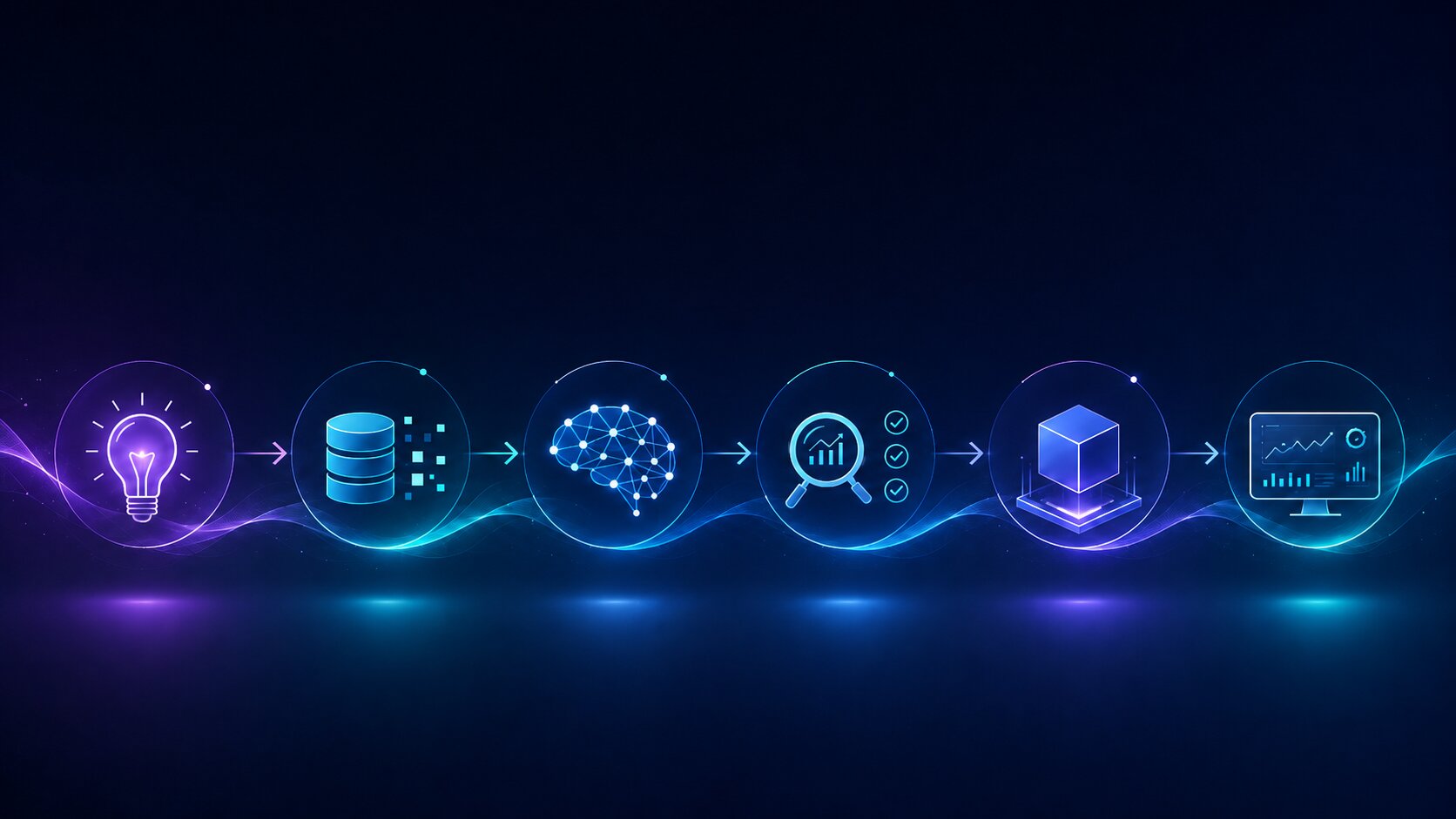
Every successful AI product starts as a rough idea and ends as a system that runs quietly in production, making decisions or predictions without anyone watching every step. The gap between those two points is called the AI development process, and most businesses underestimate how many stages sit inside it.
This guide breaks down the complete AI development lifecycle, explains how to build an AI model the right way, and shows you exactly where teams lose time, budget, or accuracy. Whether you’re a founder scoping your first AI product or an IT student trying to understand AI model development end-to-end, this blog gives you a practical, no-fluff roadmap.
Key Takeaways
- The AI development process has six core stages: discovery, data preparation, model selection, training, deployment, and monitoring.
- Clean, well-labeled data determines model accuracy more than any algorithm choice.
- Custom AI model development should start with a business problem, not a technology preference.
- Deployment isn’t the finish line. Post-launch monitoring prevents model drift and silent failure.
- Most AI model development challenges come from poor data readiness and weak governance, not weak engineering.
- Businesses that follow a phased AI development lifecycle see faster ROI and fewer costly rebuilds.
What Is AI Model Development?

AI model development is the structured process of designing, training, testing, and deploying a system that can learn patterns from data and make predictions or decisions on its own. Unlike traditional software, which follows fixed rules, an AI model improves as it sees more data, which is exactly why the process demands more planning upfront.
Think of it this way: building a normal app is like writing precise instructions for a machine to follow. Building an AI model is more like training a new employee. You feed it examples, correct its mistakes, test its judgment, and only then let it work independently. That difference is why the AI model development process needs its own dedicated framework, separate from a typical software development process.
The Complete AI Development Lifecycle
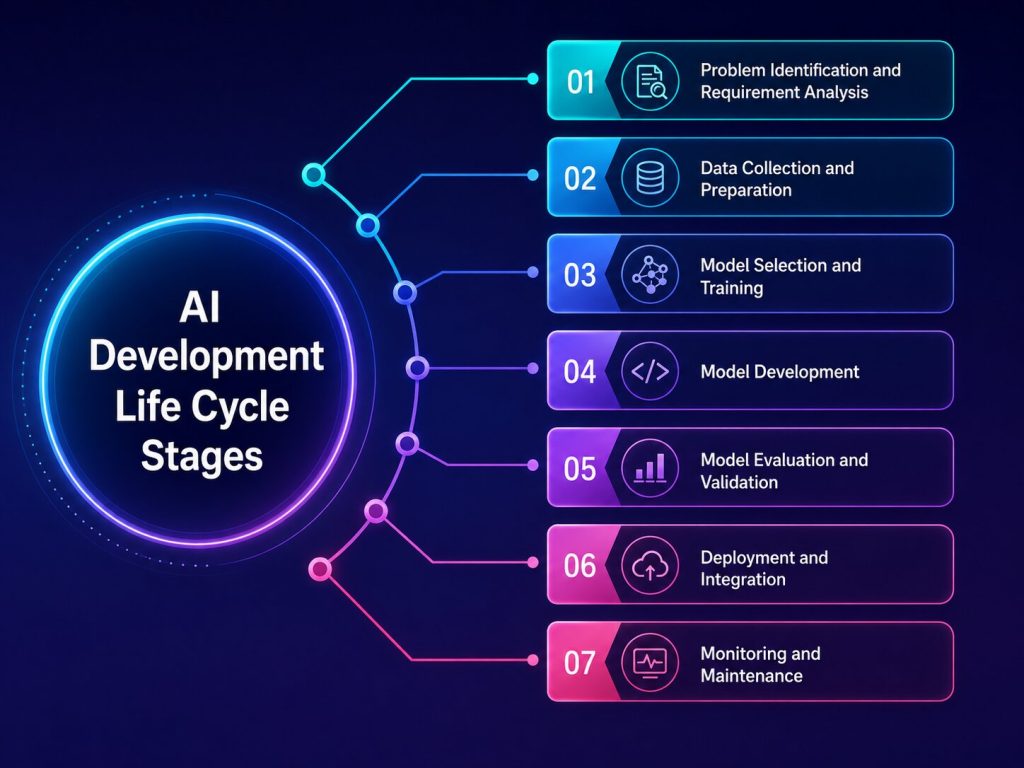
Every reliable AI software development process moves through the same core stages, regardless of industry or use case. Splunk’s roadmap research frames this well: an AI roadmap is a strategic guide for bringing your AI vision to life within your organization, breaking that vision into practical steps that move you from planning to real-world deployment in a structured, scalable, and realistic way.
Stages of AI model development:
| Stage | What Happens | Primary Output |
|---|---|---|
| 1. Discovery & Strategy | Define the business problem and success metrics | Clear objectives and KPIs |
| 2. Data Strategy & Preparation | Audit, clean, and label data | Training-ready dataset |
| 3. Model Selection & Architecture | Choose ML, DL, NLP, or rule-based approach | Model architecture |
| 4. Training & Validation | Train, tune, and test the model | Validated, benchmarked model |
| 5. Deployment | Push the model into production | Live AI feature or product |
| 6. Monitoring & Governance | Track drift, retrain, ensure compliance | Stable, trustworthy AI system |
Stage 1: Discovery and AI Strategy
This is where most teams either set themselves up for success or waste months building the wrong thing. Before writing a single line of code, define what business problem you’re solving. Is the goal automation, prediction, personalization, or accuracy improvement? A structured approach here helps you answer these questions and set clear priorities, which minimizes risks, maximizes ROI, and ensures AI initiatives align directly with business goals.
Ask three questions at this stage:
- What specific problem are we solving, and for whom?
- How will we measure success (accuracy, speed, cost savings, revenue)?
- What’s our realistic timeline and budget ceiling?
Skipping this stage is the single biggest reason AI product development processes fail before they even start.
Stage 2: Data Strategy and Preparation
Your model is only as good as the data behind it. This stage covers data auditing, cleaning, labeling, and pipeline creation. Poor data quality, missing records, or inconsistent formatting between systems will quietly sabotage a model no matter how advanced the algorithm is.
Key activities in this phase include:
- Data audit: Identify gaps, duplicates, and inconsistencies across sources.
- Data labeling: Annotate data accurately for supervised learning tasks.
- Pipeline creation: Build automated pipelines that keep data flowing cleanly into training environments.
- Quality checks: Validate accuracy, security, and compliance before training begins.
Companies serious about custom AI model development treat this stage as seriously as the modeling itself, since real production data rarely arrives clean.
Stage 3: Model Selection and Architecture
This is the technical heart of how to build an AI model from scratch. The right approach depends entirely on your use case:
- Rule-based systems: Best for simple, repetitive, predictable tasks.
- Machine learning (ML): Ideal for forecasting, fraud detection, or recommendation engines.
- Deep learning (DL): Needed for image recognition, speech processing, or complex pattern detection.
- NLP and LLMs: Used for chatbots, summarization, and content generation tasks.
Picking an overpowered model for a simple problem wastes compute and budget. Picking an underpowered model for a complex problem produces unreliable results. This tradeoff is why an experienced AI model development services partner matters more than most founders expect, and it’s a core part of how we approach AI/ML development at VectovateAI.
Stage 4: Training and Validation
Once the model architecture is set, training begins. The dataset gets split into training, validation, and testing subsets so the model learns without simply memorizing patterns. Teams then tune hyperparameters, apply regularization to prevent overfitting, and track performance metrics like accuracy, F1 score, or RMSE depending on the task.
This stage is iterative by nature. A model rarely performs perfectly on the first attempt, and repeated validation cycles are completely normal in any serious AI development lifecycle.
Stage 5: Deployment
Deployment moves the model from a controlled testing environment into the real world, where it interacts with live data and real users. This includes integration with existing systems, API setup, and infrastructure scaling. UDig’s framework on the AI journey reinforces that deployment isn’t a single event but a path that runs from early pilots to enterprise-wide scale, echoing the same phased logic found across most AI roadmaps in the industry.
A smooth rollout typically follows three phases:
- Pilot deployment in a small, low-risk environment.
- Scaled deployment across broader systems and teams.
- Enterprise-wide deployment with standardized pipelines and governance.
Stage 6: Monitoring, Retraining, and Governance
Deployment is not the finish line. Models degrade over time as real-world data shifts, a problem known as model drift. Without active monitoring, an AI system that performed well at launch can silently become unreliable within months.
Ongoing governance should include:
- Performance monitoring: Track accuracy and output quality continuously.
- Retraining schedules: Refresh models with new data at set intervals.
- Compliance checks: Maintain data privacy, security, and ethical standards.
- Feedback loops: Capture real user interactions to guide future improvements.

Common AI Model Development Challenges
Even well-funded teams run into predictable roadblocks during the AI development process. The most frequent ones include:
- Poor data quality: Incomplete or inconsistent data derails accuracy before training even starts.
- Unclear success metrics: Teams build models without agreeing on what “success” actually looks like.
- Underestimating infrastructure needs: Training and inference both demand serious compute planning.
- Skipping governance: Compliance gaps surface later as expensive legal or security problems.
- No retraining plan: Models left untouched after launch degrade quietly and lose business value.
Solving these challenges early is far cheaper than fixing them after deployment, which is why structured planning through AI strategy and consulting saves both time and budget for most teams.
How Long Does AI Model Development Actually Take
Timelines vary by complexity, but a realistic AI software development process typically breaks down like this:
| Project Type | Estimated Timeline |
|---|---|
| Simple rule-based automation | 4 to 8 weeks |
| Standard ML model (forecasting, classification) | 3 to 5 months |
| Deep learning or computer vision system | 5 to 9 months |
| Custom LLM-powered product | 4 to 8 months |
These ranges assume clean data availability. Poor data readiness can easily double any of these timelines, which is exactly why the discovery and data stages deserve more attention than most teams give them.
Why Businesses Choose a Dedicated AI Development Partner
Building AI in-house without prior experience often means learning expensive lessons on your own budget. A dedicated partner brings tested frameworks, senior architects, and infrastructure knowledge that compress the entire AI product development process.
At VectovateAI, this looks like combining AI agent development, generative AI development, and LLM development under one architecture-first methodology, backed by strong data engineering services to keep the foundation solid. You can see how this plays out in practice through our development methodology and real case studies across industries.
Conclusion
The AI development process rewards teams that plan before they build. Every stage, from discovery to deployment to ongoing monitoring, exists because skipping it creates expensive problems later. Businesses that respect this lifecycle end up with AI systems that actually deliver ROI, not just impressive demos.
If you’re ready to move from idea to a working, production-grade AI system, our team at VectovateAI can walk you through a scoped roadmap. Talk to our AI architects to see where your idea fits into this process.
Frequently Asked Questions.
Get all your answers here and if something remains ask our AI concierge or Book a call with our consultant.