AI-Driven Predictive Analytics for Businesses: Turning Data Into Decisions
Most businesses already have the data to see around corners, it is just stuck describing the past. Predictive analytics turns it forward: which customers will churn, which SKUs will sell out, which supplier will slip. Here is where it is delivering real ROI in 2026, how it differs from prescriptive analytics, and why clean data matters more than the algorithm.

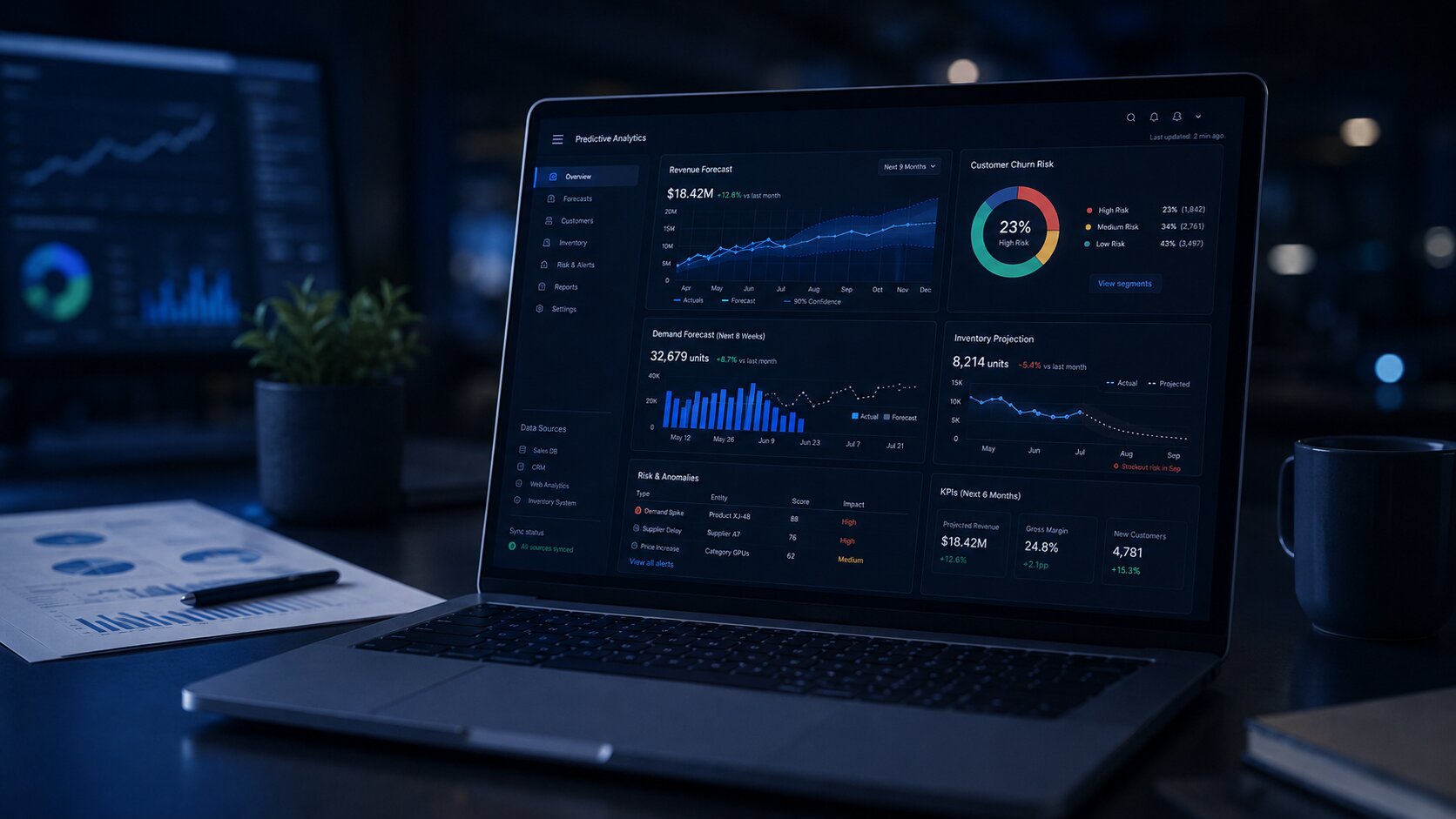
Every business already has the data it needs to see around corners. It’s just sitting in spreadsheets, CRMs, and transaction logs, describing what already happened. AI predictive analytics flips that data forward. Instead of a report on last quarter’s churn, you get a forecast of which customers are likely to leave next quarter, while you still have time to act.
For business owners and decision-makers, that shift from hindsight to foresight is turning into one of the highest-ROI AI investments available in 2026, and it doesn’t require a data science team to get started. Here’s what it actually takes to turn your data into decisions instead of just dashboards.
Key Takeaways
- AI predictive analytics turns historical and real-time data into forward-looking forecasts, not just backward-looking reports.
- The predictive analytics software market is growing fast — from $17.3B in 2025 to an estimated $21.4B in 2026, on its way to $38B by 2032.
- Retail demand forecasting models built on predictive analytics hit accuracy rates far above traditional statistical methods.
- Predictive vs prescriptive analytics are not the same thing; one tells you what’s likely to happen, the other tells you what to do about it.
- Supply chain predictive analytics is already cutting operational costs by 20–30% for logistics-heavy businesses.
- You don’t need a data science team to start. Predictive analytics for small businesses is now accessible through no-code and low-code tools.
- Getting real ROI depends less on the algorithm and more on clean data, the right use case, and the right predictive data analytics services partner.
What Is Predictive Analytics, Really?
What is predictive analytics in plain terms? It’s the practice of using historical data, statistics, and machine learning to answer one question: what is likely to happen next?
Traditional dashboards tell you what already happened: last quarter’s revenue, last month’s churn. AI predictive analytics goes further. It studies patterns in that historical data and projects them forward, so predictive analytics is a core capability of data-driven organizations planning for what’s coming instead of reacting to what already happened.
Modern predictive analytics tools blend three layers:
- Historical data: sales records, customer interactions, sensor logs, transaction history
- Statistical and ML models: regression, time-series forecasting, neural networks
- Real-time signals: live data feeds that keep predictions current instead of stale
The shift in 2026 is that this used to be a data-science-team-only capability. Now it’s embedded directly into everyday business tools — dashboards, CRMs, ERPs — so a marketing manager or operations lead can act on a forecast without waiting on an analyst.
Why Businesses Are Investing Now
The numbers explain the urgency. Global corporate AI investment reached $581.7 billion in 2025, up 130% year over year, according to Stanford’s 2026 AI Index. That capital isn’t only chasing generative AI headlines; predictive AI is quietly running the systems that matter most: fraud detection, demand forecasting, and diagnostics, while a lot of generative AI pilots have struggled to show measurable financial impact.
The predictive analytics software market itself tells the same story:
| Year | Market Size (Solutions Segment) |
|---|---|
| 2024 | $13.6 billion |
| 2025 | $17.3 billion |
| 2026 | $21.4 billion (est.) |
| 2032 (projected) | $38.0 billion |
By 2025, over 55% of businesses were expected to adopt AI-powered predictive analytics tools to sharpen decision-making, particularly in finance, marketing, and supply chain. And the results aren’t theoretical. 90% of Fortune 500 companies already use predictive analytics to convert raw data volume into decisions, with 60% of companies reporting a revenue increase of 10% or more from it.
For a mid-sized business, that’s the real pitch: predictive analytics isn’t a “nice-to-have” innovation project anymore. It’s becoming table stakes.
Predictive vs Prescriptive Analytics: Know the Difference
This is one of the most common points of confusion for decision-makers evaluating predictive data analytics services, so it’s worth separating clearly.
| Predictive Analytics | Prescriptive Analytics | |
|---|---|---|
| Core question | “What’s likely to happen?” | “What should we do about it?” |
| Output | Probabilities, forecasts, risk scores | Specific recommended actions |
| Example | 70% chance a customer churns next month | Recommend a discount + onboarding tweak to retain them |
| Techniques | Regression, time-series, ML classification | Optimization, simulation, decision modeling |
Predictive analytics tells you what’s most likely to happen, while prescriptive analytics tells you what the best action to take is. Think of it as prediction versus prescription: one is a weather forecast, the other is the advice to carry an umbrella. In practice, the two work best together: prescriptive analytics could suggest which channel to use for a campaign, while predictive analytics could estimate how much that action will increase sales.
Most businesses start with AI predictive analytics because it’s the foundation. You can’t prescribe an action based on a forecast you don’t yet trust.
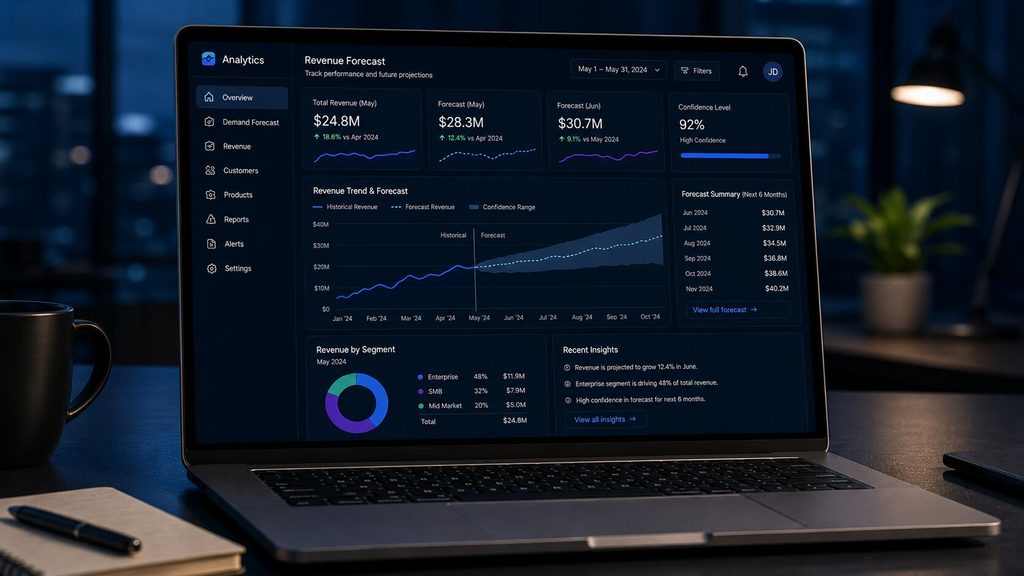
Where Is AI-Powered Predictive Analytics Delivering Real ROI?
1. Supply Chain and Operations
Supply chain predictive analytics is one of the clearest ROI stories in 2026. Predictive models forecast demand spikes, flag supplier delays before they cascade, and optimize inventory levels in real time.
Logistics firms using predictive analytics saw operational costs drop by 60%, and improvement in customer satisfaction by 45%.
Demand forecasting models in retail now hit roughly 92% accuracy, compared to about 68% with traditional statistical methods.
2. Customer Retention and Churn Prediction
Predictive models flag at-risk customers weeks before they leave — based on usage drop-off, support ticket sentiment, or payment delays — giving retention teams a real window to act.
3. Financial Risk and Fraud Detection
Banks and fintechs use predictive scoring to catch fraudulent transactions and assess credit risk in milliseconds, not days.
4. Healthcare and Patient Outcomes
Healthcare providers using predictive analytics report better patient outcomes in 58% of cases tracked, largely from earlier risk identification and resource planning.
VectovateAI helped a healthcare firm with app modernization using predictive analytics which helped increase clinical efficiency by 35% via automated scheduling.
5. Workforce and Demand Planning
Retailers and service businesses use predictive staffing models to match headcount to expected demand, avoiding both overstaffing costs and service-quality dips.
Predictive Analytics for Business Strategy, Not Just Operations
Where this gets interesting for leadership is when predictive analytics for business strategy moves beyond a single department and into planning itself — market entry decisions, pricing strategy, product roadmap prioritization. Instead of quarterly retrospectives, executive teams get rolling forecasts that update as new data comes in.
The trend for 2026 backs this up: enterprises are moving away from static dashboards and retrospective reporting, toward predictive and prescriptive intelligence embedded directly into workflows, with Gartner projecting more than 80% of enterprises will have deployed generative or predictive AI-enabled applications by 2026.
This is also where Agentic AI enters the picture, not as a buzzword, but as the natural next layer. Once a predictive model flags a risk (say, a supplier delay), an AI agent can act on it — reordering stock, alerting the right team, and adjusting a forecast — with a human reviewing the final call rather than executing every step manually. That human-in-the-loop model is what separates a responsible AI deployment from a black-box one.
Predictive Analytics for Small Business: Yes, It’s Accessible Now
A common myth: predictive analytics is only for enterprises with in-house data science teams. That’s changing fast. Predictive analytics for small business is now realistic because of two shifts:
- No-code/low-code platforms let non-technical teams build and deploy predictive analytics tools without writing code
- Cloud-based, pay-as-you-go tools remove the need for expensive infrastructure upfront
A small e-commerce brand, for instance, can use predictive analytics to forecast which SKUs will sell out before a festive season without hiring a single data scientist — by plugging existing sales data into a ready-made forecasting tool.
Choosing the Right Predictive Analytics Consulting Partner
Buying a tool isn’t the hard part. Making it work with your actual data, your actual workflows, and your actual team is. This is where predictive analytics consulting matters more than the sophistication of any single algorithm.
A good predictive data analytics services partner should help you with:
- Data readiness: cleaning and unifying data scattered across systems before any model can be trusted
- Use-case prioritization: picking the 1–2 problems where a forecast will actually change a decision, instead of trying to predict everything at once
- Model governance: monitoring for “model drift,” where a model’s accuracy degrades over time as real-world patterns shift
- Integration: embedding predictions into the tools your team already uses (CRM, ERP, BI dashboards), not a separate system nobody opens
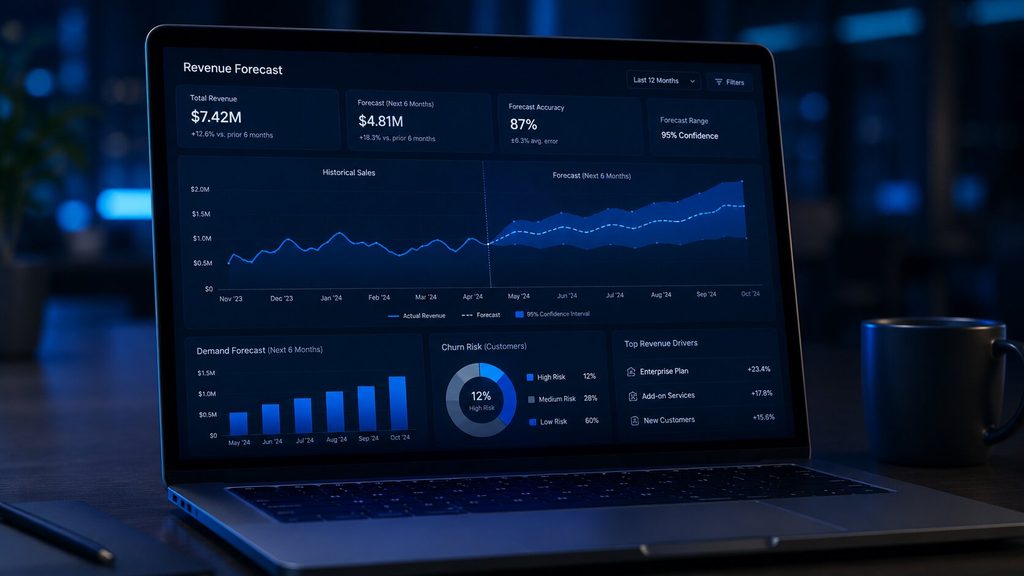
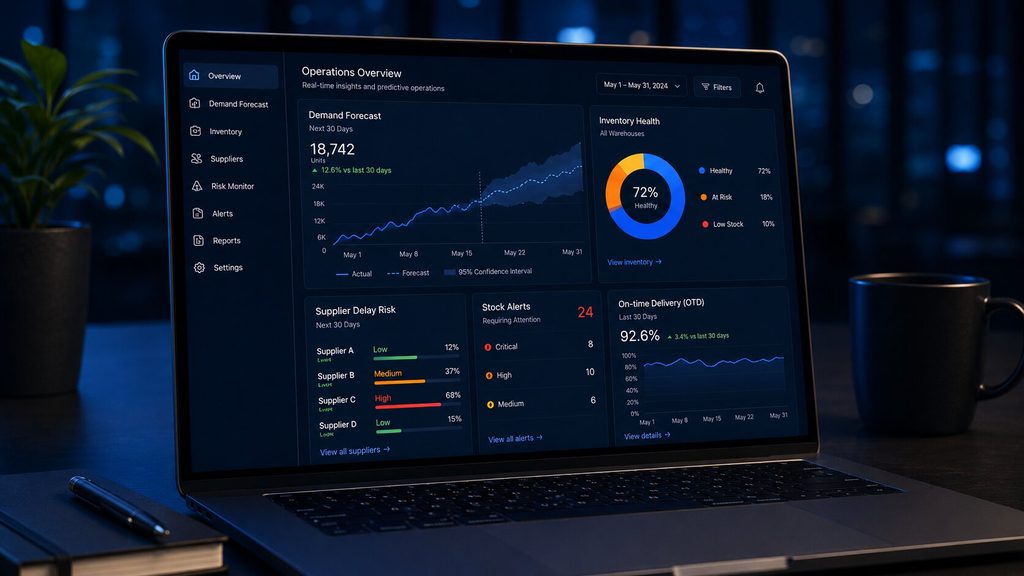
This is also where visualization matters. A forecast that lives in a spreadsheet gets ignored. A forecast that shows up as a trend line inside a Power BI dashboard your ops manager checks every morning gets acted on.
Bridging that gap — from raw prediction to a decision someone actually makes — is the difference between a predictive analytics project that sits on a shelf and one that pays for itself.
Conclusion
AI predictive analytics is already reshaping business decisions in 2026. The businesses seeing the best ROI aren’t the ones with massive data teams; they are the ones applying accessible AI tools to solve a single high-value problem and embedding those forecasts into daily workflows. Stop reacting to past data and start acting on the future. The only question left is which decision you want to stop guessing on first.
Frequently Asked Questions.
Get all your answers here and if something remains ask our AI concierge or Book a call with our consultant.