Retail Demand Forecasting with AI: A Predictive Analytics Playbook for Retail Tech Teams
Legacy forecasting tools break when flash sales, viral trends, or supply chain shocks hit. A playbook for retail tech teams architecting AI-driven forecasting pipelines.

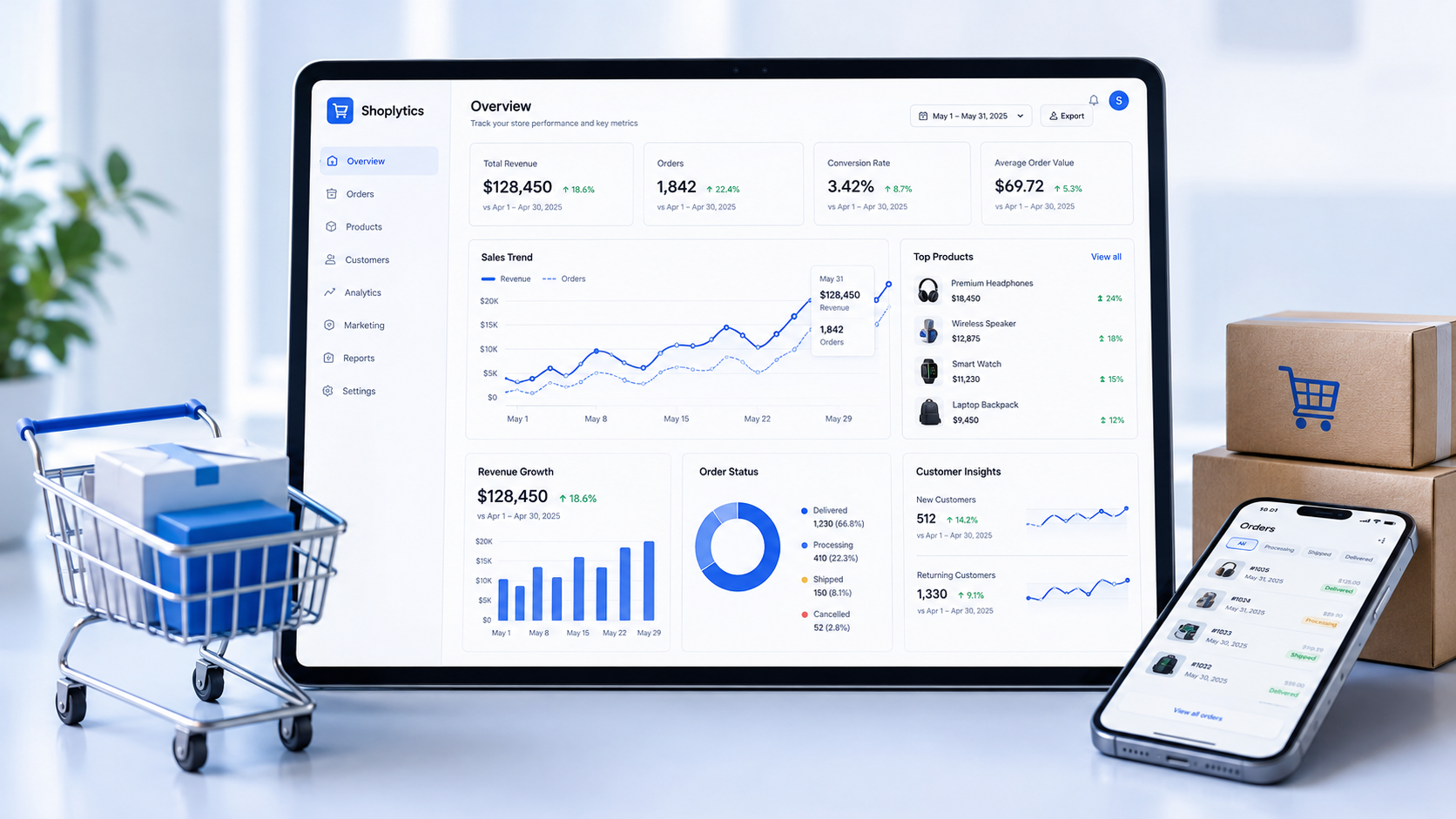
Retail demand forecasting is changing fast. Legacy forecasting tools built on batch processing and static formulas fail when flash sales, viral trends, or supply chain shocks hit. Modern AI-Native models process real-time demand signals—including promotions, local weather, and competitor pricing—to optimize inventory, protect margins, and eliminate stockouts.
This playbook breaks down how retail engineering and tech teams can architect, deploy, and scale AI-driven forecasting pipelines that integrate directly into existing ERP, WMS, and OMS infrastructure.
Key Takeaways
- AI-Native retail demand forecasting cuts forecast error by nearly 43%, reducing it from 28.76% to 16.43% in tested models, a drop of about 42.87%.
- Global retailers lose close to $1.73 trillion a year to bad forecasts, as global retail inventory distortion, the combined cost of overstocking and stockouts, amounts to about $1.73 trillion annually, roughly 6.5% of global retail sales.
- The global AI in retail market is expected to hit $96.13 billion by 2030, growing at a 46.5% CAGR, with the market projected to reach $14.24 billion in 2025 before climbing to $96.13 billion by 2030.
- Success depends less on the algorithm and more on retail dashboards, clean data, and a human-in-the-loop workflow.
Why Traditional Forecasting Keeps Failing Retailers
Classic tools like moving averages and exponential smoothing assume demand behaves predictably. That assumption breaks the moment a viral trend, a flash sale, or a weather shift hits the store.
These older methods also ignore outside signals. They rely solely on historical data, so they miss new patterns and create mismatches between inventory and real demand. The result shows up in two costly ways: stockouts that send shoppers to competitors, and overstock that ties up cash on shelves nobody wants.
Companies carrying high supply chain risk also see net working capital rise by roughly 6% each year, quietly draining liquidity long before anyone notices it on a P&L.
Retail Demand Forecasting Methods Worth Knowing
Evaluating the right architecture depends on SKU variance, data velocity, and prediction windows:
- Tree-Based Models (XGBoost, LightGBM, Random Forest): Optimal for tabular feature sets with non-linear interactions across price, region, and promotional flags.
- Deep Learning & Recurrent Neural Networks (LSTM, Transformers): Best suited for complex time-series data, high-velocity e-commerce SKUs, and long-tail products with irregular purchasing patterns.
- Hybrid Statistical-ML Approaches: Combine classical ARIMA/TBATS models with gradient boosting to maintain baseline stability while capturing real-time variance.
- Generative AI & LLM Layers: Act as an execution layer on top of model outputs, translating raw inference data into natural-language risk alerts and scenario modeling for planners
Custom AI Engineering vs. Off-the-Shelf SaaS
When enterprise tech teams evaluate retail predictive analytics, they choose between licensing legacy SaaS suites or engineering a custom solution:
| Evaluation Criteria | Off-the-Shelf SaaS | VectovateAI Custom AI Engine |
|---|---|---|
| Data Control & Sovereignty | Data hosted in third-party black boxes | 100% ownership within your private cloud/data warehouse |
| Model Customization | Fixed algorithms; cannot tweak feature weights | Tailored architectures tuned specifically to your SKU behaviors |
| Integration Overhead | Complex middleware required to sync with custom ERPs | Direct API-native integration into your existing WMS, OMS, and ERP |
| Scalability & Cost | Escalating per-SKU or per-user licensing fees | Zero per-SKU tax; predictable infrastructure operational costs |
How AI Demand Forecasting Actually Works
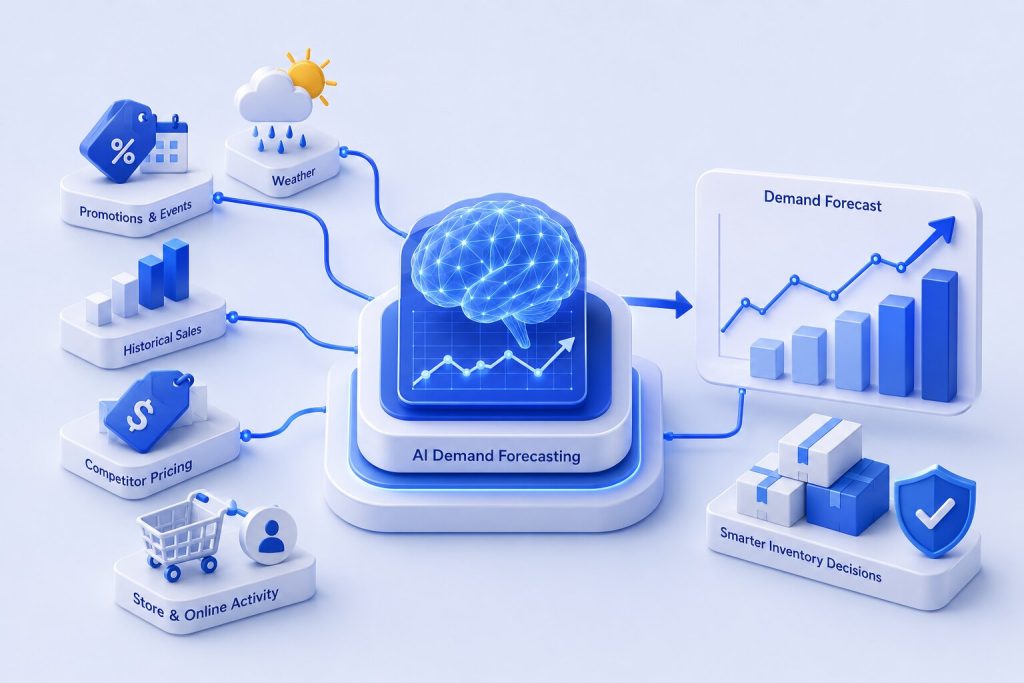
AI demand forecasting for retail blends real-time external signals with historical data to spot patterns spreadsheets miss:
| Feature | Traditional Forecasting | AI Demand Forecasting |
|---|---|---|
| Data sources | Historical sales only | Historical + real-time + external signals |
| Forecast accuracy | Moderate | Higher, with 42.87% error reduction in tested models |
| Handling volatility | Struggles with spikes | Captures non-linear demand shifts |
| Update frequency | Weekly or monthly | Near real-time |
| Human role | Manual adjustment | AI recommends, planner approves |
Most retail analytics software today builds this intelligence layer directly into existing dashboards, so planners don’t need a separate tool to act on it.
Benefits of AI in Retail Demand Forecasting
The accuracy gain is the headline. The business case sits in what that accuracy changes downstream. For retail tech teams, the benefits show up in five places:
- Fewer stockouts: Forecasts at SKU, store and day level catch demand spikes early enough to reorder before the shelf goes empty.
- Less overstock and fewer markdowns: Buyers place smaller, better-timed orders, so less stock ends up discounted at the end of a season.
- Cash released from inventory: Lower safety stock on predictable SKUs frees working capital without hurting availability.
- Sharper promotion planning: Models learn promo uplift and the knock-on effect on related SKUs, so planners can test a discount before it runs.
- Faster planning cycles: Near real-time updates replace the weekly spreadsheet refresh. Planners review exceptions instead of every line.
There is also a platform benefit. Once the forecast runs as a service, the same output feeds replenishment, allocation, store staffing and reporting. One model, many consumers. That connected-data approach is the core of our 4-pillar AI framework for retail commerce.
What Real Results Look Like
Numbers convince skeptical stakeholders faster than theory. Here is one grounded example worth citing in a boardroom deck: Eurocell Group forecasted over 43,000 SKUs more accurately using AI, improved product availability by 6.7%, and freed £1.86 million in working capital.
That is the kind of benefit of AI in retail demand forecasting finance teams care about. It is not abstract accuracy. It is real cash unlocked from a warehouse.
On a broader scale, retailers already using AI report more than double the sales and profit growth compared to those that have not adopted it. And adoption is no longer niche. 92% of US retail marketers now use AI, so waiting on the sidelines carries its own competitive risk.
Architecting the Data Pipeline & Feature Store
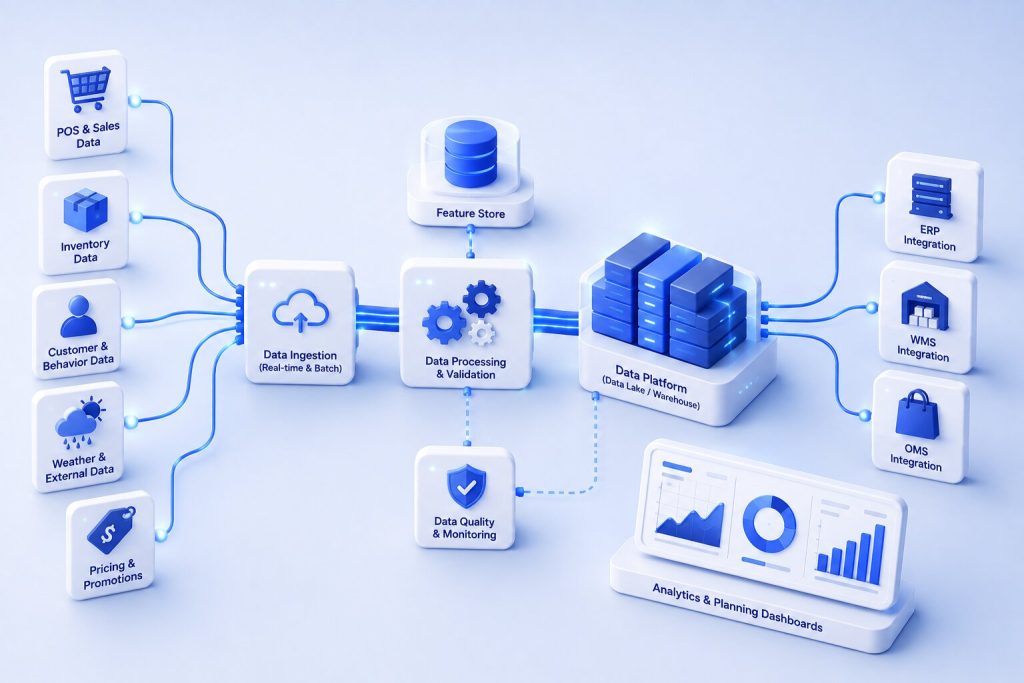
No AI model performs well on messy data. Before evaluating best demand forecasting software for retail, fix the data layer:
- Clean Historical Baselines: Standardize 18 to 24 months of historical SKU transactional data across all physical and digital sales channels.
- Feature Engineering & Storage: Build automated pipelines (via Kafka, Databricks, or Snowflake) to aggregate pricing shifts, promotional calendars, weather API data, and local events.
- ERP & Warehouse Synchronization: Expose REST/gRPC endpoints to feed ML model predictions directly back into existing WMS, OMS, and replenishment systems.
- Data Governance & Schema Validation: Ensure SKU IDs, multi-currency conversions, and store location hierarchies stay uniform across all database schemas.
This sequence matters. Skipping ahead to a flashy model while the data layer stays broken is the single biggest reason retail demand forecasting dataset projects stall.
Where to Start (and Where to Wait)
Not every category is ready for AI on day one. Retail tech teams get faster wins by prioritizing correctly.
Start here:
- High-volume, high-signal SKUs with steady sales history
- Multi-channel and e-commerce items with strong real-time signals
- Seasonal or repeat-purchase categories where small accuracy gains matter a lot
Hold off here:
- Low-volume or erratic SKUs where data signal is too thin
- Categories with no clear owner for reviewing AI recommendations
A simple readiness checklist helps here: clean historical data, stable product IDs, linked pricing data, and a named business owner who reviews AI outputs before they hit the shop floor.
Human-in-the-Loop: Why Full Automation Is the Wrong Goal
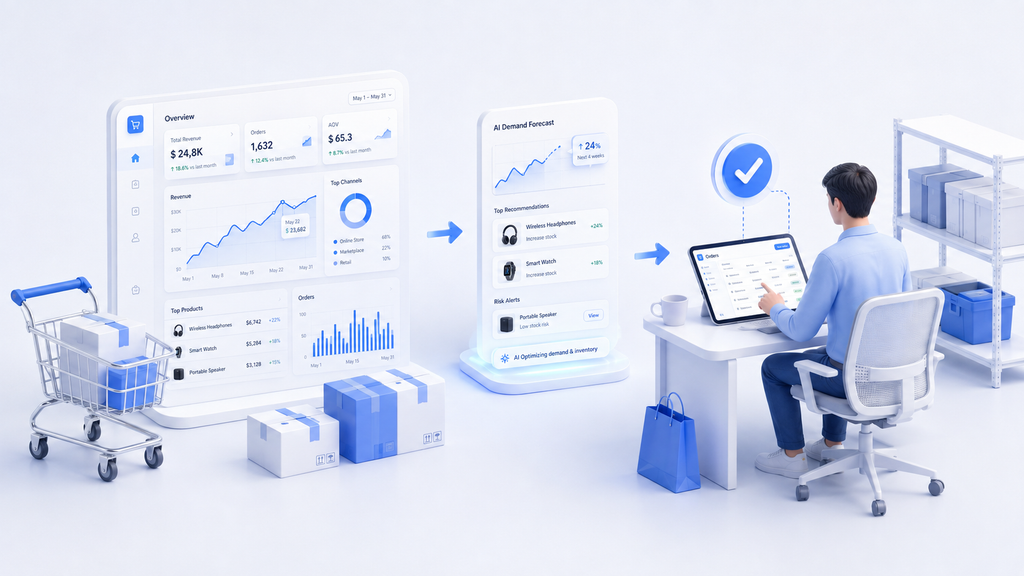
The best demand forecasting in retail industry deployments does not remove people from the loop. They upgrade what those people do.
For high-impact SKUs, the “AI suggests, planner approves” model works best. The AI recommends reorder quantities or promotional adjustments. The planner checks those against local knowledge, like a stadium event down the street or a competitor’s closing sale, before confirming.
Low-risk, routine SKUs can run on automated rules without review, freeing planner hours for the decisions that genuinely need judgment. This balance builds trust in the system instead of forcing blind faith in a black box.
Architectural Common Failure Modes & Mitigations
| Failure Mode | Root Cause | Engineering Mitigation |
|---|---|---|
| Data Drift | Consumer shopping behaviors change post-launch | Implement automated model retraining pipelines triggered by drift detection |
| Overfitting Volatility | Model treats a rare viral event as recurring demand | Cross-validate training windows against clean, anomaly-filtered historical datasets |
| Pipeline Latency | Slow batch processing delays daily stock reorders | Shift from nightly batch processing to event-driven streaming ingestion |
| Planner Overrides | Black-box models cause planners to mistrust outputs | Display feature importance weights (SHAP values) alongside every forecast |
Best Practices for Integrating AI Demand Forecasting in Retail
Integrating AI-driven predictive analytics into an existing retail tech stack requires balancing data discipline, system architecture, and organizational change. Retail engineering teams that achieve high adoption rates and measurable ROI follow key core practices:
- Decouple Data Ingestion from ML Modeling: Build decoupled, event-driven streaming pipelines (using tools like Kafka or Snowflake) so feature stores update independently without bottlenecking core ERP systems.
- Establish Explainability Thresholds (SHAP Values): Prevent planner distrust by embedding feature importance metrics directly into dashboards. When planners understand why a forecast changed, manual overrides drop significantly.
- Implement Continuous Drift Monitoring: Consumer behavior and supply chains shift post-deployment. Automated retraining triggers based on model drift detection prevent degradation over time.
- Standardize Master Data Schemas: Ensure SKU IDs, multi-currency conversions, and store location hierarchies stay uniform across ERP, WMS, and OMS databases before executing inference models.
Engineering Roadmap: A 90-Day Implementation Blueprint
- Days 0–30 (Data Audit & Baseline Model): Scope high-signal SKU categories. Clean historical pipelines, extract baseline features, and train initial XGBoost/LSTM benchmark models offline against legacy forecasts.
- Days 31–60 (Pipeline Integration & Shadow Testing): Deploy real-time streaming pipelines to stream live weather, promo, and pricing data. Run AI forecasts in shadow mode alongside legacy ERP tools during weekly planning meetings.
- Days 61–90 (Production MLOps & ERP Sync): Expose API endpoints to push forecast outputs into production ERP workflows. Establish confidence-score thresholds for automated vs. planner-approved reorders.
What to Look for in Retail Demand Forecasting Software
Whether you license a platform or build your own, the evaluation questions are the same. Most retail analytics software demos well on clean sample data. The gaps show up on yours. Test for these before you sign a contract or scope a build:
- Forecast granularity: Can it forecast at SKU, store and day level, then roll up to category and region without the numbers drifting apart?
- External signals: Does it ingest promotions, pricing, weather and local events, or only historical sales?
- New product handling: How does it forecast a SKU with no history? Look for attribute-based matching to similar products, not a flat guess.
- Stockout-aware demand: Does it separate true demand from lost sales, so an empty shelf is not read as low demand?
- Explainability: Can a planner see why a forecast moved, down to the drivers behind it?
- Integration: Does it push forecasts into your ERP, WMS and OMS through APIs, or does it rely on manual exports?
- MLOps: Who retrains the models, how often, and what triggers a retrain when accuracy drops?
If a tool fails more than two of these, the subscription is the smaller cost. That is usually the point where a custom forecasting engine built on your own machine learning stack becomes the better long-term option.
Metrics That Prove the Investment Works
Before pitching this project to leadership, define how success gets measured.
- MAPE (Mean Absolute Percentage Error): average forecast accuracy
- Inventory turns: how efficiently stock moves
- Stockout rate: how often products go unavailable
- Excess inventory/markdown rate: overstock and discount exposure
- OTIF performance: how reliably orders ship on time and in full
- Planner hours saved: time freed up for strategic work instead of manual adjustments
These metrics turn a vague “AI initiative” into a business case finance teams can actually approve.
Engineered for Scale with VectovateAI
At VectovateAI, we build AI-Native demand forecasting systems designed specifically for complex retail enterprise environments. Rather than forcing you into rigid SaaS subscriptions, our engineering team constructs custom ML pipelines, feature stores, and MLOps workflows that integrate directly into your proprietary technology stack.
Whether you are seeking to replace manual spreadsheet processes or modernize legacy ERP modules, we help you deploy production-ready AI forecasting models in weeks.
We applied this playbook in an AI-integrated eCommerce and predictive ordering build that drove 40% revenue growth, part of our wider work on AI for retail and eCommerce. For the personalization side of the same data, see AI recommendation engines in eCommerce.
Ready to audit your data architecture and build high-precision demand forecasting pipelines? Schedule a 30-Minute Technical AI Architecture Audit with VectovateAI.
Frequently Asked Questions.
Get all your answers here and if something remains ask our AI concierge or Book a call with our consultant.