Data Engineering for AI: How to Build Data Pipelines That Make Your AI Projects Succeed
Why AI fails without good data, what a modern pipeline looks like, batch vs real time, the tool stack, a quality checklist, and when to hire a partner.


Your AI pilot looked great in the demo. The model was trained on a clean export someone prepared by hand. Then it went live on real data: customer IDs that don’t match across systems, a pipeline that breaks every Monday, and a sales table that is three days late. Within a month, nobody trusts the predictions.
This is the most common way AI projects die, and it has little to do with the model. RAND notes that, by some estimates, more than 80% of AI projects fail, about twice the rate of other IT projects. Two of the five root causes it found are about data: not having the data the model needs, and not having the infrastructure to manage it.
That is why data engineering services have become the first step of serious AI work, not an afterthought. Below, you will find why AI fails without good data, what a modern data pipeline looks like, when you need real-time data, which tools to use, how to keep data trustworthy, and when to bring in a partner.
Key Takeaways
- Most AI failures are data failures. In a Fivetran survey, 42% of enterprises said more than half of their AI projects were delayed, underperformed, or failed because of data readiness.
- A modern pipeline has five layers: sources, ingestion, storage, transformation, and serving, with orchestration and monitoring around them.
- Batch pipelines are enough for most reporting and model training. Real-time pipelines pay off when a decision must happen in seconds or minutes.
- Data quality is still the top problem. Poor data quality remains the most frequently reported obstacle in dbt Labs’ 2026 State of Analytics Engineering.
- Ownership, testing, and monitoring matter as much as the tools you pick.
- A good data engineering partner will tell you when your existing stack only needs fixing, not replacing.
Why AI Projects Fail Without Good Data
A model is only as good as the data it learns from and the data it sees in production. Three gaps cause most of the trouble.
- The data doesn’t exist in usable form. The information is there, but spread across CRM, ERP, spreadsheets, and apps with no shared IDs.
- The data isn’t ready on time. Training used last year’s export. In production, the model needs today’s data, and the pipeline can’t deliver it.
- Nobody trusts the data. A dashboard showed the wrong number once, and now every AI output gets questioned.
The cost adds up. Gartner research puts the average cost of poor data quality at $12.9 million a year per organization. In the Fivetran survey, 67% of highly centralized enterprises still spent over 80% of their data engineering effort maintaining existing pipelines. That leaves little time for new AI work.
Generative AI raises the stakes. A RAG system that answers questions from your documents is a data pipeline first. Documents must be collected, cleaned, split, embedded, and kept up to date. If that pipeline is weak, the LLM application will answer confidently from outdated or wrong content.
The fix is to plan data work as part of the AI project, not before or after it. In our AI development process, data preparation is its own stage with its own budget, because it usually takes longer than training the model. Teams that skip it end up rebuilding pipelines after launch, under pressure.
What a Modern Data Pipeline Looks Like
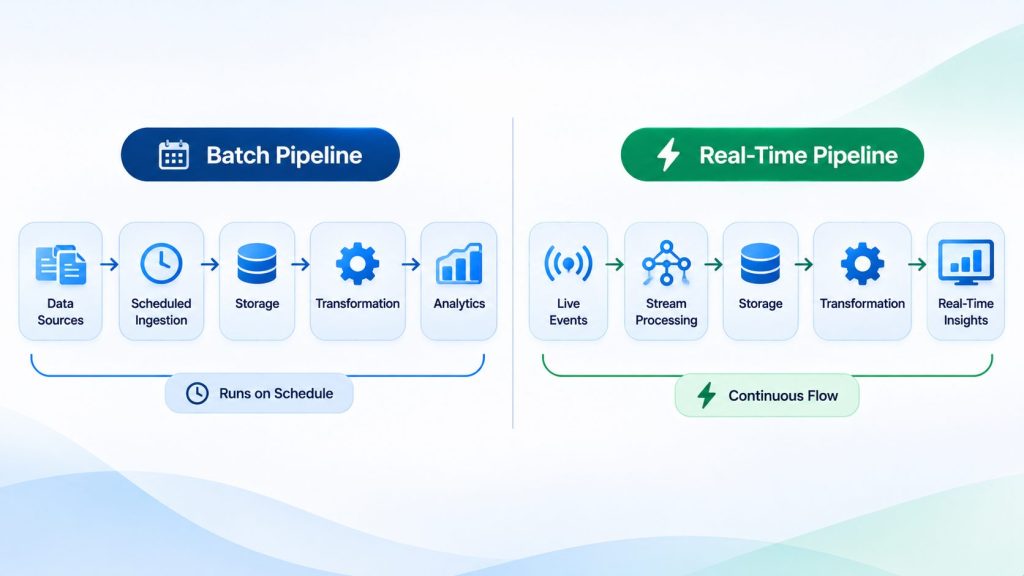
A data pipeline moves data from where it is created to where it is used, and makes it trustworthy on the way. Most modern pipelines follow the same shape.
- Sources. Business apps, databases, files, APIs, IoT devices, and event streams.
- Ingestion. Connectors and change data capture copy data in on a schedule or as it changes. Managed data integration tools cover common apps, and custom connectors handle the rest.
- Storage. A cloud data warehouse or lakehouse holds raw and cleaned data. Our comparison of Snowflake, BigQuery, Redshift, and Databricks covers how to choose.
- Transformation. Raw data is cleaned, joined, and modeled into tables that people and models can use. Many teams organize this in layers, such as the bronze, silver, and gold pattern of the medallion architecture.
- Serving. Clean data feeds dashboards, ML features, APIs, and vector stores for generative AI.
Around all five sit two jobs. Orchestration runs each step in the right order. Monitoring tells you when something breaks before a user does.
Batch vs Real-Time Pipelines
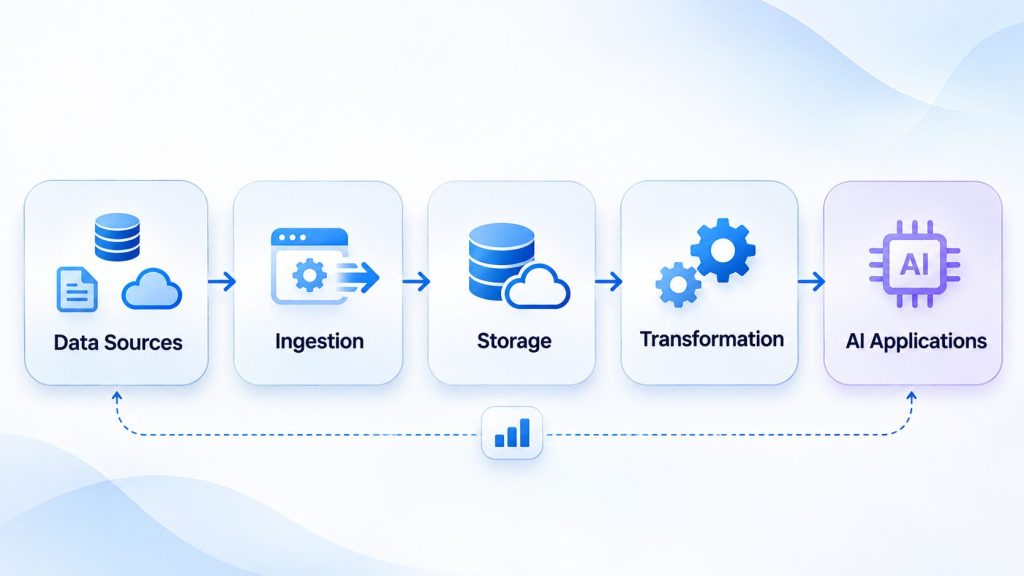
Not every pipeline needs to be real time. Real time costs more to build and run, so use it only where speed changes a decision.
| Factor | Batch pipelines | Real-time pipelines |
|---|---|---|
| How data moves | In scheduled runs, such as hourly or nightly | Continuously, as events happen |
| Typical delay | Minutes to hours | Seconds |
| Best for | Reporting, model training, finance, planning | Fraud checks, live tracking, personalization, alerts |
| Complexity and cost | Lower | Higher, with more moving parts to monitor |
| Common tools | ELT tools, dbt, warehouse scheduling | Kafka, stream processing, change data capture |
A quick test helps. If the person or model using the data would act differently with five-second-old data instead of one-hour-old data, consider real time. If not, a well-run batch pipeline is cheaper and easier to trust.
When you do need streaming, Apache Kafka is the usual backbone. The project says more than 80% of Fortune 100 companies use it. Most companies end up with both: real-time pipelines for a few critical flows, and batch for everything else.
Tool Stack: ETL/ELT, Orchestration, Warehouse
Tools change fast, but the roles stay the same. Pick one strong option per role and keep the stack small.
| Layer | What it does | Common options |
|---|---|---|
| Ingestion | Copies data from sources | Fivetran, Airbyte, custom connectors, change data capture |
| Storage | Holds raw and modeled data | Snowflake, BigQuery, Redshift, Databricks |
| Transformation | Cleans and models data with tested SQL or code | dbt, Spark, warehouse SQL |
| Orchestration | Schedules and connects every step | Apache Airflow, Dagster, cloud-native schedulers |
| Streaming | Moves events in real time | Kafka, cloud streaming services |
| Quality and monitoring | Catches broken or unusual data | dbt tests, data observability tools |
ETL transforms data before loading it. ELT loads raw data first and transforms it inside the warehouse. ELT is now the default for most cloud stacks. Modern warehouses have the computing power for it, and keeping raw data makes fixes easier. Apache Airflow is still one of the most widely used open-source orchestrators, though newer tools are gaining ground. For pipeline builds, see our data warehousing and ETL services.
Data Quality and Governance Checklist
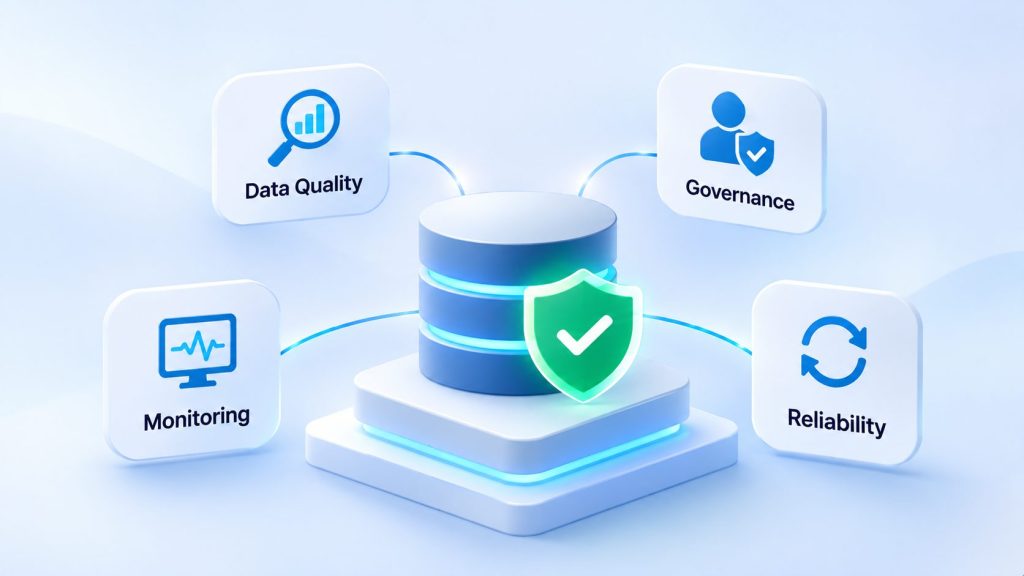
Good data doesn’t happen by accident. Use this checklist on every pipeline that feeds AI:
- Clear owners. Every important table has a named owner. Ambiguous data ownership was a challenge for 41% of respondents in dbt Labs’ 2026 report.
- Tests in the pipeline. Check for missing values, duplicates, broken relationships, and impossible numbers on every run.
- Freshness alerts. Know when data is late before a dashboard or model uses it.
- Monitoring. In Monte Carlo’s 2024 State of Reliable AI survey, 70% of data leaders said it takes longer than four hours to find a data incident. Automated monitoring shortens that.
- Documentation and lineage. Show where each number came from and what depends on it.
- Access control and privacy. Mask personal data, limit who sees what, and log access.
- Version control. Pipeline code lives in Git, with reviews before changes go live.
These habits cost little to set up early and a lot to add later.
When to Hire a Data Engineering Partner
Data engineering consulting services earn their fee in four clear situations:
- You’re starting AI with no data platform. A partner can set up a solid foundation in weeks, instead of months of trial and error.
- Your team spends most of its time fixing pipelines. An outside review often finds a few root causes behind most breakages.
- You’re migrating. Moving off on-premise systems or an old warehouse is a one-time project where experience matters. It should come with a proper data migration plan.
- You need skills you don’t have. Streaming, lakehouse design, or vector pipelines for generative AI.
If one of these fits, here is what the work looks like. A typical engagement with a data engineering services company runs in four phases, and each phase should leave you with something usable:
- Audit (2 to 3 weeks). Map sources, pipelines, quality issues, and costs, then agree on priorities. Even if you stop here, you have a ranked list of fixes.
- Foundation (4 to 8 weeks). Set up or fix the warehouse, ingestion, orchestration, testing, and monitoring.
- Use-case pipelines. Build the data products that feed specific dashboards and AI models, one at a time, each proving its value before the next.
- Handover and support. Document everything, train your team, and stay on for tuning if needed.
Budgets follow the same phases. As indicative figures, an audit usually costs $5,000 to $15,000, a first production pipeline $15,000 to $40,000, and a full data platform $60,000 to $200,000, depending on sources and scale. A good data engineering consulting company will give you a fixed quote for the audit and a phased plan for the rest. You should not commit the full budget on day one.
When comparing data engineering service providers, ask to see production pipelines they built, how they test and monitor them, and how they hand over to your team. You should own all the code and documentation. If your warehouse choice is still open, start with data warehouse consulting before building pipelines on top.
Why Teams Bring in VectovateAI for Data Engineering
Every data engineering project we take on starts with a data landscape audit, because the cheapest pipeline is often the one you already have. If your current stack only needs tuning, that is what we recommend. When we build, our senior architects in Ahmedabad collaborate directly with your engineering leadership to design the pipelines and the AI layer together, which is the core of AI-native software development. In our sports analytics project, automated ingestion and validation delivered 99.9% data accuracy and cut reporting latency by 65%. In our logistics orchestration project, a single source of truth for IoT and shipment data helped reduce operational costs by 60%.
Final Thoughts
AI projects rarely fail because the model was too simple. They fail because the data behind it was late, messy, or untrusted. Most teams hire data scientists first and data engineers second. The order should usually be the other way around.
Fix the foundation first: clear owners, tested pipelines, and monitoring that catches problems early. Then build AI on top. That is how data engineering services turn into AI projects that actually reach production.
Planning an AI project or tired of fixing broken pipelines? Book a Free Data Architecture Review with VectovateAI
Frequently Asked Questions.
Get all your answers here and if something remains ask our AI concierge or Book a call with our consultant.