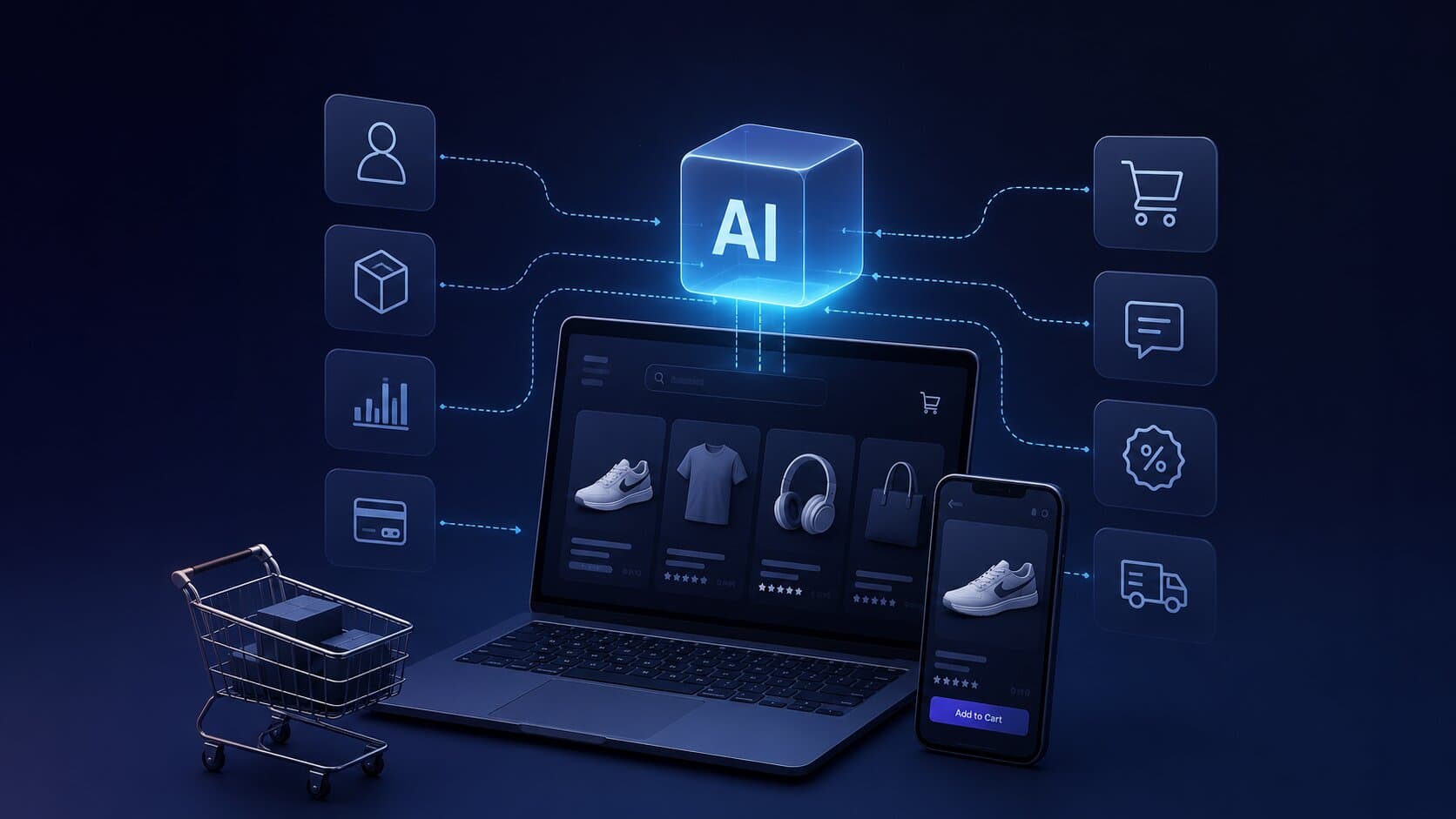
How Companies Use AI to Gain Competitive Advantage: Real-World Examples
Real competitive advantage from AI does not come from simply licensing off the shelf tools but from owning proprietary data pipelines, custom infrastructure, and bespoke workflows, as shown by companies like Amazon, Goldman Sachs, and Moderna, that turn AI into a genuine strategic moat rather than a commodity anyone can buy.


Artificial intelligence has moved well past its hype cycle, and the enterprises pulling ahead are no longer the ones simply adopting it, but the ones engineering it into the core of how they operate. Using AI to gain competitive advantage has become a core and integral part of business strategy.
McKinsey’s 2024 Global AI Survey found that 78% of organizations now use AI in at least one business function. That number jumped from 55% just a year earlier. Generative AI adoption has grown just as fast. Yet Deloitte research shows a perception gap. Executives feel more transformed by AI than frontline employees do. This gap signals that strategic AI implementation separates leaders from laggards.
Key Takeaways
- 78% of organizations now use AI in at least one function.
- Real competitive advantage AI comes from owning the underlying data pipelines and orchestration layers.
- Retail eCommerce giants like Amazon and Netflix drive revenue through AI personalization.
- Manufacturers use predictive maintenance to cut downtime and waste significantly.

AI Business Strategy: How Leading Companies Gain a Competitive Edge?
Leading companies treat AI as a strategic asset engineered into core infrastructure. They align AI initiatives with core business goals, invest in data infrastructure well before deploying advanced models, and measure success in business outcomes rather than isolated technical metrics.
Financial Services: Speed and Risk Management
As per the CNBC report, Goldman Sachs has been testing generative AI tools for its software developers. Internal pilots showed developers writing up to 40% of code automatically. The bank also tested an autonomous software engineer designed to work alongside human teams, treating AI as a productivity partner rather than a replacement.
Barclays takes a similarly engineered approach to fraud detection, deploying AI models that analyze transaction patterns and flag anomalies in real time, which has meaningfully reduced financial losses while strengthening customer trust in digital banking.
AI-Native software for financial services builds real-time event streaming pipelines, typically on architectures like Kafka or Flink, to intercept anomalies at the transaction gateway level before capital leakage occurs, rather than flagging fraud after settlement.
Retail and E-Commerce: Personalization at Scale
Amazon uses AI to optimize inventory, pricing, and product recommendations simultaneously, and its dynamic pricing algorithms adjust rates in response to real-time demand and competitive signals.
Cross-selling and upselling driven by these systems reportedly account for a large share of total revenue, which demonstrates how business intelligence AI translates directly into bottom-line impact rather than remaining a marketing abstraction.
Netflix applies comparable logic to content, where its recommendation engine analyzes viewing behavior to boost engagement; personalized suggestions keep subscribers watching longer and canceling less often. These systems prove that AI-driven innovation can shape entire business models, precisely because the recommendation layer is inseparable from the product itself.
AI-Native retail platforms pair vector search with graph databases that track how user intent shifts across a session. Running that in production takes real-time data pipeline orchestration, millisecond latency reduction at checkout, and infrastructure scaling that holds through flash-sale demand spikes.
Manufacturing: Predictive Maintenance and Efficiency
Procter & Gamble is digitizing over 100 manufacturing sites worldwide. The company uses machine learning to predict equipment failures before they happen. It also applies computer vision for real-time quality checks. This reduces waste, downtime, and manual inspection costs across its supply chain.
General Electric takes a similar approach to predictive maintenance, feeding sensor data into AI models that flag potential failures early enough to prevent costly downtime and extend machine lifespan. Enterprise AI adoption at this scale, however, is only possible with strong data pipelines and genuine cross-team collaboration between operations and engineering.
Running predictive maintenance at scale takes data pipeline orchestration to normalize IoT signals from thousands of sensors, latency reduction so predictions arrive early enough to act on, and infrastructure scaling across facilities.
Healthcare and Biotech: Faster Innovation Cycle
Moderna built its business around a data-first AI strategy, creating an integrated system for designing mRNA-based medicines. This infrastructure helped the company develop a COVID-19 vaccine in record time, and Moderna now embeds AI assistants across research, legal, and manufacturing functions.
Regulated biotech demands more engineering discipline than commercial platforms typically offer: data pipeline orchestration that preserves lineage and audit trails, validation rigor over raw latency reduction, and infrastructure scaling for massive batch workloads like candidate screening, all without compromising reproducibility.
Telecommunications: From Automation to Reinvention
Telstra started with simple AI assistants for customer service agents, and these tools cut follow-up support calls by 20%, with most operational stakeholders reporting meaningful real-time savings from the system.
Telstra did not stop at automation, though; it later formed a joint venture focused on agentic AI and full process reinvention. This reflects a broader shift in enterprise AI adoption toward reimagining entire workflows rather than automating isolated tasks.
Moving from a chat assistant to a full agentic workflow is an infrastructure leap: it takes data pipeline orchestration across billing, network, and CRM systems, latency reduction so multi-step workflows resolve fast, and infrastructure scaling for concurrent sessions nationwide.

Why does Strategic AI Implementation Matter More Than Tools?
Procuring a commoditized software license does not, by itself, create a competitive advantage. Strategic AI implementation requires clear goals, strong data foundations, leadership buy-in, and genuine cross-functional collaboration.
Why Off-the-Shelf AI Won’t Build You a Moat
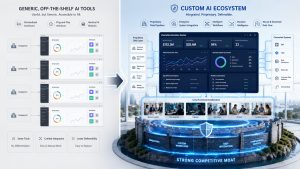
Here is the uncomfortable truth most vendors won’t tell you: commercial, out-of-the-box AI software licenses offer zero competitive edge on their own, because your competitors can buy the exact same software the same afternoon you do.
A licensed model is a commodity the moment it ships; whoever holds the purchase order gets identical capabilities, identical limitations, and identical blind spots.
A true strategic moat is built somewhere else entirely: in owning your sovereign data pipelines, in custom middleware layers that connect models to your actual operational systems, and in bespoke multi-agent workflows fine-tuned on your enterprise’s proprietary logic, the accumulated judgment calls, edge cases, and institutional knowledge that no vendor’s model was ever trained on.
Common Challenges Businesses Must Address
Algorithmic bias: AI systems can produce unfair outcomes, especially in recruitment and facial recognition; diverse datasets and rigorous bias-testing pipelines help reduce this risk before it reaches production.
Data privacy: AI depends heavily on sensitive data, so strong data protection frameworks are essential to maintaining customer trust; Apple’s privacy-first, on-device processing offers a useful architectural model here.
Workforce disruption: Automation can displace repetitive roles, but forward-thinking companies invest in reskilling programs for operational stakeholders instead of relying on layoffs, protecting institutional knowledge that no model can replicate.
Lack of transparency: Many AI systems function as “black boxes” with unclear decision logic, which creates real compliance risk in regulated industries like finance and healthcare.
Explainability gaps: Explainability tooling helps businesses validate and defend AI-driven decisions, especially where regulators or customers demand accountability rather than a confident-sounding output.
AI-Driven Innovation Beyond the Obvious Use Cases
Toy maker Mattel used an AI image generator to speed up product design, where designers describe an idea in plain language and the system produces multiple visual concepts within seconds.
The agriculture industry is another unexpected example of AI-driven innovation. Costa Group, an Australian produce grower, replaced manual pollination with computer vision robots. The robots identify ready flowers and pollinate them automatically, lifting yields well beyond traditional methods.
Construction firms are exploring similar territory. Teams building the UK’s HS2 railway used an AI scheduling simulator that generated dozens of construction plans within minutes, after which planners reviewed and refined the strongest options rather than building each scenario by hand.
Checklist for the Mid-Market AI Readiness Audit
Use the checklist below to audit your own workflows before committing to an engineering budget.
- Data foundation audit: Can your core systems expose clean, structured, real-time data, or does data still live in fragmented, siloed spreadsheets and legacy databases?
- Process mapping: Which workflows consume disproportionate time or headcount relative to the value they produce, and would a bespoke workflow address the root cause?
- Integration reality check: Does your existing middleware support real-time orchestration between systems, or will any AI layer sit bolted on top, disconnected from your actual operations?
- Governance readiness: Do you have a framework in place to monitor bias, model drift, and explainability before deployment, or only after something goes wrong?
- Talent and ownership: Do you have, or can you engineer, the in-house or partner capability to own your models long term, rather than renting a black box you cannot inspect or modify?
Executing against this checklist surfaces the three biggest real-world engineering roadblocks enterprises actually run into.
1. Model Hallucination Mitigation: Production systems need retrieval-grounding, confidence scoring, and human-in-the-loop checkpoints to prevent a confidently wrong output from reaching a customer or a regulator.
2. Secure Data Masking for Privacy Compliance: Any pipeline touching personally identifiable information needs tokenization or masking at the ingestion layer before an audit.
3. Handling Model Drift: Production accuracy degrades as market conditions and user behavior shift, which means monitoring and retraining pipelines are a permanent operating cost of running AI safely in production.
Build Your Own AI Business Strategy
- Map high-impact processes: Identify workflows that consume excessive time or resources. These are your best starting points.
- Evaluate the right tools: Look at where predictive analytics or automation could add real, measurable value.
- Start small if needed: Small businesses can begin with affordable tools for marketing, support, or bookkeeping.
- Scale with the right infrastructure: Larger enterprises should invest in scalable data infrastructure and skilled AI talent.
- Focus on measurable impact: The goal isn’t chasing every new AI tool. It’s driving measurable business outcomes.
- Align with clear KPIs: Companies that tie strategic AI implementation to clear KPIs consistently outperform competitors, cutting costs and unlocking new revenue.
- Leverage local talent ecosystems: Ahmedabad’s growing tech ecosystem combines strong software engineering talent with cost-efficient delivery, making agent-first, human-in-the-loop AI systems achievable even for smaller teams.
Contact VectovateAI for Custom AI Engineering Foundations
Every business faces a different set of challenges and opportunities, which is exactly why a generic AI rollout rarely delivers lasting results. The enterprises that win are the ones that engineer AI-Native infrastructure around their specific operations rather than licensing someone else’s generic model.
We help companies design and build custom AI engineering foundations, sovereign data pipelines, custom middleware, and bespoke multi-agent workflows, that create a defensible moat rather than a temporary edge.
We help you identify the right use cases first. We then build scalable, human-in-the-loop AI systems around your goals. Whether you need predictive analytics, workflow automation, or customer intelligence tools, we tailor the approach to your industry.
Contact VectovateAI today to start building your competitive advantage with AI.
Frequently Asked Questions.
Get all your answers here and if something remains ask our AI concierge or Book a call with our consultant.