From Customer Support Chaos to Intelligent Commerce: The 4-Pillar AI Framework Behind Modern RetailTech Growth
The 4-Pillar AI Framework — workflow automation, AI agents, predictive analytics, and operational dashboards — that RetailTech brands use to turn scattered customer support into intelligent, revenue-driving commerce.

A missed order update. A refund query stuck in a queue for three days. A customer who abandons a cart because no one answered quickly enough. This scattered support experience is exactly what’s costing retail brands loyal customers, and it’s why AI customer support retail strategies have moved from a nice-to-have to a growth requirement in 2026.
Retail and eCommerce brands need a connected system that automates the busywork, engages shoppers in real time, predicts what’s about to go wrong, and gives leadership a live view of the whole operation.
According to Mordor Intelligence, the agentic AI market in retail and eCommerce was worth USD 60.43 billion in 2026 and is growing at a 29.29% CAGR to reach USD 218.37 billion by 2031, a signal that this shift is no longer experimental.
Here’s the 4-Pillar AI Framework that modern RetailTech companies are using to move from reactive support chaos to intelligent, revenue-driving commerce.
Key Takeaways
- Connected Systems Win: Automation, AI agents, analytics, and dashboards deliver maximum value when integrated into a single ecosystem rather than fragmented tools.
- Fastest ROI: Order tracking, returns, and inventory sync are where ecommerce automation software delivers the fastest, most visible ROI.
- Routine Ticket Deflection: Retail AI agents now autonomously resolve the vast majority of repetitive support queries.
- Proactive Revenue Protection: Conversational AI catches cart abandonment, churn risks, and demand shifts before they impact margins.
- Role-Based Visibility: Real-time dashboards present unified operational data tailored to founders, ops leads, and CX teams.
The 4-Pillar AI Framework for Intelligent RetailTech Operations
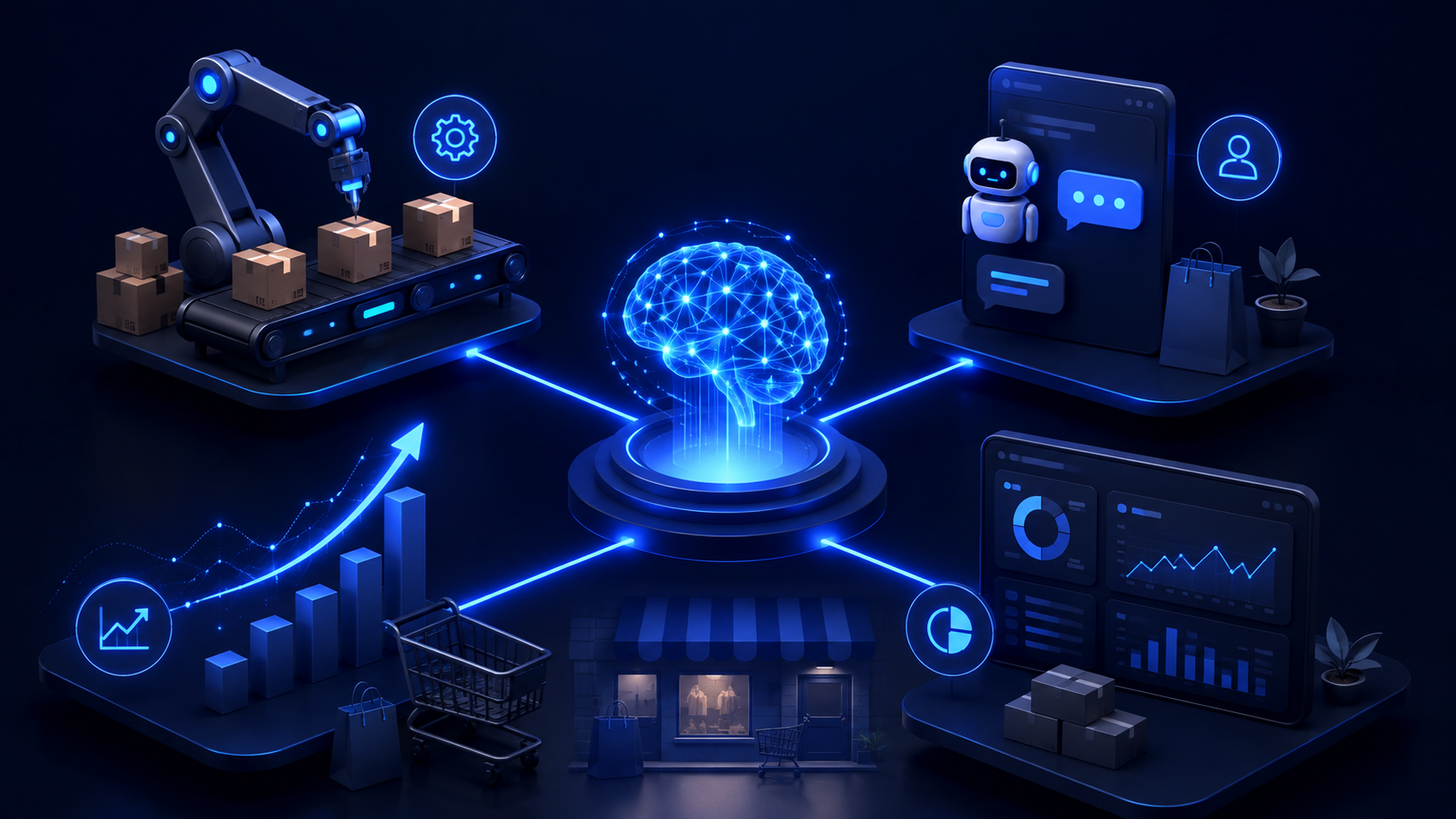
High-growth retail and eCommerce brands are building around four interconnected pillars instead of stitching together disconnected tools:
- Pillar 1: Workflow Automation
- Pillar 2: AI Agents & Intelligent Customer Engagement
- Pillar 3: Predictive Analytics
- Pillar 4: Operational Intelligence Dashboards
Together, these four layers turn a retail operation from reactive and support-heavy into proactive and self-optimizing.
Pillar 1: Workflow Automation
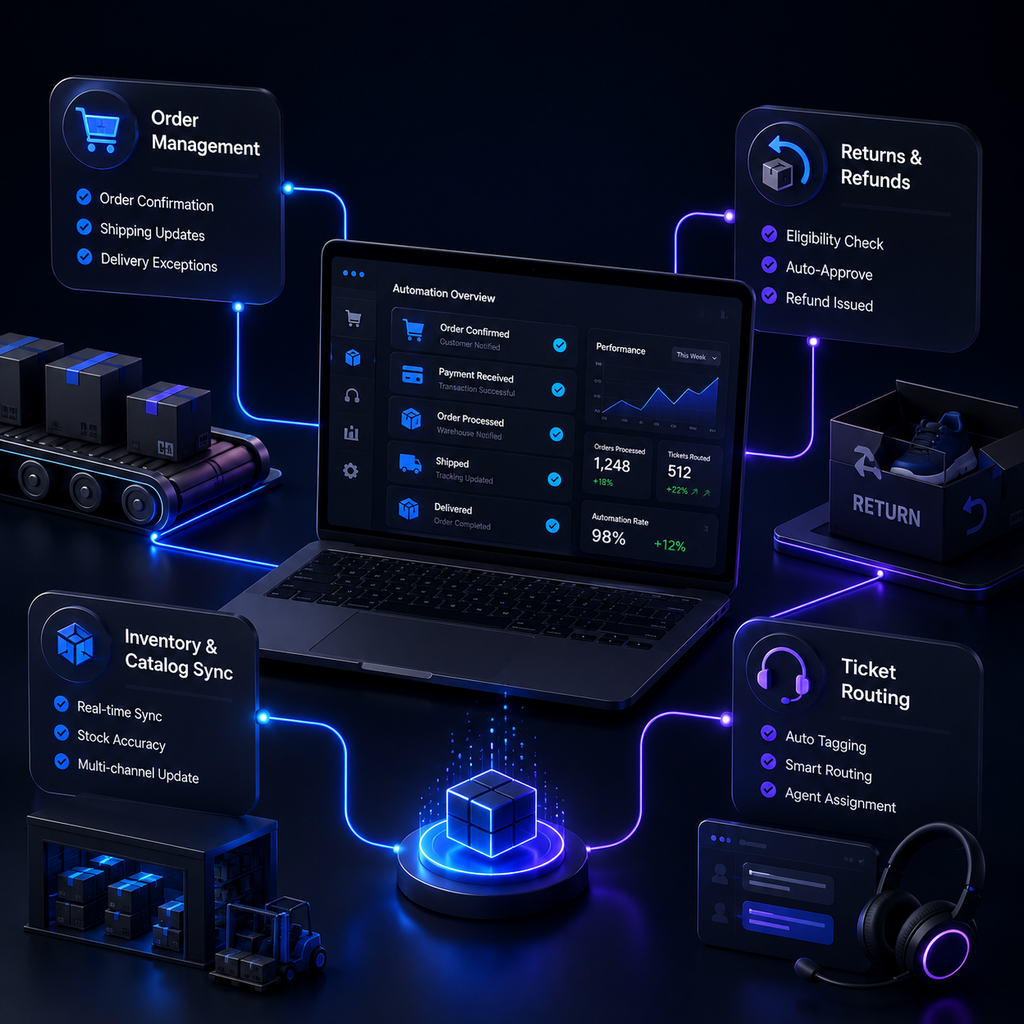
Workflow automation is the foundation. It targets the repetitive, rules-based tasks that quietly eat up a support team’s entire day, without touching the judgment calls that still need a human.
This is where ecommerce automation software earns its keep the fastest, because it turns scattered manual steps into a single trackable process. Instead of relying on simple rule-based scripts, modern workflow engines connect directly to your OMS and ERPs (like SAP, NetSuite, or Shopify Plus) using REST/GraphQL APIs and real-time webhooks.
What gets automated:
- Order Management Automation: Order confirmations, shipping updates, and delivery exceptions sync directly with your storefront and courier APIs, so customers stop messaging “where is my order” every single day.
- Returns and Refunds Handling: AI systems triage return requests, check eligibility against policy, and auto-approve straightforward cases, cutting the manual back-and-forth that usually stretches into days.
- Inventory and Catalog Sync: Stock levels update across every sales channel in real time, so a product doesn’t get sold out on the website while it’s actually out of stock in the warehouse.
- Rules-Based Ticket Routing: Support tickets get tagged and routed automatically, and only the complex, judgment-heavy ones land in front of a human agent.
Business impact:
| Manual Process | With Workflow Automation |
|---|---|
| Order status checked manually via email or call | Real-time tracking pushed automatically to the customer |
| Returns processed over 2-3 days | Eligible returns auto-approved in minutes |
| Inventory mismatches across channels | Live sync across storefront, marketplace, and warehouse |
| Support tickets sorted each morning manually | Auto-tagged and routed the moment they arrive |
Pillar 2: AI Agents & Intelligent Customer Engagement
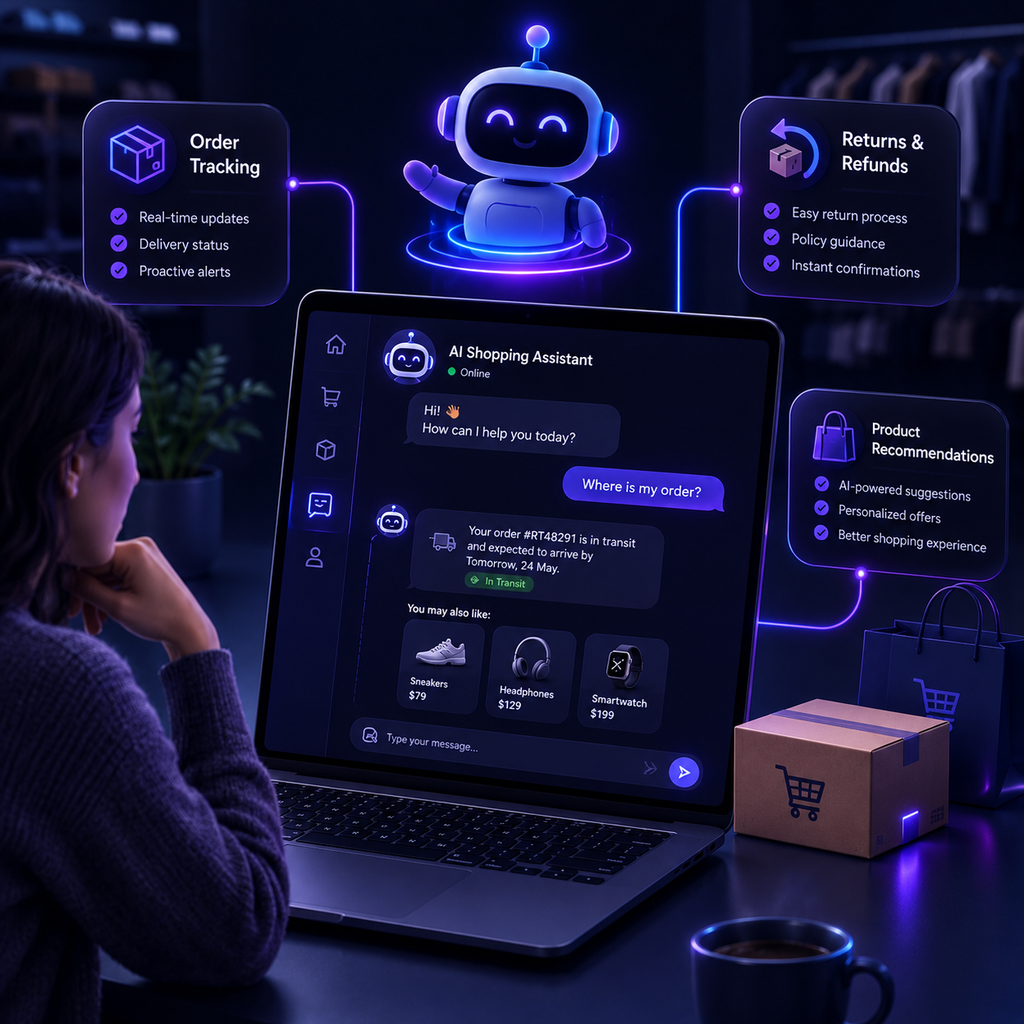
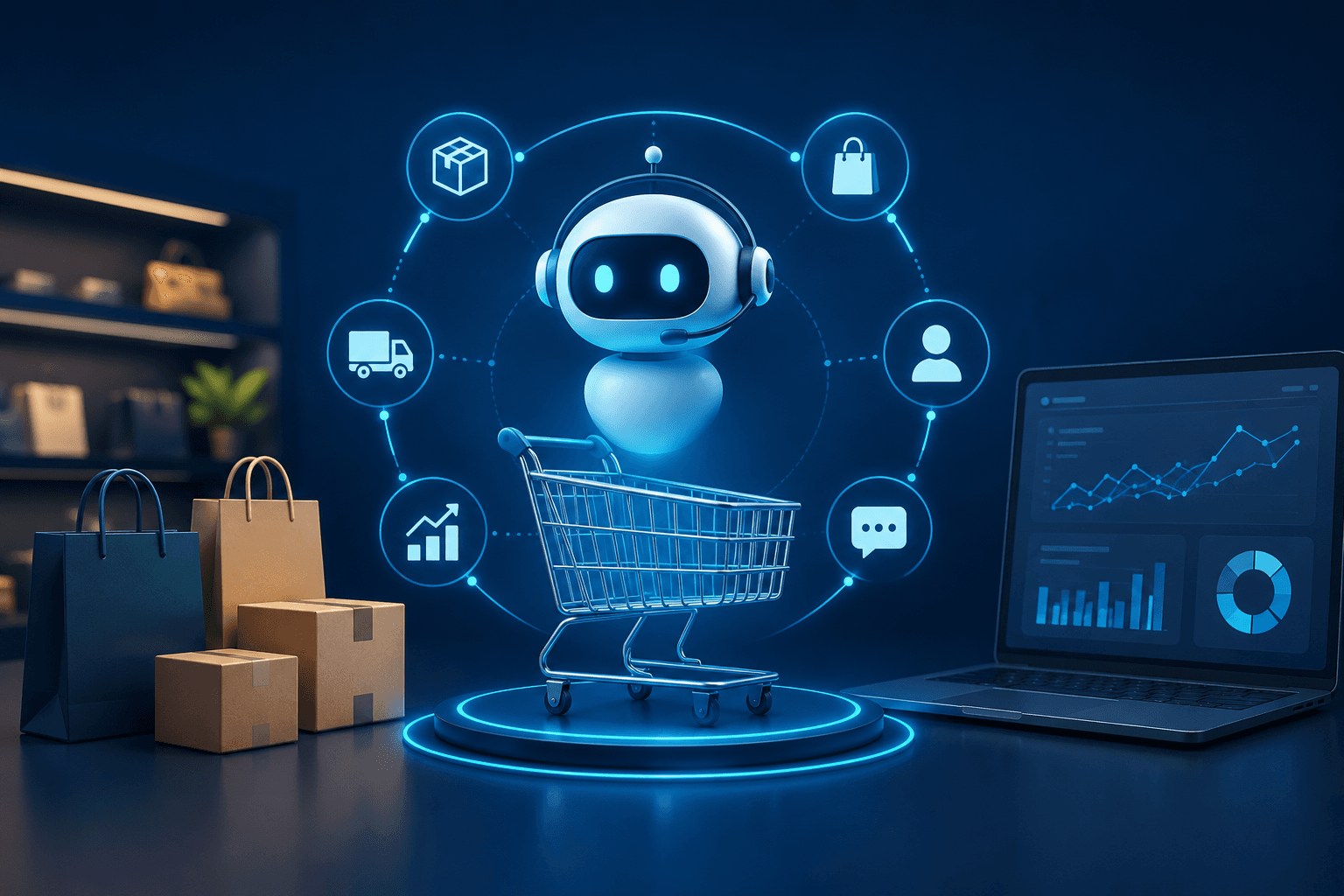
The second layer is where AI agent for ecommerce take over the conversations that used to require a full support roster. Rather than relying on rigid decision trees, enterprise-grade AI agents utilize Retrieval-Augmented Generation (RAG) and vector databases grounded in your brand’s custom knowledge base.
How retail AI agents help:
- 24/7 order and product queries. A shopper browsing at midnight gets an instant, accurate answer instead of a “we’ll reply within 24 hours” auto-message.
- Handling returns and refund queries conversationally. AI agents for handling ecommerce returns and refund queries walk customers through the process step by step, check order eligibility, and issue confirmations without a ticket ever being raised.
- Conversational product discovery. Instead of scrolling through filters, shoppers describe what they want, and the agent surfaces the right products. McKinsey’s research found AI-generated recommendations convert 4.4x higher than traditional search results, a gap driven by how much more relevant agent-guided discovery feels compared to static browsing.
- Multilingual, always-on support. For brands selling across regions, conversational AI agents for ecommerce remove language as a barrier to checkout.
Why this matters for the bottom line:
When e-commerce leaders evaluate the top AI agents for customer support, they are ultimately looking for one metric: which platform achieves the highest first-contact resolution rate without sacrificing customer satisfaction?
The market data backs this up clearly. 80% of retail and online businesses either use AI chatbots or plan to use them soon, and 74% of shoppers feel AI makes their shopping experience better.
On the support side specifically, ecommerce brands using autonomous AI agents are achieving 76-92% resolution rates depending on ticket type, which is a direct answer to what most brands are really asking when they search for the best AI customer service agents for ecommerce.
The nuance that gets missed: the best-performing setups treat agentic AI for ecommerce as human-in-the-loop, and not human-replacing. Escalation to a real person needs to be instant whenever a query goes beyond what the agent should decide on its own, especially anything touching payments, disputes, or unhappy customers.
Struggling with fragmented support bots and legacy OMS integrations?
Transitioning from basic chatbots to action-oriented AI agents requires a clean, scalable architecture.
Book a Free AI Agent Architecture Review with VectovateAI
Pillar 3: Predictive Analytics
Predictive analytics is where raw store data turns into decisions made before the problem happens, rather than after the monthly report shows it.
Key use cases:
- Cart Abandonment & Churn Prevention: Automated intent tracking flags high-risk sessions and triggers real-time nudges before checkout drop-off occurs.
- AI agents for conversion rate optimization eCommerce: Dynamic pricing, tailored offers, and personalized recommendations trigger automatically based on live buyer signals.
- Demand Forecasting: Predictive models align inventory and staffing with active market demand rather than historical guesswork.
- Return-Risk Mitigation: Identifies high-return products and buyer segments early, enabling merchandising teams to adjust policies before margins suffer.
Business impact:
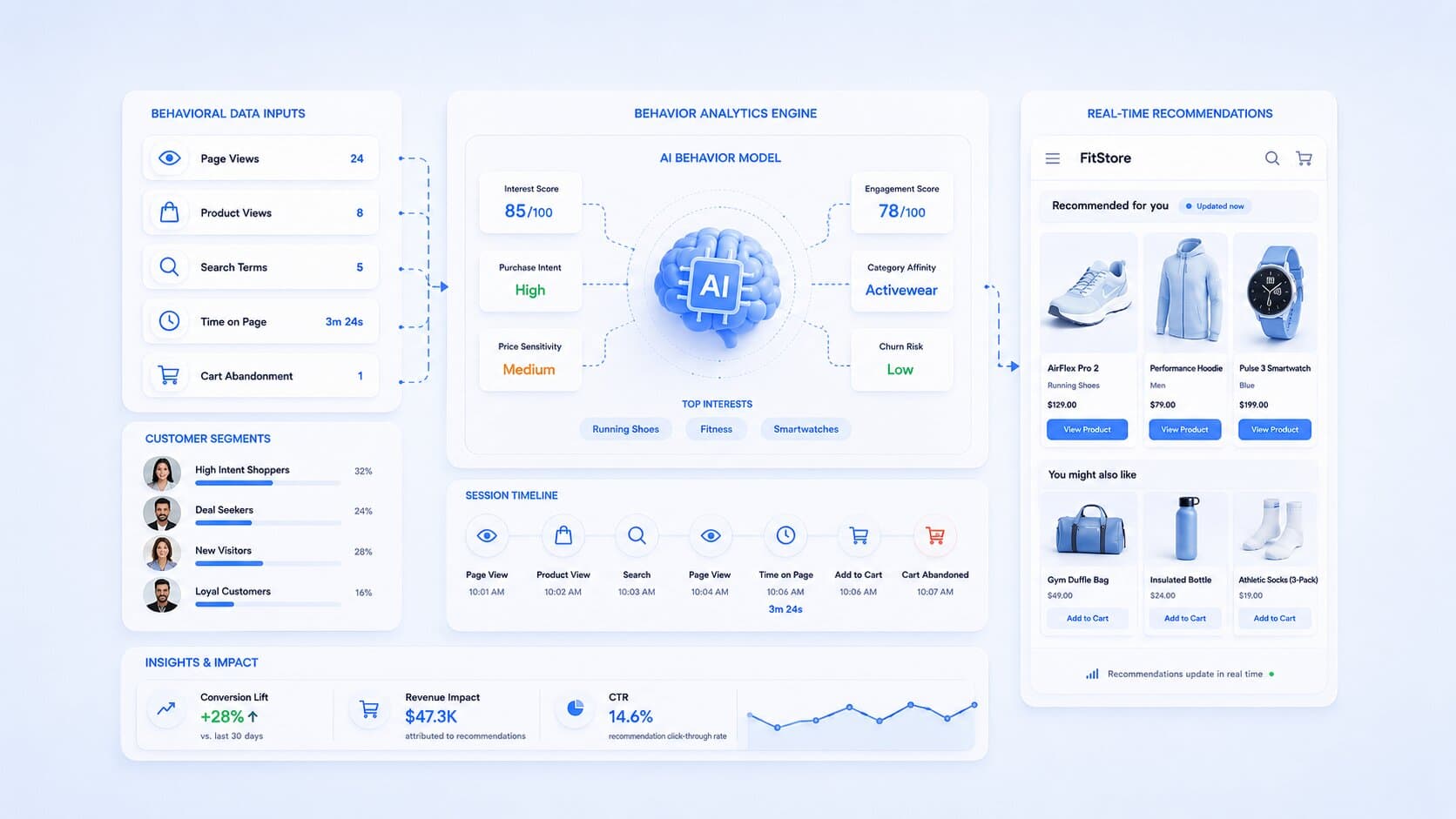
Retailers using AI-driven personalization report meaningful lifts in both conversion and revenue.
AI personalization delivers conversion rate lifts of up to 23%, alongside revenue increases of around 40%, while operational efficiency gains include 30-50% reductions in forecast error and roughly 35% improvement in inventory optimization.
Predictive analytics depends heavily on Pillars 1 and 2. Clean, structured order and conversation data is what makes accurate prediction possible in the first place, which is exactly why sequencing this framework matters.
Pillar 4: Operational Intelligence Dashboards
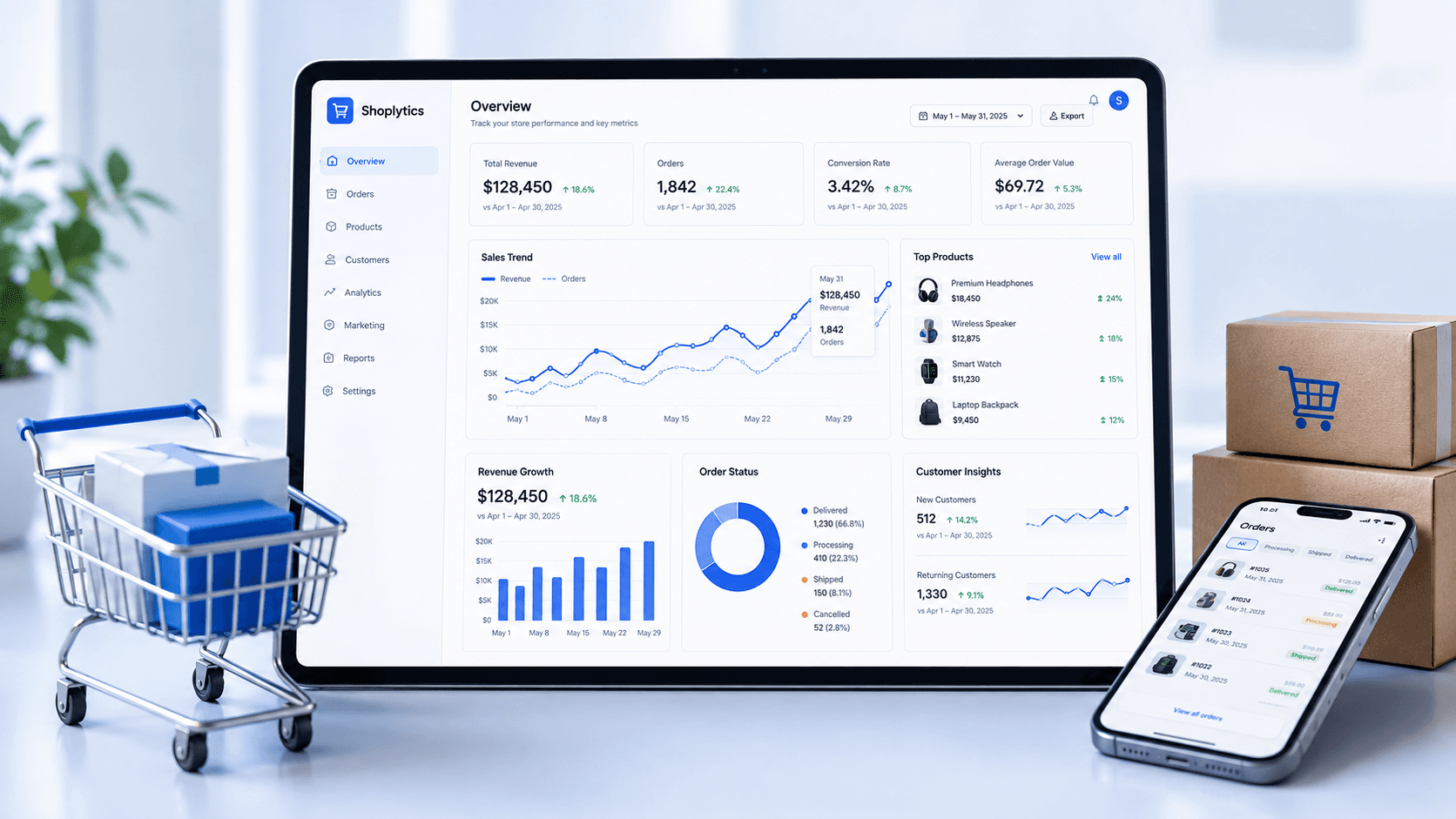
The final pillar turns everything the first three pillars generate into one real-time, role-specific view, because a founder, an ops manager, and a support lead all need to see different things from the same underlying data.
Executive-Level Visibility
Leadership teams can monitor resolution rates, customer retention, revenue recovered through cart and conversion assistance, cost per resolution, and channel performance.
Operational Visibility
Managers gain insight into ticket volume by type, response times, escalation rates, and AI-agent and human-handoff performance.
Marketing and CX Visibility
Growth teams can track recurring product questions that signal content gaps, intent-rich first-party conversation data, cart recovery and conversion patterns, and customer sentiment trends.
How the Four Pillars Work Together
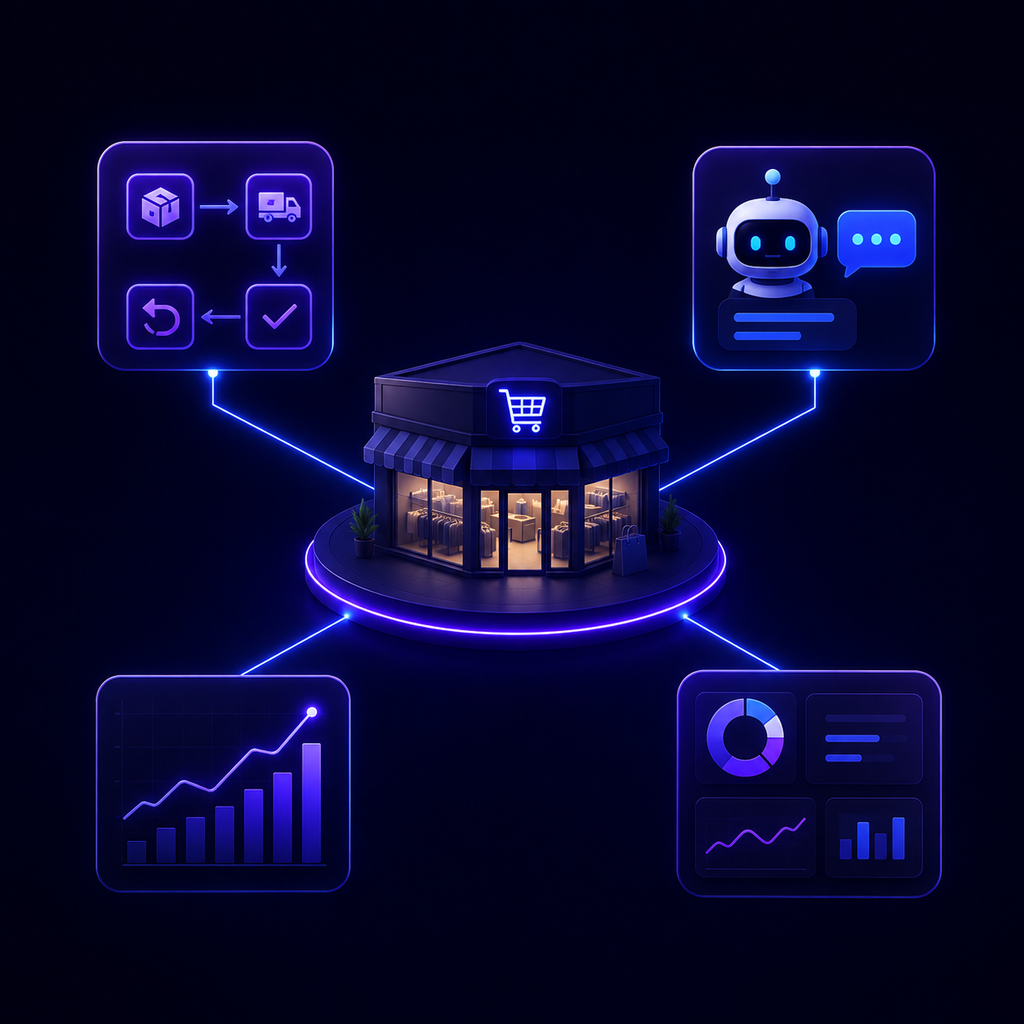
Most retail brands invest in these capabilities in isolation: a chatbot here, an inventory tool there. The brands actually scaling fast connect all four so each pillar strengthens the next.
The typical rollout sequence:
- Automate the operational backbone (orders, returns, inventory) to eliminate manual friction and create clean data.
- Deploy conversational AI agents to handle routine customer engagement around the clock.
- Layer in predictive analytics using the data the first two pillars generate.
- Monitor everything through real-time dashboards and refine continuously.
This interconnected build is also why the market is moving fast. SellersCommerce reports that AI agents are expected to automate between 15% and 50% of business tasks by 2027. McKinsey estimates that by 2030, redesigning workflows around AI agents and robots could unlock $2.9 trillion in economic value in the US alone.
Which AI Agents Are Best for Ecommerce Support?
The best AI agents for ecommerce support are the ones that can understand customer intent, access the right business information, complete routine tasks, and hand off complex issues to human teams with the full conversation context intact.
For eCommerce businesses, the most useful AI agents typically support:
- Order Tracking & Management: Gives customers instant updates on status, shipping, and delays without agent intervention.
- Returns & Refunds: Collects details, verifies policy rules, auto-approves eligible returns, and routes edge cases to human reps.
- Product Discovery: Recommends relevant items based on conversational buyer input rather than static site search filters.
- Cart & Conversion Assistance: Resolves on-the-spot sizing, shipping, or product doubts right at checkout to prevent abandoned carts.
- Multilingual Support: Delivers 24/7 global coverage across multiple languages without building out regional support desks.
- Context-Aware Human Handoff: Transfers sensitive or complex issues to live reps with the full chat history intact.
Final Words
The brands leading this shift are building one connected system: Workflow Automation to strip out friction, retail AI agents to extend support past business hours, predictive analytics to catch drop-off before it happens, and real-time dashboards to keep the entire operation visible.
This is the foundation of intelligent commerce, and it’s the difference between a support function that reacts to chaos and one that quietly drives growth.
At VectovateAI, we help retail organizations build AI-native solutions that transform fragmented support into intelligent, data-driven commerce.
Retail brands can reduce costs, improve customer experience, and unlock measurable business outcomes through an AI-powered retail automation platform teams can actually rely on day-to-day.
See the framework in production: our neural seasonal style analysis case study lifted conversion rates by 40% for a fashion retailer, and the RetailTech growth engine guide shows how AI agents and predictive analytics fit together.
Ready to turn customer support from a cost center into a revenue engine? Book a Free AI Agent Architecture Review.
Frequently Asked Questions.
Get all your answers here and if something remains ask our AI concierge or Book a call with our consultant.