RAG vs Fine-Tuning vs Prompt Engineering: How Businesses Build Custom LLM & Generative AI Solutions in 2026
RAG, fine-tuning or prompt engineering? A plain-words guide to building custom LLM solutions: costs, timelines, accuracy, and how to pick a partner.

Your team tried ChatGPT on a few support tickets, and the answers looked impressive. Then someone asked about your refund policy, and it invented one. Someone else asked for last month’s numbers, and it had no idea they existed. Now the question on the table is: do we need to train our own model?
Usually, no. Most business problems are solved with better prompts, a connection to your own data, or both. Training or fine-tuning a model is the right answer far less often than vendors suggest, and it is the most expensive one.
Below is a practical map of how businesses build custom LLM and generative AI solutions in 2026. It covers when prompt engineering is enough, when RAG is the right tool, when fine-tuning or a private LLM makes sense, and how to choose an LLM development company that will give you the honest answer.
Key Takeaways
- A custom LLM solution rarely means a new model. It usually means an existing model, connected to your data and systems, with guardrails around it.
- Start with prompt engineering. OpenAI’s own guidance calls it the best place to start, and for many tasks it is enough.
- Use RAG when the model needs your company’s knowledge, such as policies, products, contracts, or tickets, and that knowledge changes.
- Use fine-tuning when you need consistent style, format, or behavior that prompts can’t hold, and you have good examples to train on.
- Private LLMs make sense when data can’t leave your environment, or when volume makes self-hosting cheaper than paying per call.
- Gartner predicted at least 30% of generative AI projects would be abandoned after proof of concept by the end of 2025. Clear success metrics help prevent that.
What a Custom LLM or GenAI Solution Means
When a business says it wants “its own ChatGPT,” it usually means four things:
- It knows our business. Answers come from our documents, data, and rules, not the open internet.
- It works inside our tools. It lives in the CRM, help desk, intranet, or app our people already use, often as an AI chatbot or assistant.
- It’s safe. Customer data stays protected, and the system refuses to answer what it shouldn’t.
- It’s measurably useful. It saves time, resolves tickets, or speeds up work in ways we can track.
None of that requires building a model from scratch. It requires the right technique, a clean data pipeline, and solid LLM integration services that wire the model into the systems your team already uses. Spending is moving fast in this direction: Menlo Ventures estimates enterprises spent $37 billion on generative AI in 2025, up from $11.5 billion in 2024.
If you need a refresher on how generative AI differs from older approaches, see generative AI vs traditional AI.
Prompt Engineering: When It Is Enough
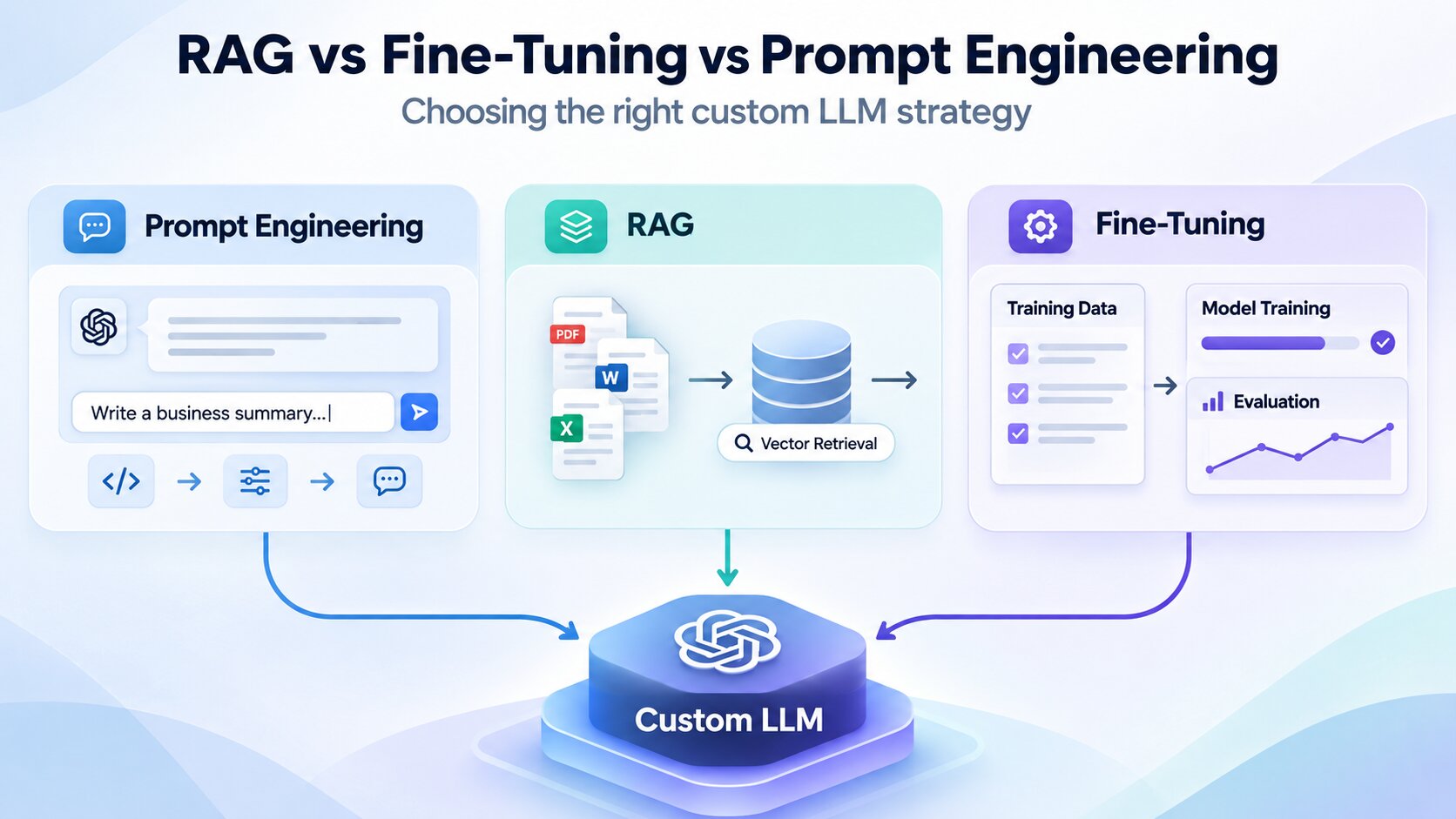
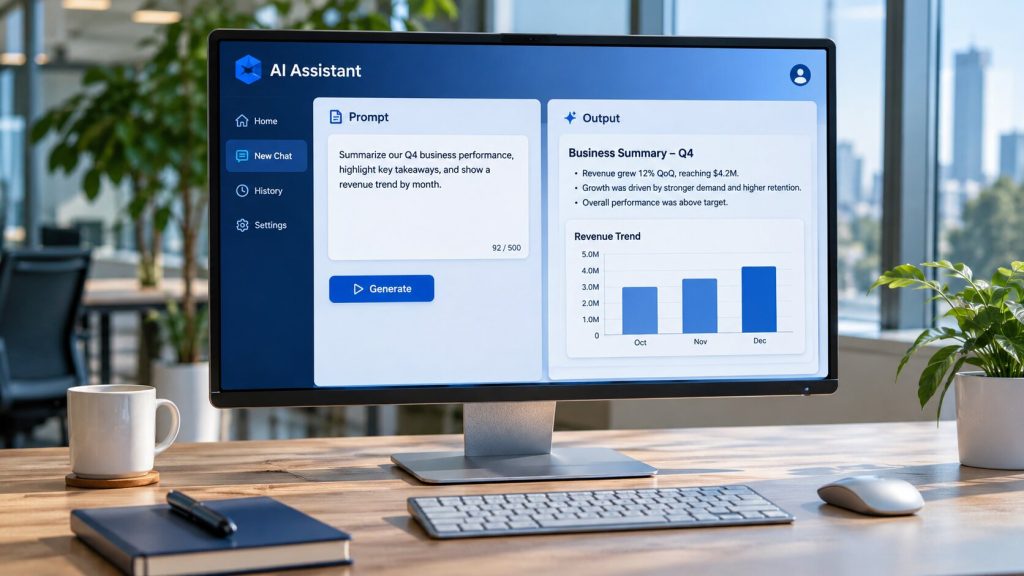
Prompt engineering means writing clear instructions, examples, and rules for the model. It sounds simple, and that is the point. OpenAI’s guide to optimizing LLM accuracy describes prompt engineering as typically the best place to start, and often enough on its own for tasks like summarization, translation, and code generation.
Prompt engineering is usually enough when:
- The task uses general knowledge. Drafting emails, summarizing calls, rewriting content, or classifying feedback.
- The rules fit in the prompt. Tone of voice, output format, and a short list of do’s and don’ts.
- The input carries the context. The user pastes or uploads the document the model should work with.
Good prompt work is more than clever wording. It needs a test set of real examples, a way to score answers, and version control so changes don’t silently break things. Costs are lower than many expect, too. For long, reused prompts, Anthropic says prompt caching can cut costs by up to 90% and latency (response time) by up to 85%.
A quick test helps. Write the best prompt you can, run it on 50 real examples, and score the results. If most answers are right and the wrong ones are wrong because the model lacked information, you need RAG. If they are wrong in style or format, you may need fine-tuning.
RAG: Using Your Own Company Data
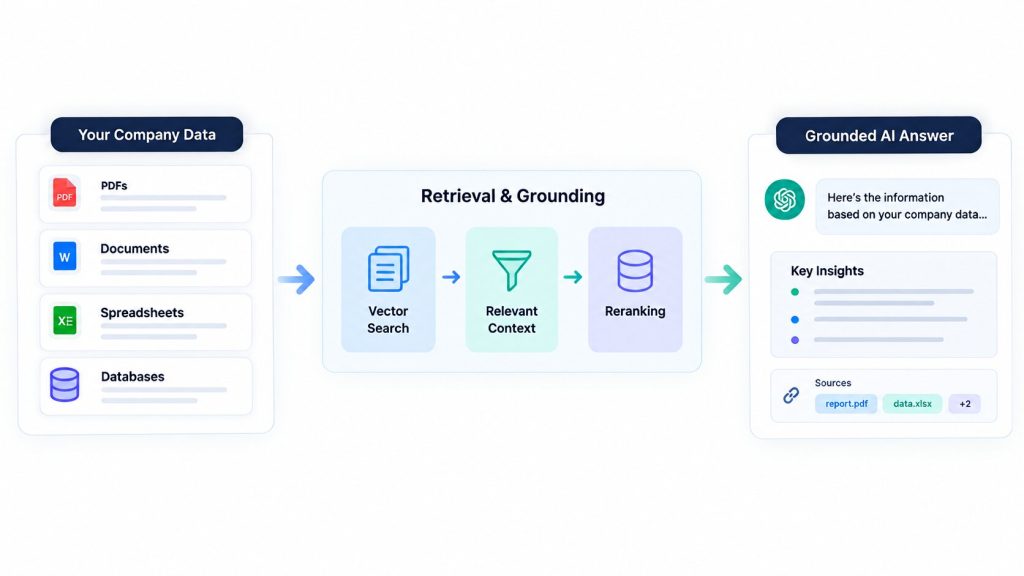
Retrieval-augmented generation (RAG), first described in a 2020 research paper, hands the model the right information at the moment it answers. When someone asks a question, the system searches your documents or databases, pulls the most relevant passages, and gives them to the model with the question. The model answers from that content and can cite its sources.
RAG is the right choice when:
- The knowledge is yours. Policies, product specs, contracts, manuals, tickets, and internal wikis.
- The knowledge changes. Update a document, and the next answer reflects it. No retraining needed.
- Answers must be traceable. Users and auditors can see which document an answer came from.
- Access must be controlled. The system can respect who is allowed to see which documents.
Most of the work in RAG is data work, not model work. Documents have to be collected, cleaned, split into sensible chunks, and kept in sync, which is why strong data engineering matters. Retrieval quality decides answer quality. Anthropic reported that its contextual retrieval technique cut failed retrievals by 49%, and by 67% when combined with reranking (a second pass that reorders results by relevance).
Production Case Study: Live RAG Agents in Logistics
RAG also powers AI agents that act on live data, a shift we cover in the rise of AI agents. In our logistics orchestration project, VectovateAI deployed LLM-powered assistants connected to live shipment databases via RAG. By answering complex tracking and exception queries directly from real-time operational data without escalating to a human, the client lifted customer satisfaction by 45%.
Fine-Tuning and Private LLMs
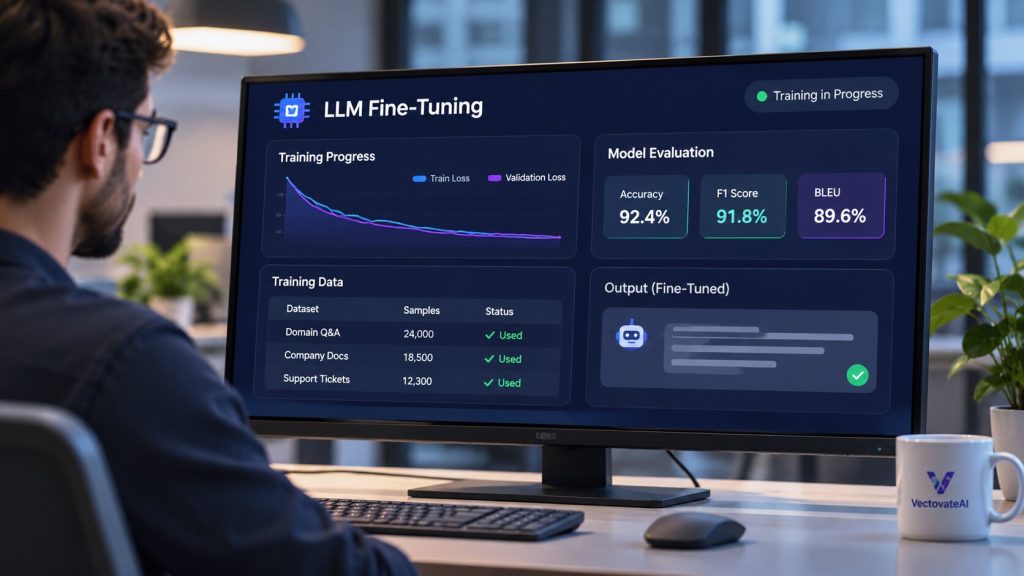
Fine-tuning trains an existing model further on your own examples, so it learns a behavior: a format, a tone, a classification scheme, or a specialist task. It changes how the model responds, not what facts it can look up.
Fine-tuning makes sense when:
- Prompts can’t hold the behavior. You need the same structure or style every time, across thousands of calls.
- You have good examples. Hundreds to thousands of high-quality input and output pairs that show exactly what “right” looks like.
- A smaller model must do a narrow job. A fine-tuned small model can be faster and cheaper than a large general model for one task.
Fine-tuning is cheaper than it used to be. The LoRA method showed it is possible to cut trainable parameters (the internal settings that change during training) by about 10,000 times compared with full fine-tuning of GPT-3. GPU memory needs fell by three times. But it still needs clean training data, careful evaluation, and retraining when your needs change.
A private LLM is a different decision. It means running an open-weight model (one whose files you can download and run yourself) inside your own cloud or data center, so prompts and data never leave your environment. Companies choose it for strict data rules, regulated industries, or very high volumes where per-call API fees add up. The trade-off is that you now operate the model: hosting, scaling, security, and updates.
One honest caveat: fine-tuning does not fix missing knowledge. If the model needs facts from your documents, use RAG. Many strong systems combine both: RAG for knowledge, light fine-tuning for behavior.
Side-by-Side Comparison: Cost, Time, Accuracy
| Factor | Prompt engineering | RAG | Fine-tuning or private LLM |
|---|---|---|---|
| Best for | General tasks, clear rules | Answers from your own changing data | Consistent behavior, narrow tasks, strict data control |
| Time to first version | Days to 2 weeks | 4 to 10 weeks | 8 to 16 weeks or more |
| Indicative build cost | $5,000 to $20,000 | $25,000 to $100,000 | $60,000 to $250,000+ |
| Keeping it current | Edit the prompt | Update the documents | Retrain or update the model |
| Accuracy on company facts | Low unless facts are in the prompt | High, with source citations | Low on its own, needs RAG for facts |
| Main risk | Fragile prompts | Poor retrieval quality | Cost, data preparation, and maintenance |
The budgets above are indicative for custom business builds and depend on data volume, integrations, and security needs. For wider ranges, see our guide to AI development cost in 2026.
Most companies follow the same path: prompt engineering first, RAG once the model needs company knowledge, and fine-tuning only where a clear gap remains. That order keeps costs down and gets something useful to users quickly.
If you are not sure which use case to start with, a short AI strategy consulting engagement ranks your ideas by value and data readiness before any build. For customer-facing use cases, our guide to how AI chatbots transform customer experience shows where the returns usually come from.
How to Pick an LLM Development Company
LLM development services look alike on a website. The differences show up when you ask a few plain questions:
- Will you start with the simplest approach? A good partner tests prompts and RAG before proposing fine-tuning or a private model.
- How do you measure quality? Ask for their evaluation method: test sets, scoring, and how they track accuracy after launch.
- How do you stop wrong answers? Look for source citations, refusal rules, and human review for high-stakes outputs.
- Where does our data go? Your data should never be used to train public models. Ask about private deployment options.
- Which models do you work with? A model-neutral large language model development company can switch providers as prices and quality change.
- Who owns the code, prompts, and data pipelines? You should own all of it.
Our Take at VectovateAI
Build the simplest thing that works, then add only what the test set proves you need. As an AI-native software development company in Ahmedabad serving global product and enterprise teams, we start every generative AI development project with a short discovery and a test set built from your real data. If a well-designed prompt solves the problem, we ship that and stop there. When you need more, our senior architects design the retrieval pipeline, guardrails (rules that block unsafe or off-topic answers), and integrations together, and keep a human in the loop for decisions that matter. Where your data rules require it, we also work as a private LLM development company, running open-weight models inside your own cloud so prompts and data stay in your environment.
Conclusion
There is no single best way to build with LLMs. There is the simplest approach that meets your accuracy, cost, and privacy needs. The expensive mistakes come from fine-tuning a model to learn facts that a search over your documents would have handled better.
Start with prompts and a test set. Add RAG when the model needs your knowledge. Fine-tune only for behavior that prompts can’t hold. Whichever LLM development company you choose, ask it to prove that order on your own examples before it quotes a large build. That is how a custom LLM solution moves from impressive demo to daily tool.
Planning a chatbot, knowledge assistant, or AI agent on your own data? Book a Free LLM Architecture Review with VectovateAI
Frequently Asked Questions.
Get all your answers here and if something remains ask our AI concierge or Book a call with our consultant.