Predictive Analytics in Healthcare: Turning Patient Data into Decision Intelligence
Hospitals sit on mountains of data — labs, vitals, claims, wearable feeds — and most of it just sits there. Predictive analytics turns it into forward-looking signals: who gets readmitted, which claim gets denied, where the next bed crunch is coming. Here are the real use cases, the architecture behind them, and the HIPAA governance it all depends on.

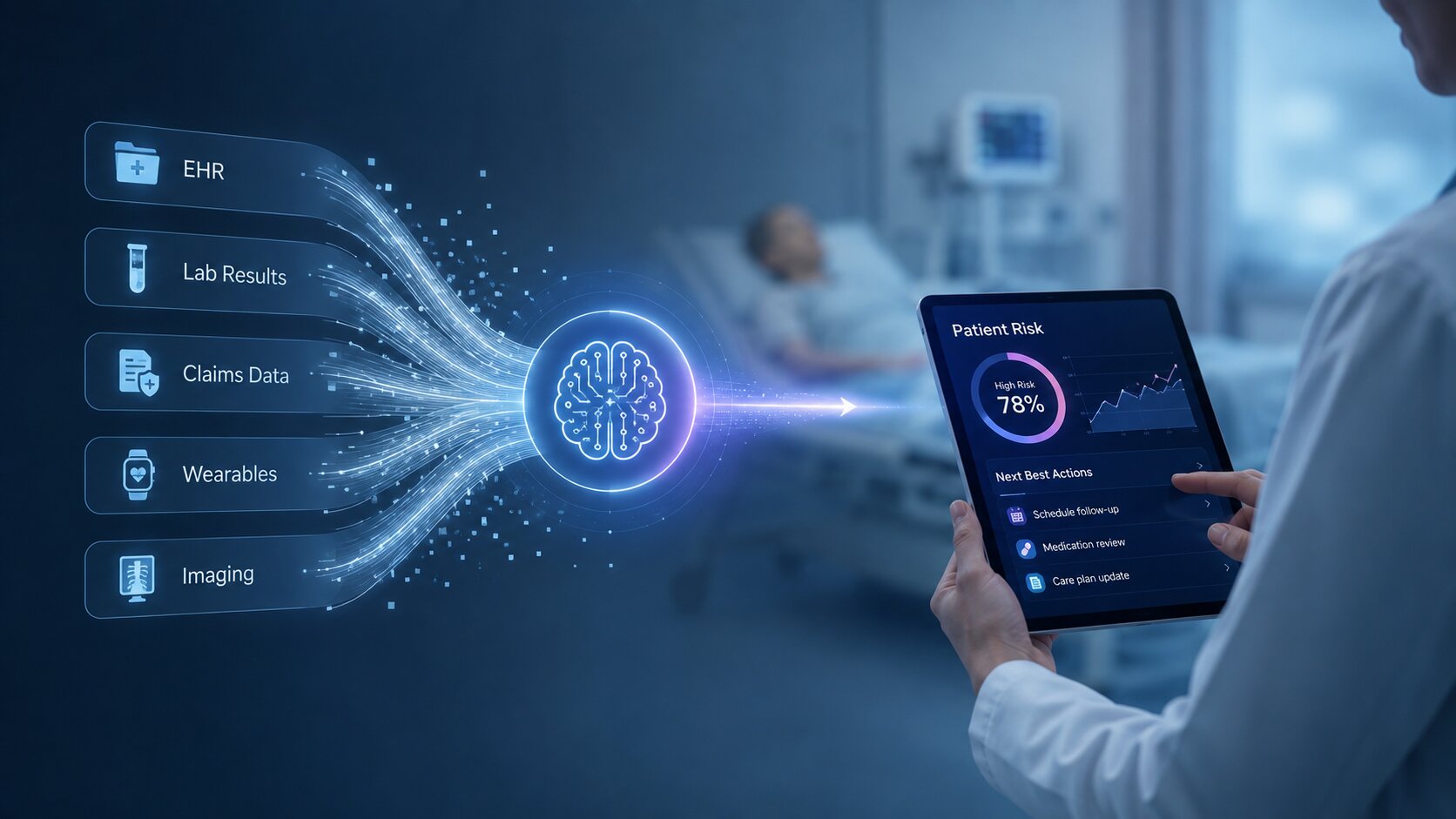
Hospitals sit on mountains of data every day: lab results, vitals, claims, wearable feeds. Most of it just sits there unused. Predictive analytics in healthcare changes that.
It takes historical and real-time patient data and turns it into forward-looking signals: who’s likely to be readmitted, which claim will get denied, where the next bed crunch is coming from. Instead of reacting after something goes wrong, hospitals and payers can act before it happens.
The healthcare predictive analytics market itself proves the shift is real: it’s projected to grow past $50 billion by 2030, at over 24% a year. This blog breaks down what it is, how it works, real examples, and how you can start using it, without the jargon.
Key Takeaways
- Predictive analytics in healthcare uses ML models on EHR, claims, and device data to forecast risk before it becomes a crisis.
- Real-world use cases span readmission prevention, chronic disease risk scoring, fraud detection, and staffing forecasts.
- A healthcare data analytics platform built on clean, governed data is the real foundation, not just the isolated algorithm.
- Power BI for healthcare and custom embedded UI layers (like SMART on FHIR) make predictive dashboards accessible directly inside existing clinician workflows.
- The biggest barriers aren’t technical. They’re data silos, HIPAA compliance, and clinician trust.
What Is Predictive Analytics in Healthcare?
Predictive analytics in healthcare applies statistical modeling and machine learning to clinical, operational, and financial health data to forecast upcoming events such as readmissions, claim denials, or ER demand spikes.
Think of it in three layers:
- Descriptive analytics tells you what happened last month.
- Predictive analytics tells you what’s likely to happen next month.
- Prescriptive analytics tells you what to do about it.
Most hospitals are strong on the first layer and weak on the other two. That gap is exactly where healthcare predictive analytics earns its value.
How Predictive Analytics in Healthcare Works Using Big Data
Every predictive model follows a similar path, and it starts long before any AI touches the data.
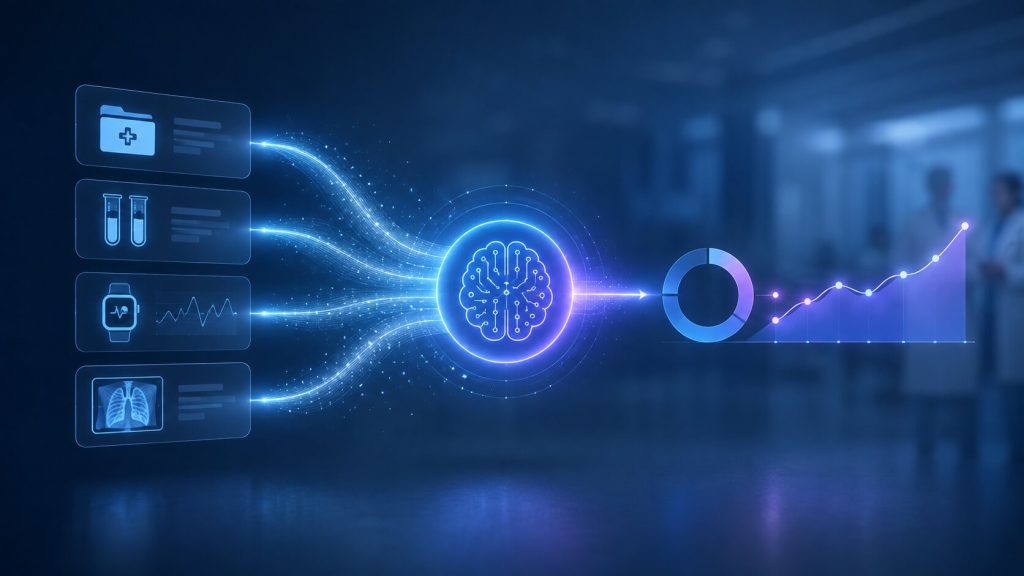
- Data collection: pulling from EHRs, lab systems, imaging, claims, and wearable devices.
- Cleaning and normalization: messy, duplicate, or missing records get standardized.
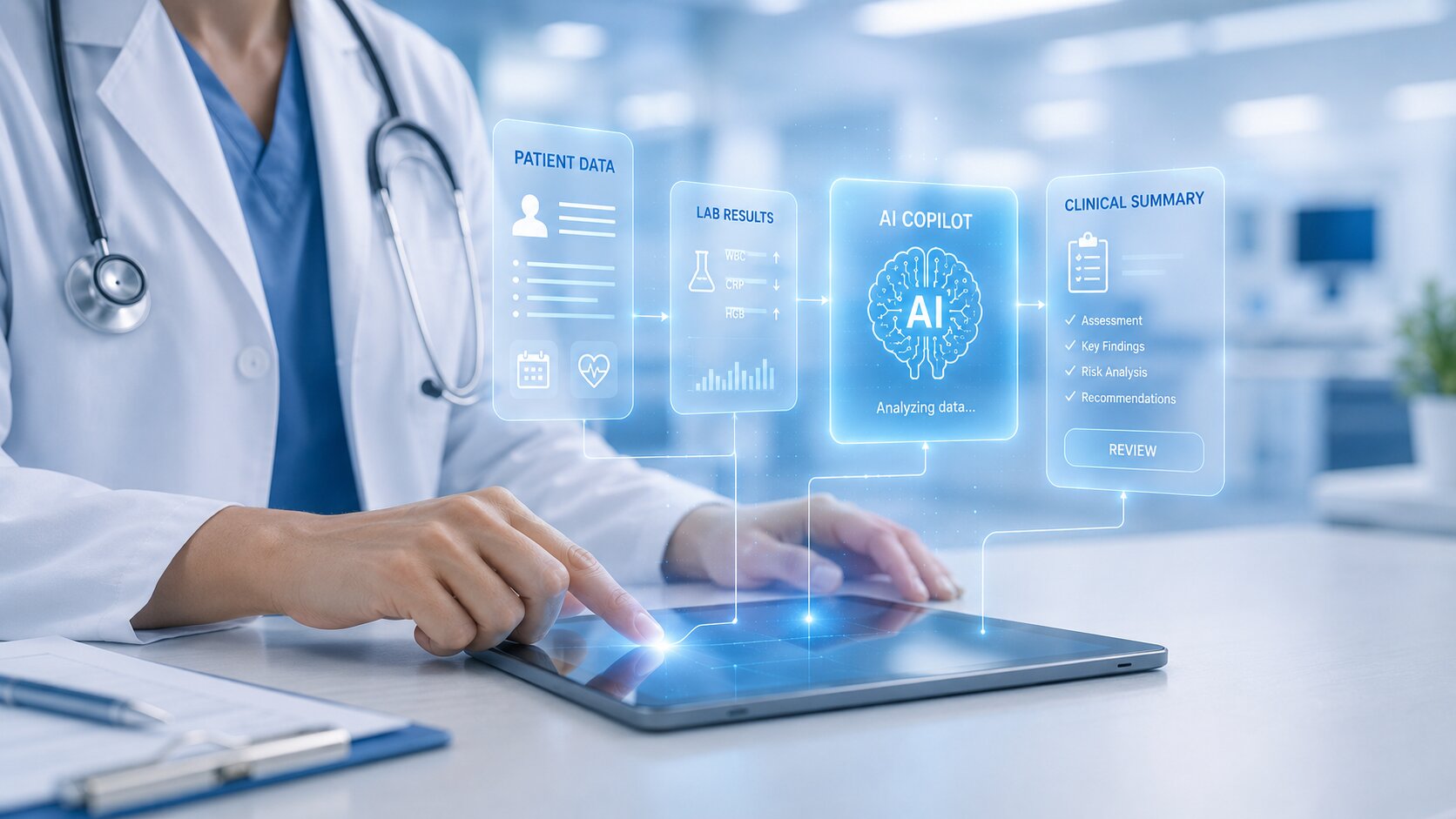
- Model training: algorithms like logistic regression, random forests, or gradient boosting learn patterns from historical outcomes. This is where AI predictive analytics in healthcare moves past basic statistics, using machine learning to catch patterns a human reviewer would likely miss in raw data.
- Integration into workflow: the output shows up as a risk score or alert inside the tools clinicians already use, not a separate report nobody opens.
This is what people mean by predictive analytics in healthcare using big data.
The Technical Architecture of an Enterprise Healthcare Data Engine
Delivering real-time risk scores in a live health environment requires a scalable, secure backend architecture:
- Interoperability & Data Ingestion: Ingestion engines pull continuous streams using HL7 v2/v3 and FHIR (Fast Healthcare Interoperability Resources) RESTful APIs to bridge legacy EHRs (like Epic or Cerner) with cloud environments.
- Unified Data Lakehouse: Raw data lands in an enterprise lakehouse (such as Snowflake, AWS HealthLake, or Azure Health Data Services) where automated ETL/ELT pipelines handle de-identification, schema mapping, and normalization.
- MLOps & Model Serving: Models are containerized via Docker and managed using Kubernetes. Automated MLOps pipelines track data drift and clinical bias, ensuring model predictions remain accurate as patient demographics shift.
Predictive Analytics in Healthcare — Examples
Looking at real examples of predictive analytics in healthcare in action is the fastest way to see where the ROI actually shows up.
| Use Case | What the Model Predicts | Business Impact |
|---|---|---|
| Re-admission risk | Which discharged patients are likely to return within 30 days | Fewer penalties, targeted follow-up care |
| Chronic disease management | Patients trending toward complications (diabetes, COPD) | Earlier, cheaper intervention |
| Clinical deterioration alerts | Sepsis or cardiac risk hours in advance | Faster clinical response |
| Claims and denial prediction | Which claims will likely get denied before submission | Cleaner first-pass approvals |
| No-show prediction | Patients likely to miss an appointment | Better scheduling, less revenue leakage |
| Fraud detection | Anomalous billing patterns | Blocked fraudulent payouts |
A Duke University study, cited by ForeSee Medical, on EHR-based no-show modeling found it flagged nearly 5,000 additional missed appointments annually with higher accuracy than legacy forecasting methods.
Insurers use the same logic differently. Anthem, as reported by ForeSee Medical, has applied predictive modeling to build patient profiles that shape more personalized outreach and messaging.
Healthcare fraud alone drains an estimated 3 to 10% of total US healthcare spending every year, per NHCAA. A single well-tuned fraud detection model can pay for the entire analytics investment.

Predictive Analytics in Healthcare Supply Chain
Predictive analytics in healthcare supply chain management forecasts demand for medications, PPE, and critical inventory using seasonal surge data and admission forecasts. This cuts inventory carrying costs and prevents emergency shortages before flu seasons hit.
Benefits of Predictive Analytics in Healthcare
The benefits of predictive analytics in healthcare hit three groups at once: patients, providers, and the finance team.
- Better outcomes: earlier detection means smaller, cheaper interventions instead of emergency ones.
- Lower costs: fewer avoidable admissions, less fraud, fewer denied claims.
- Operational efficiency: staffing and bed planning based on forecasted demand, not guesswork.
- Personalized care: treatment plans shaped by a patient’s specific risk profile, not a generic protocol.
- Stronger health equity: risk stratification that factors in social determinants helps direct resources to underserved populations, not just the loudest requests.
Power BI for Healthcare & Embedded Dashboards: Making Predictions Usable
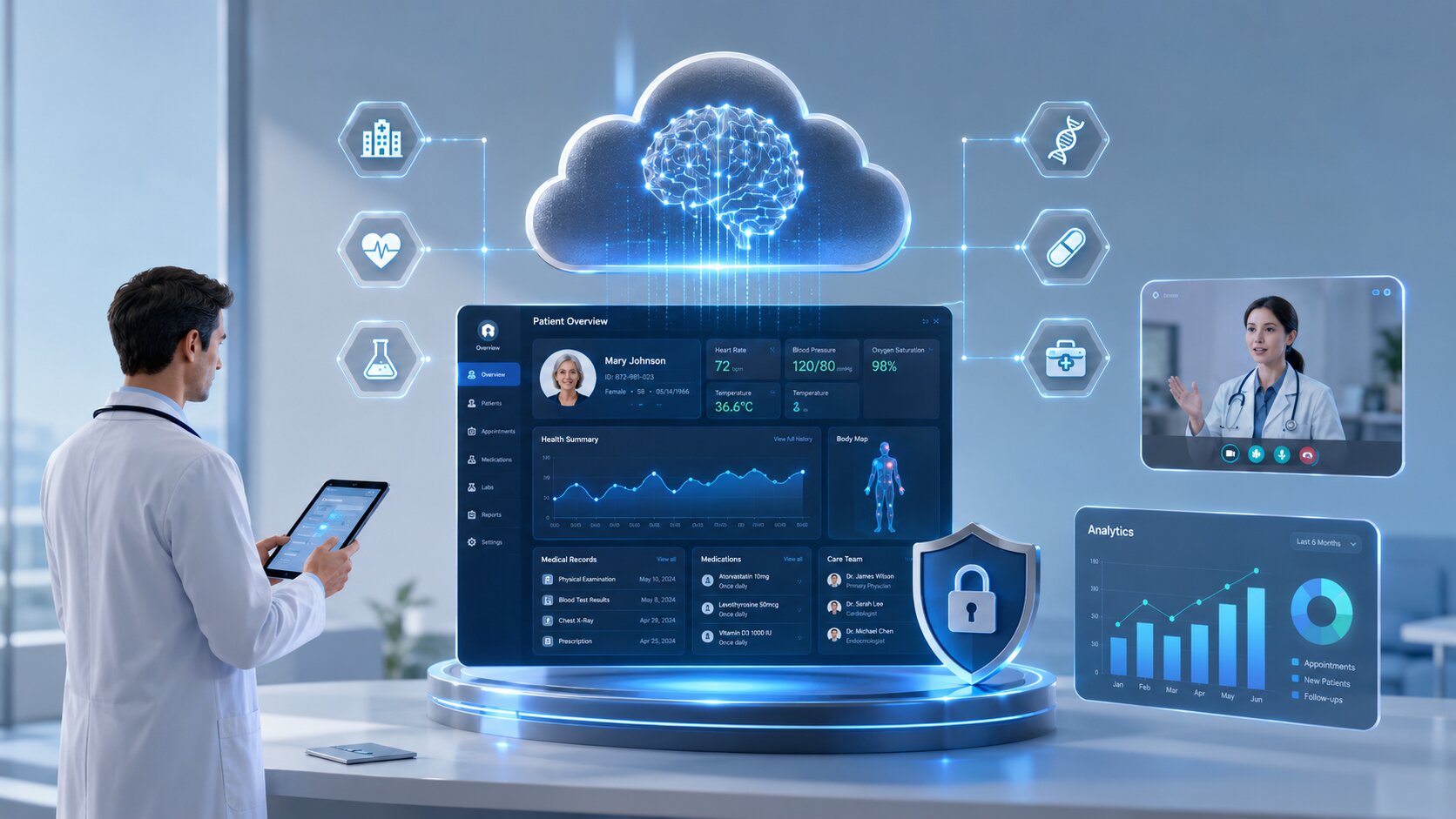
A brilliant model is useless if non-technical clinical and finance teams can’t interpret it. This is where Power BI for healthcare earns its place, as the visible front end of a strong healthcare business intelligence strategy, turning complex data science into actionable, visual intelligence.
A well-built enterprise healthcare dashboard typically shows:
- Real-time bed occupancy and length-of-stay trends by department.
- Readmission risk scores flagged directly against patient cohorts.
- Billing and denial-rate trends broken down by payer.
- Predictive staffing recommendations based on forecasted patient census.
In production deployments, combining predictive modeling with live occupancy tracking has helped health systems achieve around a 22% reduction in unplanned ICU overflow. For operations teams, tools like Copilot in Microsoft Fabric allow staff to query aggregated operational trends in plain language, delivering instant answers without waiting on custom IT reports.
Bridging the Clinical Gap: Executive dashboards alone do not drive bedside adoption. For physicians and nurses, context-switching between an EHR and a third-party BI tool causes friction. High-impact implementations solve this by deploying custom-embedded UIs — such as SMART on FHIR micro-apps built directly into Epic or Cerner interfaces — delivering real-time risk predictions straight to the patient record where decisions happen.
Enterprise Security, HIPAA, and Data Governance
Building a production-grade predictive engine requires a zero-trust security model:
- HIPAA & SOC 2 Compliance: All infrastructure enforces strict end-to-end encryption, both at rest (AES-256) and in transit (TLS 1.3) — backed by formal Business Associate Agreements (BAAs).
- PHI De-identification: Personally identifiable health data (PHI) undergoes automated de-identification and anonymization protocols in compliance with HIPAA Safe Harbor standards before model training.
- Role-Based Access Control (RBAC): Access policies ensure clinicians view only the risk scores relevant to active cohorts, while analysts view aggregated, non-PHI trends.

Building a Healthcare Data Analytics Platform: What It Actually Takes
Building a real healthcare data analytics platform is a sequencing problem before it’s a technology one.
| Step | What It Solves |
|---|---|
| Assess data readiness | Confirms your EHR, claims, and device data can actually support a model |
| Pick one measurable use case | Avoids the trap of trying to “do AI” everywhere at once |
| Build a governed data layer | One trusted source, not five conflicting spreadsheets |
| Train and validate the model | Tested for accuracy and bias before it touches a patient |
| Lock in HIPAA governance | Access control, audit trails, de-identification, non-negotiable |
| Deploy and monitor | Predictions land inside existing workflows, tracked for drift over time |
Skipping straight to “build the AI model” without steps one through three is the most common and costly mistake health systems make.
Pros and Cons of Predictive Analytics in Healthcare
| Pros | Cons |
|---|---|
| Earlier intervention, better outcomes | Requires clean, unified data, most hospitals don’t have this yet |
| Reduces avoidable costs and fraud | HIPAA and privacy compliance add real complexity |
| Frees up staff from manual pattern-spotting | Models can carry bias if trained on non-representative data |
| Scales across clinical, financial, and operational teams | Clinician adoption takes time and trust-building |
| Works well alongside existing EHR systems | Needs ongoing validation, a model isn’t “done” after launch |
How to Use Predictive Analytics in Healthcare: Where to Start
If you’re a decision-maker wondering how to use predictive analytics in healthcare without a six-month pilot that goes nowhere, start narrow:
- Pick one high-cost, high-frequency problem. Readmissions or claim denials are usually the easiest wins.
- Audit whether your current data can actually support that specific prediction.
- Get a dashboard in front of the team that owns the decision, not just IT.
- Measure the outcome against a clear number, like fewer readmissions or faster claim turnaround, before expanding to a second use case.
The organizations that get real ROI from predictive analytics rarely start with the most ambitious project. They start with the smallest one that proves the loop works: data in, prediction out, decision made, outcome improved.
Conclusion
Predictive analytics in healthcare isn’t about replacing clinical judgment. It’s about giving decision-makers a head start. Whether that’s a nurse manager staffing for tomorrow’s patient surge, a CFO chasing down claim denials, or a care coordinator flagging a high-risk diabetic patient before a hospitalization, the pattern is the same: turn patient data into decision intelligence, and act while there’s still time to change the outcome.
Our clinical scheduling automation case study shows this loop in production, lifting clinical efficiency by 35%. The same forecasting discipline applies outside healthcare, as in our retail demand forecasting playbook.
Ready to turn your patient data into decisions? Book a Free Healthcare Data Architecture Review with VectovateAI
Frequently Asked Questions.
Get all your answers here and if something remains ask our AI concierge or Book a call with our consultant.