Your Data Inside Your Walls: Architecting Private Cloud AI for Healthcare Infrastructure
Learn how healthcare organizations can deploy secure Cloud AI Environments for Healthcare, secure PHI using private, air-gapped LLMs, FHIR/HL7-compliant microservices, and vector-level RBAC.


1. Introduction: The High-Stakes Friction in Enterprise Healthcare AI
Artificial intelligence is transforming global healthcare, accelerating diagnostics, improving workflows, and reducing administrative overhead. Large language models (LLMs) have quickly become top strategic priorities for modern healthcare networks.
However, healthcare Chief Information Security Officers (CISOs) and Chief Technology Officers (CTOs) face a severe infrastructural hurdle. Patient records, clinical datasets, and diagnostic imagery contain sensitive Protected Health Information (PHI) protected by strict laws. As organizations deploy generative AI tools, standard public API-wrapping introduces dangerous surfaces for data leakage and compliance violations.
The core friction lies between AI innovation and strict data governance. Connecting external, cloud-hosted models to internal Electronic Health Record (EHR) systems risks breaching the security perimeter with every user prompt.
To solve this, advanced medical enterprises are shifting toward Cloud AI Environments for Healthcare built on single-tenant, private infrastructure models. By retaining complete ownership over data pathways, engineering leaders leverage AI without sacrificing clinical AI data privacy, compliance, or network control.
2. Moving Past Public Wrappers: The Technical Reality of Private Cloud AI
A production-ready private cloud AI environment is a single-tenant infrastructure stack designed to handle intensive AI workloads while giving the enterprise total control over data routing, application binaries, and security layers.
Unlike multi-tenant public AI platforms that process data outside your network, private deployments completely isolate memory structures and compute cycles. Your proprietary data is never used to train third-party foundational models, and your systems remain invisible to the public internet. These environments deploy across three core footprints:
- Virtual Private Cloud (VPC) Isolations: Single-tenant deployments inside isolated AWS or Azure zones, using dedicated instances with zero public internet gateways.
- On-Premise AI Deployment Healthcare: Bare-metal deployments on high-performance computing clusters (like NVIDIA DGX systems) located inside hospital data centers.
- Air-Gapped Private LLM Architectures: Network-isolated environments where model inference engines run locally without outbound network connectivity, preventing data exfiltration.
This architectural shift transitions the organization from a passive API consumer into an absolute data governor. It provides deep visibility into data transit, enforces zero-trust access, and eliminates the latency and compliance grey areas of public consumer AI systems.

3. Why Healthcare Demands an AI-Native Engineering Standard
Electronic Health Records (EHRs), structured clinical notes, and high-fidelity PACS imaging files contain sensitive data. Under regulatory frameworks like HIPAA and the HITECH Act, engineering teams cannot treat medical text like generic corporate data.
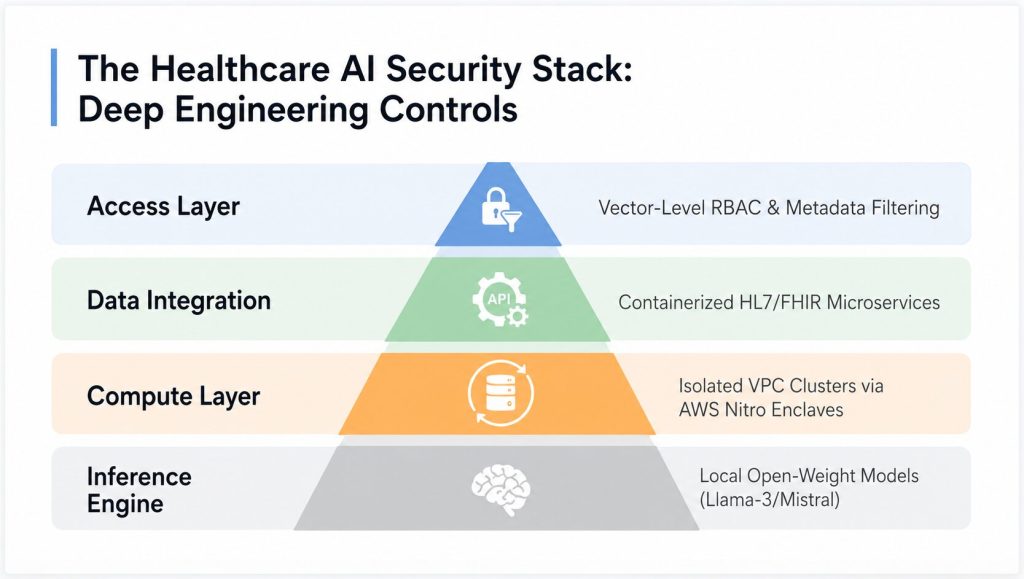
When architecting an AI infrastructure layer, security teams must reject high-level developer wrappers and enforce lower-level systems engineering guidelines. A true healthcare cloud security framework optimizes for perimeter defense, structural transparency, and data sovereignty via three core pillars:
Healthcare Data Sovereignty & Regional Auditing
Enterprises must guarantee exactly where patient records are physically processed. Strict health data residency requirements mean public clouds risk spreading data across international server clusters. Private environments lock execution to explicit geolocations, ensuring complete auditability during formal regulatory inspections.
Zero-Trust Technical Interoperability
Traditional applications rely on broad perimeter firewalls, allowing excessive lateral access once inside the network. In an AI-native healthcare environment, every individual microservice, vector database query, and model execution call must be cryptographically authenticated, logged, and constrained to its exact functional scope.
Protection Against Model Poisoning and Exploit Surfaces
Public LLM endpoints are highly vulnerable to indirect prompt injection and data extraction attacks. If an adversary manipulates data downstream, public models can hallucinate corrupted medical guidance. Running an air-gapped, internally managed model limits the attack surface strictly to validated corporate data ingestion pipelines.
4. Deep-Dive Compliance Architecture: Mapping HIPAA and HITECH
Building a secure HIPAA-compliant AI infrastructure requires replacing broad checklists with low-level systems engineering controls at the data layer.
Cryptographic Security Standards for PHI
To comply with HHS HIPAA Security Rule Standards for Data at Rest and in Transit, data must be rendered unreadable to unauthorized individuals.
- Encryption-at-Rest: All persistent storage volumes, SQL instances, and vector spaces must be encrypted using AES-256 with customer-managed keys (CMK) via tools like AWS Key Management Service (KMS).
- Encryption-in-Transit: Internal communication between application frontends, microservices, and AI inference clusters must be strictly bound to TLS 1.3, explicitly blocking plaintext HTTP or unencrypted internal traffic.
Granular Auditing and Access Telemetry
HITECH compliance artificial intelligence requires immutable log generation for all actions involving patient data.
- Comprehensive Logging: Every API payload, user prompt, and model output must generate a structured log entry sent to an isolated, append-only log analytics cluster.
- Traceable Lineage: When a tool recommends a clinical path, the framework must log the user identity, the exact version of the model weights, the underlying prompt templates, and the specific vectors retrieved from the reference database.
5. Core Components of an Elite Private Healthcare AI Infrastructure
To match the operational demands of an elite engineering powerhouse, private environments must integrate deep structural components.
1. Ingestion Layer: Advanced EHR Integration via HL7/FHIR Protocols
Connecting an AI cluster directly to raw healthcare databases creates massive security risks. Instead, enterprise deployments isolate the data plane using containerized microservices running inside Kubernetes (EKS/AKS) clusters. These microservices securely consume inbound HL7 v2 streams or RESTful FHIR JSON payloads from systems like Epic or Cerner, parsing data and scrubbing metadata before tokenization.
2. Compute Layer: Confidential Computing and Isolated Enclaves
To protect high-value model execution, engineering teams leverage hardware-tier confidential computing. Utilizing specialized instances like AWS Nitro Enclaves or Azure Confidential Computing, the system processes patient information within hardware-isolated memory zones. This blocks system administrators or cloud providers from viewing active data inside the CPU cache during inference.
3. Inference Layer: Self-Hosted Open-Weight LLMs (Llama 3 & Mistral)
Relying on external commercial APIs exposes enterprises to unpredictable pricing shifts, token rate limits, and data leakage. An elite deployment utilizes open-weight enterprise models—such as Meta’s Llama 3 or Mistral AI—hosted entirely within corporate infrastructure and optimized via vLLM or TensorRT-LLM for predictable latency.
4. Storage & Retrieval Layer: Vector-Level Metadata Filtering and RBAC
When deploying Retrieval-Augmented Generation (RAG) systems, data security must be maintained down to individual embedded vectors. Instead of applying security filters at the application frontend, access control is embedded directly into the vector database metadata layer (e.g., pgvector or Pinecone). Search queries execute metadata-driven filtering to ensure clinicians only retrieve vectors they are authorized to view.
6. Real-World Architectural Blueprint: Deploying Private LLMs inside VPCs
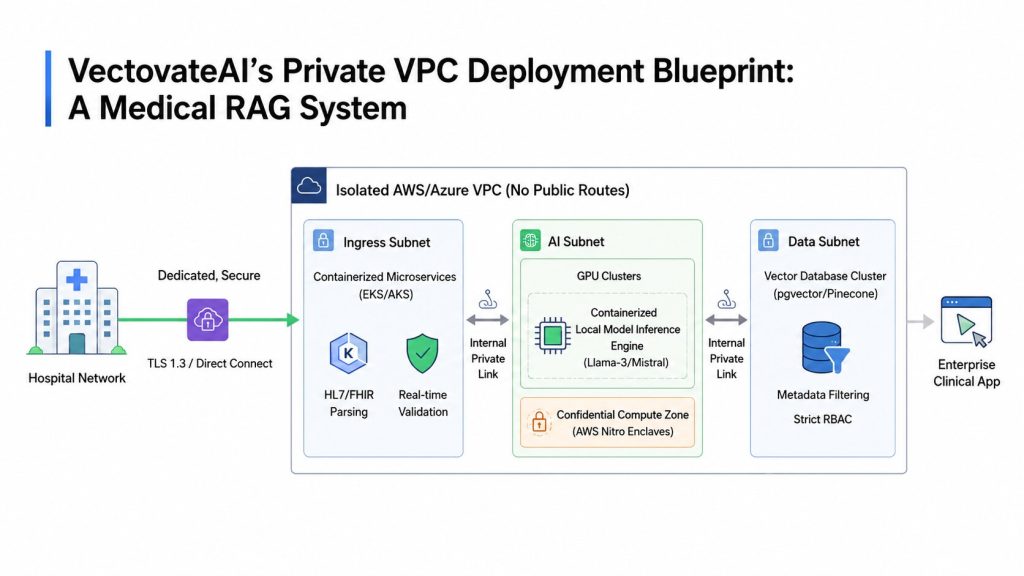
Here is the production-ready architectural blueprint for deploying an enterprise RAG system inside a private virtual cloud.
Step 1: Isolation of the Networking Subnets
The entire AI stack is built inside a custom cloud virtual private network with zero public internet routing tables. All compute nodes, GPU instances, and database clusters are assigned strictly to isolated private subnets. Data ingestion occurs through dedicated cloud interconnect pathways like AWS Direct Connect or Azure ExpressRoute combined with PrivateLink endpoints, completely bypassing public web traffic.
Step 2: Automated Microservice Orchestration
To handle the internal routing of FHIR resources securely, containerized microservices manage data translation locally within the private network loop. When a clinical application requests an AI inference, the internal service validates the user’s cryptographic security context, processes the patient payload, and interacts with the model layer via secure internal private links—ensuring zero external network hops.
7. Overcoming Enterprise Deployment Challenges
| Operational Challenge | Root Engineering Cause | Enterprise-Grade Solution |
|---|---|---|
| Legacy Incompatibility | On-premise HL7 systems struggle to interface with modern vector indexing. | Deploy containerized microservices to map, transform, and stream historical relational data into modern schemas. |
| Latency Bottlenecks | Local LLM hosting can hit severe concurrency delays under usage spikes. | Implement elastic container scaling backed by automated model quantization (e.g., FP8 or INT4 formats). |
| Data Hallucination | Unstructured medical charting contains abbreviations that lead to model inaccuracies. | Implement custom-trained medical vocabulary maps combined with strict RAG context validation steps. |
| Evolving Regulations | Global data compliance policies are continuously updated, shifting audit requirements. | Rely on modular code design configurations where data parsing and retention are handled by updateable policy scripts. |
8. Conclusion: Transitioning into an Elite, AI-Native Powerhouse
The future of enterprise medical software is defined by deep, uncompromising architectural security. While high-level software wrappers offer speed during prototyping, they introduce systemic operational vulnerabilities that cannot survive rigorous enterprise CISO or CTO technical reviews.
True engineering innovation within regulated healthcare infrastructure demands an architecture that values data ownership as highly as computational intelligence. Building scalable Cloud AI Environments for Healthcare ensures your enterprise satisfies every layer of compliance while maintaining maximum operational efficiency.
Take Control of Your AI Infrastructure Matrix
Do not allow high-level abstractions to compromise your organization’s compliance standing or expose critical IP. Transition your clinical workflows to an elite architectural standard.
Contact our core engineering team at VectovateAI today to schedule a comprehensive Private Cloud AI Feasibility Assessment. We will evaluate your existing infrastructure, map out your private VPC or on-premise hardware strategy, and design a custom, air-gapped system that keeps your high-value data exactly where it belongs: securely inside your walls.
Frequently Asked Questions.
Get all your answers here and if something remains ask our AI concierge or Book a call with our consultant.