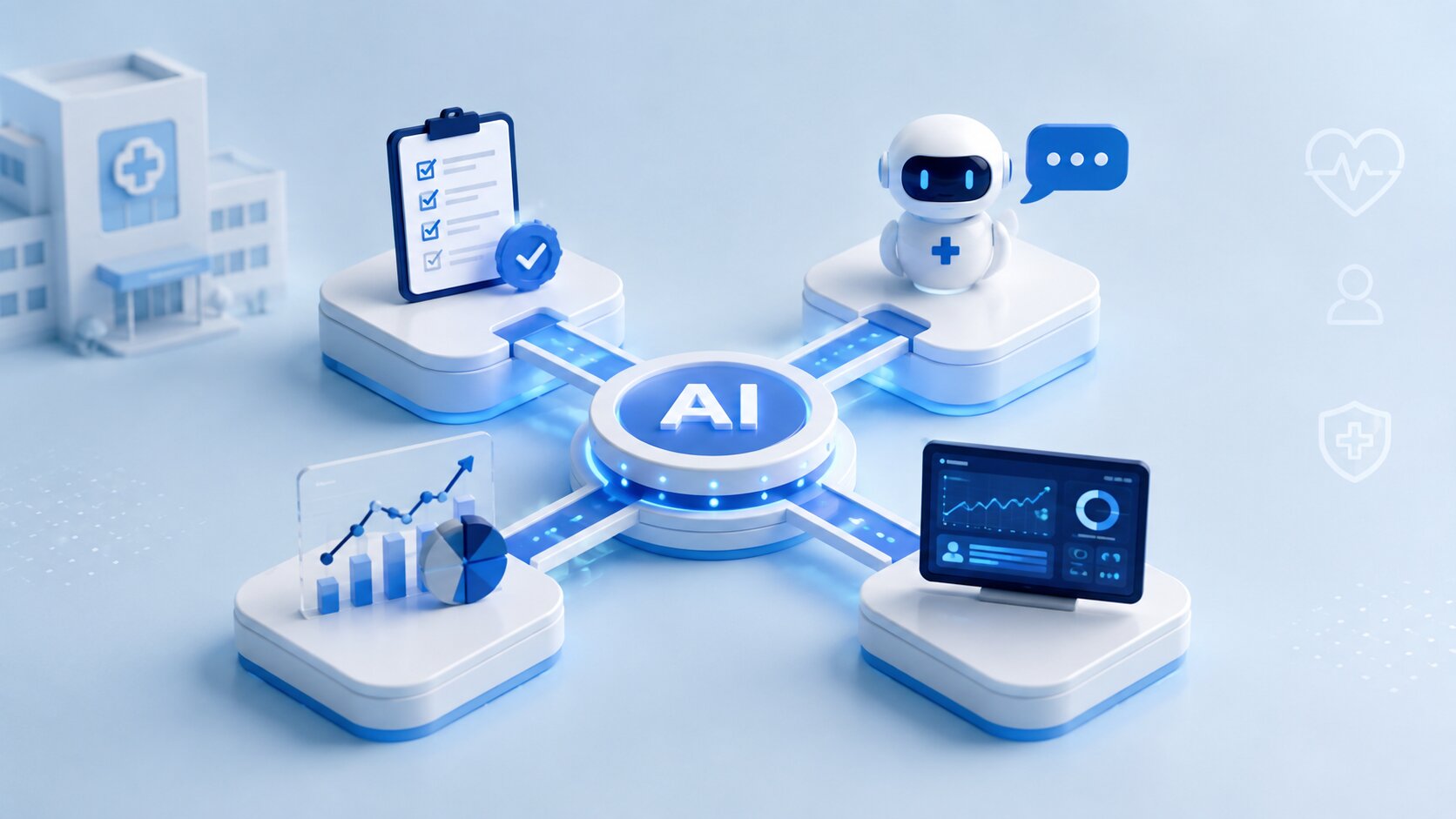
Patient Onboarding Automation: How HealthTech Platforms Cut Intake Time by 90%
New-patient intake used to take 30 to 50 minutes of forms, hold music, and repeating the same details to three staff members. Automated intake compresses that to under five. Here is what actually changes step by step, what to look for in a platform, and why human-in-the-loop exception handling is non-negotiable.

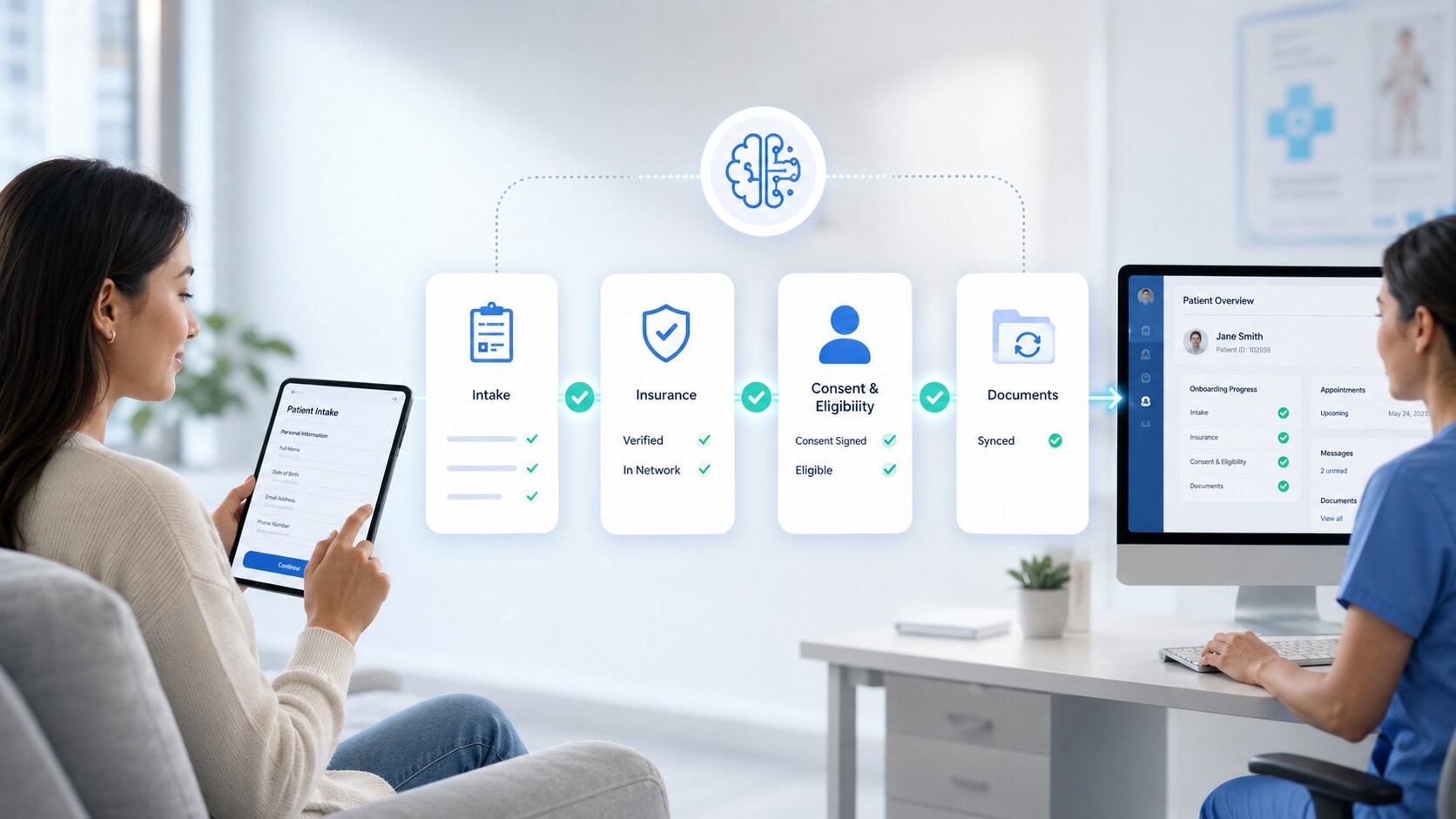
Patient onboarding automation is changing how clinics greet new patients. A new patient used to spend 30 to 50 minutes filling out forms, waiting on hold, and repeating the same details to three different staff members. Today, that same journey takes under five minutes. HealthTech platforms are proving that patient onboarding automation is no longer just an operational upgrade. It’s the primary lever to keep front-desk teams from burning out under relentless administrative overhead.
This blog breaks down exactly how healthcare process automation compresses a 45-minute ordeal into a 2-minute experience, what tools make it possible, and how your practice can start.
Key Takeaways
- Manual onboarding wastes 30 to 50 minutes per patient on forms, insurance checks, and re-typing data.
- Robotic process automation in healthcare and AI-driven intake tools cut that time by 80 to 90%.
- Automated eligibility checks reduce claim denials and speed up the revenue cycle by several days.
- The right healthcare business process automation stack combines digital intake forms, RPA bots, and EHR integration.
- Choosing a solution depends on your EHR compatibility, HIPAA compliance, and how well it handles unstructured documents.
Why Is Manual Onboarding Breaking Down?
Most clinics still run onboarding the old way. A patient walks in, fills a clipboard, and waits while a receptionist retypes everything into three separate systems. This isn’t a small inconvenience. According to LMTEQ, administrative delays in registration create an average patient throughput lag of 45% in medium to large hospitals.
The real damage runs deeper than wait times. Automating healthcare processes matters because manual intake creates:
- Fragmented data: the same patient exists in three systems with three slightly different records.
- Compliance exposure: paper consent forms get lost, and audits catch it too late.
- Revenue leakage: a missed insurance pre-authorization can cost thousands in denied claims.
- Staff burnout: front-desk teams spend their day typing instead of talking to patients.
None of this happens because staff isn’t capable. It happens because the systems around them were never built to talk to each other.
What Is Robotic Process Automation in Healthcare?
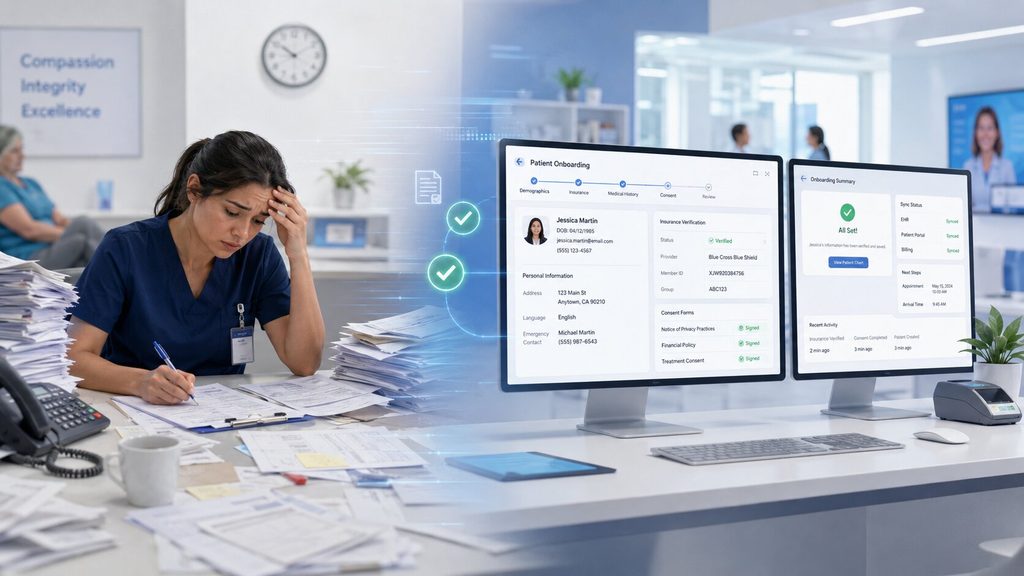
Robotic process automation in healthcare, or RPA, uses software bots to handle repetitive, rules-based tasks — the kind a human currently does by clicking through screens. Think data entry, eligibility lookups, and document routing. RPA doesn’t replace clinical judgment. It replaces the boring, error-prone parts of the job.
Layer AI on top of RPA — reading a scanned insurance card, extracting fields from a handwritten form, flagging a duplicate patient record — and you get intelligent process automation in healthcare. This combination is what actually delivers the 90% time reduction platforms are advertising.
The 45-Minute-to-2-Minute Shift: What Changes
Here’s what a typical new-patient visit looks like before and after healthcare robotic process automation enters the picture.
| Onboarding Step | Manual Process | Automated Process | Time Saved |
|---|---|---|---|
| Form filling | 10 minutes at the counter | 0 minutes (completed online pre-visit) | 10 min |
| Insurance verification | 15 minutes on phone/portal | 3–5 seconds via real-time API | ~14 min |
| Demographic data entry | 10 minutes of manual typing | 2 minutes (auto-synced from form) | 8 min |
| Scheduling confirmation | 5 minutes | 1 minute (smart matching) | 4 min |
| Consent collection | Paper chase, often incomplete | E-signature before visit, 100% completion | 1–2 min per visit at check-in |
These efficiency gains are backed by real-world clinical benchmarks. OmniMD found that AI-driven front desks cut total onboarding from 40–50 minutes down to roughly 18–20 minutes, while healthcare automation firm Gistia reports pushing patient intake from 15 minutes down to under 2 minutes by targeting the specific manual bottlenecks in a clinic’s existing workflow, without ripping out current software.
How Automated Document Processing Fixes Healthcare Claims
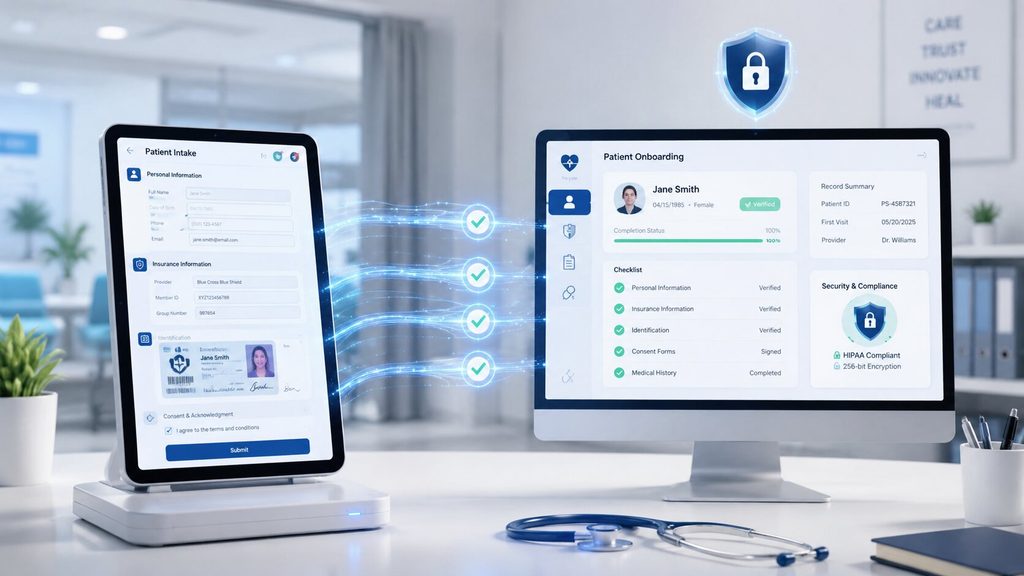
One of the most expensive bottlenecks sits between intake and billing. Automated document processing healthcare tools read insurance cards, IDs, and referral letters, then push clean, structured data straight into the EHR and billing system with no retyping required.
The downstream effect shows up fastest in automated healthcare claims processing. When eligibility gets verified the moment an appointment is booked instead of at check-in, gaps in coverage surface early, not after the visit, when it’s too late to fix. OmniMD’s data shows this kind of real-time validation can push claim rejection rates down from 12–14% to roughly 3–4%, translating into faster reimbursement and fewer write-offs for clinics running high patient volumes.
Intake and Referral Workflow Automation Healthcare Practices Actually Need
Intake and referral workflow automation healthcare systems solve a problem that’s bigger than a single clinic: coordination across departments. For specialty centers like oncology, cardiology, and transplant care, onboarding a single patient can involve labs, radiology, insurance, and multiple clinical teams.
LMTEQ’s case studies show that case-based automated workflows, triggered the moment a referral lands, can push documentation accuracy above 90% while shrinking the time to first treatment. Each department gets automatic notifications instead of waiting for a fax or a phone call, and every step gets tracked in real time so nothing falls through the cracks.
Key Features to Look For in Healthcare Process Automation Tools
Not every automation vendor solves the same problem. Before you buy, check for these key features to look for in healthcare process automation tools:
- EHR-native integration: Epic, Cerner, Athenahealth, or eClinicalWorks compatibility without custom middleware.
- HL7 & FHIR Standard Compliance: Support for HL7 v2 and FHIR standards to guarantee bi-directional data flow into custom fields without corrupting base EHR schemas.
- Real-time eligibility API checks: coverage verified in seconds, not after a phone hold.
- AI-based document reading: extracts data from insurance cards, IDs, and handwritten forms.
- Duplicate detection: fuzzy matching on name, date of birth, and insurance ID to stop split patient records before they happen.
- E-signature and consent tracking: audit-ready by default, not after a compliance scare.
- HIPAA-compliant infrastructure: encryption, access controls, and a signed BAA.
- Human-in-the-loop exception handling: bots handle the routine 90%; staff reviews the flagged 10%.
Managing Edge Cases: The Human-in-the-Loop Workflow
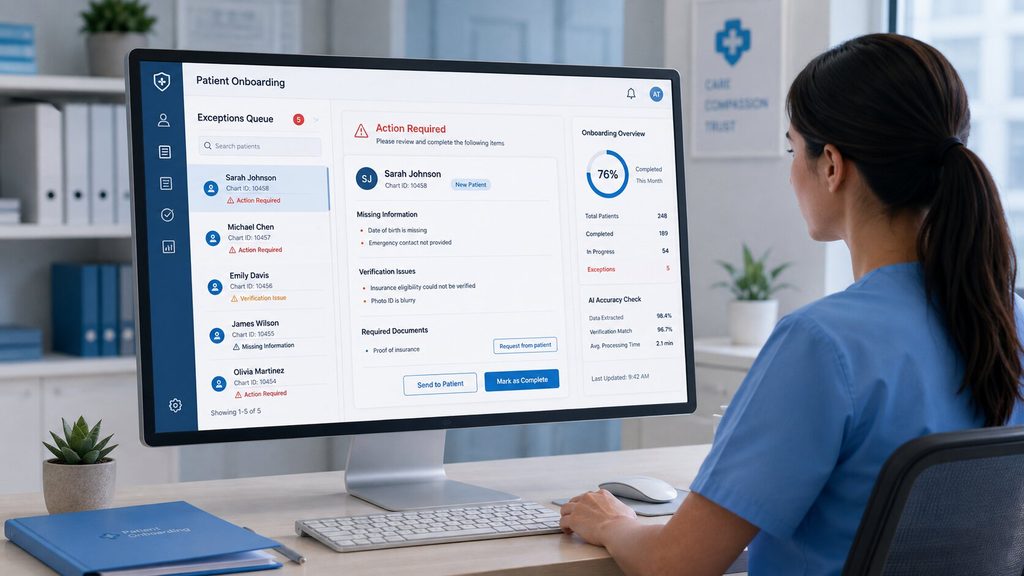
No AI model achieves 100% optical character recognition (OCR) accuracy on crumpled insurance cards or damaged IDs. High-performing automation architectures implement a Human-in-the-Loop (HITL) fail-safe:
- Confidence Scoring: The system assigns a confidence percentage to extracted fields (e.g., >95%).
- Automated Routing: Any extraction falling below the threshold gets routed to an “Exception Queue” for human review.
- Continuous Feedback: Staff corrections automatically retrain local parsing models, progressively lowering error rates over time.
Benefits of Healthcare Process Automation Beyond Speed
The time savings get all the attention, but the benefits of healthcare process automation run wider than a shorter waiting room.
| Impact Area | What Improves |
|---|---|
| Data accuracy | Manual entry averages 93–94% accuracy; automated sync pushes this above 99% |
| Staff capacity | A 30-patient clinic can recover roughly 10 staff-hours per day |
| Patient experience | Fewer repeated questions, shorter waits, higher satisfaction scores |
| Revenue cycle | Faster eligibility checks shrink billing cycle time by several days |
| Compliance | Every consent and access event is logged automatically |
None of this requires hiring more staff. It requires removing the manual steps standing between your team and the patient.
How to Choose a Healthcare Process Automation Solution
Picking the right platform isn’t about the flashiest AI demo. Here’s a practical checklist for how to choose a healthcare process automation solution that actually fits your clinic:
- Map your bottlenecks first. Don’t automate everything at once, and find where staff loses the most time (usually eligibility checks or data re-entry).
- Check integration depth. A tool that “connects” to your EHR isn’t the same as one that syncs data bidirectionally in real time.
- Ask about unstructured data handling. Can it read a messy, handwritten form or a photographed insurance card, not just a clean digital field?
- Confirm HIPAA compliance, BAA availability and zero-data-retention pipelines. This is non-negotiable for any vendor touching patient data.
- Start small, scale fast. Most successful rollouts begin with one workflow: digital intake or eligibility verification before expanding to referrals and consent management.
- Look for human-in-the-loop design. Full automation without oversight creates new risks. The best platforms flag exceptions for a human to review, not bury them.
Final Word
Patient onboarding automation isn’t about replacing your front desk. It’s about giving them back the ten hours a day they currently lose to retyping the same information three times. Clinics that adopt business process automation in healthcare aren’t just running faster. They’re building a first impression that makes patients trust the visit before it even starts.
For the scheduling half of the same intake problem, see our clinical scheduling automation case study, which cut clinical overhead and lifted efficiency by 35%.
Ready to cut your intake time? Book a Free Patient Onboarding Automation Review with VectovateAI
Frequently Asked Questions.
Get all your answers here and if something remains ask our AI concierge or Book a call with our consultant.