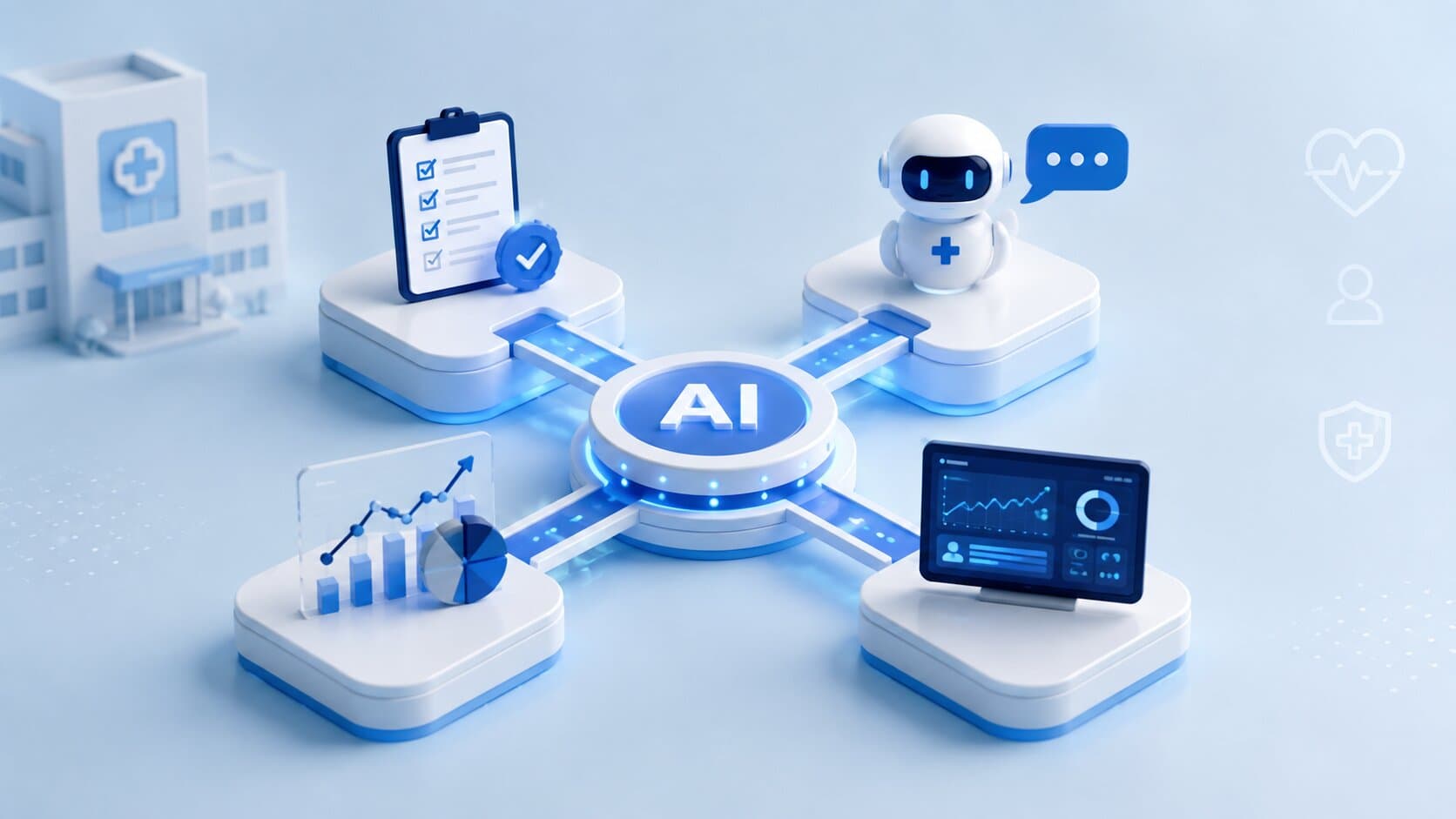
The Modern HealthTech Operating Model: Turning Patient Engagement & Operational Automation into Sustainable Growth
81% of health system leaders say their operating model is neither effective nor efficient. Fixing it means treating patient engagement automation, compliance, accessibility, and clinician adoption as one connected strategy — not four separate projects. Here is the roadmap, with the ROI numbers finance teams actually ask for.


Healthcare leaders are under pressure from two directions at once: patients expect instant, personalized care, and boards expect leaner margins and measurable ROI. The organizations solving both problems are investing in patient engagement automation as a core part of their operating model, not as a side project bolted onto an old EHR.
This shift is no longer optional. According to McKinsey‘s Provider Operating Model Survey, 81% of health system leaders say their current operating model is not effective or efficient, and 70% list operating model redesign among their top priorities, amid intensifying margin pressures and macroeconomic headwinds.
Key Takeaways
- Patient engagement automation reduces staff burden while improving adherence, satisfaction, and readmission rates.
- Healthcare operational efficiency directly affects reimbursement, CAHPS scores, and margin, not just the back office.
- Every automation layer must be built on HIPAA, SOC 2 Type II, and consent-first architecture, not patched in later.
- Automation only works if it reaches every patient, including elderly and low-digital-literacy populations, via multilingual and SMS-first fallback options.
- AI tools are becoming the default interface for patient questions, so health systems must modernize or lose the “source of truth” role.
- Automation succeeds only when clinicians trust it and change management matters as much as the technology.
- A federated operating model — governance centralized, execution local — drives the fastest gains in efficiency and quality.
What Operational Efficiency in Healthcare Means for HealthTech Growth ?
Operational efficiency in healthcare is a healthcare system’s ability to deliver consistent, high-quality care using fewer redundant processes, less manual labor, and better data. Most systems already have the technology, and what’s missing is a connected operating model.
Let’s understand the real difference between traditional and modern operating model:
| Traditional Approach | Modern Operating Model |
|---|---|
| Reactive care delivery | Preventive, proactive care |
| Manual administrative processes | AI-assisted, automated workflows |
| Disconnected patient data | Interoperable healthcare ecosystem |
| Episodic patient touchpoints | Continuous patient engagement |
| Resource-heavy scaling | Technology-enabled scalability |
| Compliance treated as an afterthought | Compliance engineered into the architecture |
Why Patient Engagement Automation Is the Growth Lever
Patients aren’t waiting for office hours to get answers. An OpenAI survey found that 60% of US adults have used AI tools for health-related questions in the past three months. Every health system is already competing with AI chatbots for patient trust. The winners aren’t banning AI—they are engineering their own compliant, AI-native engagement layer with custom event-driven pipelines so the health system stays the authoritative source.
A modern stack typically includes video microlearning for pre- and post-visit instructions, omnichannel reminders tied to clinical triggers, EHR-integrated workflows that “prescribe” education automatically, and real-time analytics flagging patients who need human follow-up, resulting in fewer inbound calls, better-prepared patients, and reduced no-shows.
Data Security, Privacy & Compliance
When we talk about patient engagement automation strategy, the first key is and should always be compliance. An enterprise-grade AI-native healthcare architecture requires these strict baseline security protocols :
- HIPAA compliance for every workflow touching Protected Health Information, including automated SMS, email, and chatbot interactions.
- SOC 2 Type II certification for any vendor or cloud infrastructure handling patient data, proving controls hold up over time.
- GDPR alignment if the health system serves EU patients or partners globally.
- End-to-end encryption for data in transit and at rest, across every automated channel.
- Granular patient consent management, so patients can opt in or out of specific communication types rather than a blanket consent.
- Signed Business Associate Agreements (BAAs) with every vendor in the stack, including AI and messaging providers.
A generic scheduling or chatbot tool that isn’t HIPAA-aware is a liability, not an efficiency gain. Self-scheduling platforms lacking a signed BAA should be disqualified immediately in vendor evaluation.
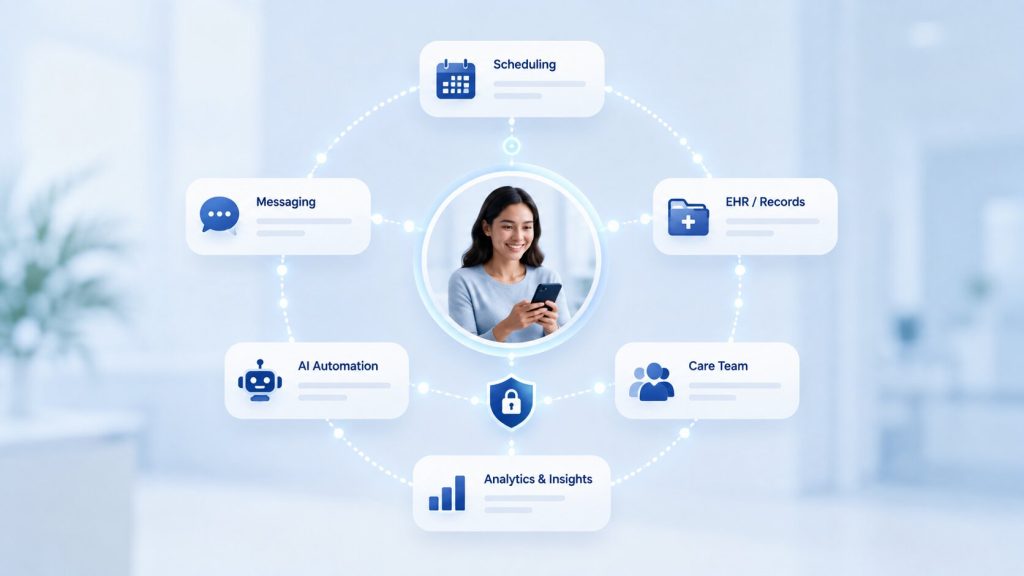
Closing the Digital Divide: Accessibility for Every Patient
Automation and AI chatbots only create value if every patient can use them. A meaningful share of the population elderly patients, rural populations, people with low digital literacy won’t download an app or navigate a complex portal.
An inclusive patient engagement automation flow should include multi-language support, SMS fallback requiring no app or login, WCAG accessibility standards, and phone-based options for patients uncomfortable with text tools. Equity isn’t a “nice to have”, it determines whether automation reduces call center load or shifts the burden onto the patients least equipped to handle it.
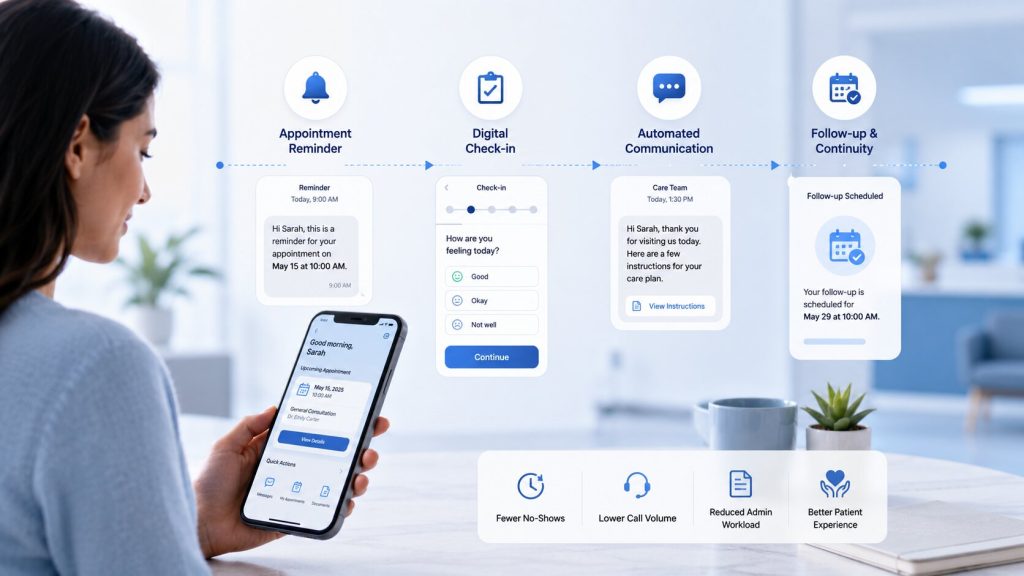
Importance of Healthcare Product Engineering
None of this works without the right engineering foundation. Healthcare product engineering is the discipline of designing software, integrations, and data pipelines that make automation safe, compliant, and scalable. Most engagement failures aren’t caused by bad ideas.
They’re caused by weak product engineering: brittle EHR integrations, siloed databases, and automation layered on broken workflows, which simply scales the inefficiency.
The Real-World EHR Integration Challenge
Interoperability sounds simple on a slide. In production, it’s the hardest part of any digital health product development project.
Legacy platforms like Epic, Cerner, and Athenahealth each expose data differently. Their engineering teams routinely face inconsistent API implementations, rate limits, data mapping mismatches, and gaps between sandbox and production behavior.
The teams that succeed treat EHR integration as its own product workstream, with dedicated data mapping and monitoring, rather than a one-time task to “get connected and move on.”
Digital health product development needs a different mindset than typical enterprise software. It requires interoperability first with HL7/FHIR as the foundation, human in the loop design where AI drafts and flags but a clinician confirms anything touching a care decision, and an AI-Native, agent first architecture where specialized AI agents handle scheduling, education, and follow up with narrow, auditable responsibility.
This is exactly how VectovateAI’s software engineering team is approaching healthtech builds in 2026.
Why Does Clinician Adoption Make or Break Automation?
The most common reason a well-built automation platform fails is the staff resistance. Clinicians have been burned before by tools that promised to save time and instead added another screen to click through.
A matched-control study at UChicago Medicine found clinicians using ambient AI documentation spent 8.5 percent less total time in the EHR, with over a 15 percent drop in time spent composing notes, multiple recovered hours per week for a clinician seeing 20 patients a day.
Automation removes the charting fatigue that pulls doctors and nurses away from patient care. Health systems that lead with this message and involve clinicians in tool selection see far higher adoption than those that mandate a tool top-down.
Tangible ROI: The Numbers Finance Teams Actually Want to See
| Metric | Reported Impact |
|---|---|
| No-show rate reduction (automated reminders) | 25% to 38% reduction in missed appointments |
| No-show reduction (AI-powered scheduling) | Up to 42% reduction, outperforming manual reminders |
| Inbound call center volume | Up to 50% drop after online self-scheduling |
| Clinician burnout (30-day ambient AI pilot) | Dropped from 51.9% to 38.8% |
| Documentation time in the EHR | 8.5% less total time, 15%+ less time composing notes |
| Cost per missed appointment | ~$200, scaling to $67,000+ per physician annually |
There’s also an indirect lever worth flagging for CFOs: reduced 30-day readmissions. CMS penalizes hospitals financially for excess readmissions under the Hospital Readmissions Reduction Program, so every improvement in post-discharge engagement and follow-up communication has a direct line to avoiding those penalties, on top of the savings above.
Healthcare Operational Efficiency in Practice
AI operational efficiency healthcare initiatives tend to succeed or fail based on governance, not technology. Chartis research found that a product-based structure, with a dedicated product manager owning a workflow in short agile cycles, consistently outperforms the traditional project-based IT model.
| Metric | Example Target |
|---|---|
| User satisfaction | Up to 20% improvement through faster request handling |
| Development speed | Up to 25% reduction in project duration |
| Incident resolution | Up to 30% faster mean time to resolve |
| Internal revenue impact | Up to 15% increase from improved product use |
The lesson for anyone evaluating healthcare operational efficiency tools is simple: the tool matters less than the operating model, compliance posture, and staff buy-in around it. A brilliant platform inside a fragmented governance structure will still underperform.
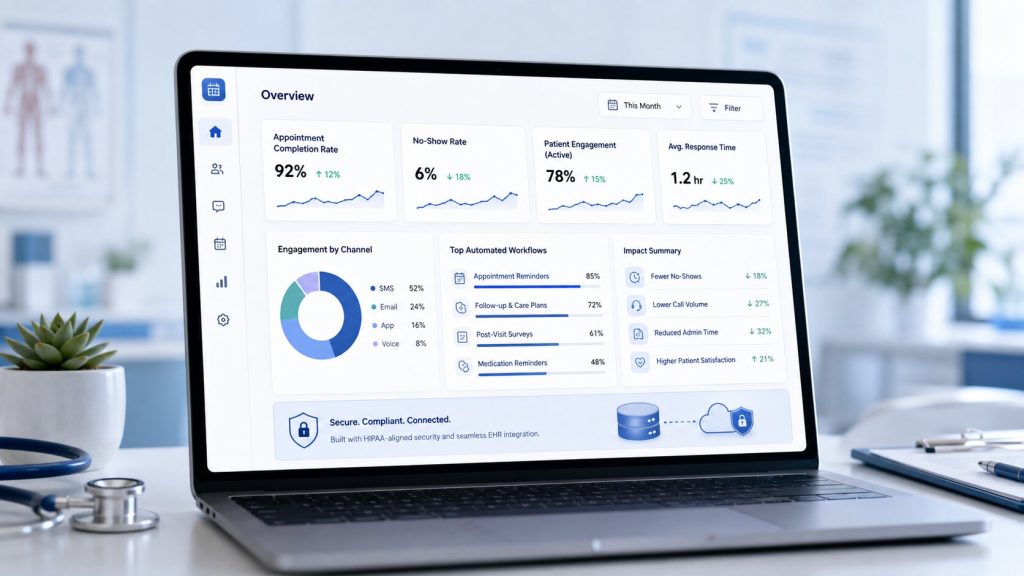
A Practical Roadmap to Improve Operational Efficiency in Healthcare
For teams asking how healthcare systems can improve operational efficiency through technology, the answer is a phased, deliberate rollout rather than a big-bang transformation.
Step 1: Audit before automating:
Map current workflows, staff burden, compliance gaps, and patient drop-off points before choosing any tool.
Step 2: Build the compliance layer first:
Confirm HIPAA readiness, SOC 2 Type II status of vendors, and consent management before a single automated message goes live.
Step 3: Centralize standards, localize execution:
McKinsey‘s research shows leading health systems are moving toward a federated model: governance, data standards, and shared services stay centralized, while day-to-day care delivery stays local. This approach has allowed systems to capitalize on AI solutions at scale across HR, finance, and other relevant departments while avoiding one-size-fits-all implementation at the facility level
Step 4: Automate the highest-friction touchpoints first, with accessibility built in:
Discharge instructions, appointment reminders, and pre-op education usually deliver the fastest ROI, but only if multilingual and SMS fallback options are included from day one.
Step 5: Bring clinicians in early:
Pilot with a small group, gather feedback, and communicate clearly that the goal is reducing charting fatigue, not replacing judgment.
Step 6: Measure clinical, operational, and financial outcomes together:
Track readmissions, CAHPS scores, no-show rates, call volume, and CMS penalty exposure side by side. One number alone tells an incomplete story.
Conclusion
The health systems that lead in the next few years will be the ones treating patient engagement automation, operational efficiency, compliance, accessibility, and clinician adoption as one connected strategy.
The ideal software is the one that is agent-first where it makes sense, human-in-the-loop where it matters, and grounded in disciplined software engineering that turns a good idea into a system patients and providers can trust.
The operating model above starts with AI integration into the systems clinicians already use. Our clinical scheduling automation case study shows the result: 35% higher clinical efficiency. The 4-pillar AI framework for HealthTech operations breaks the same model into build steps.
Ready to build a patient engagement and automation strategy that’s secure, accessible, and clinician-approved from day one? Talk to our healthcare product engineering team today.
Frequently Asked Questions.
Get all your answers here and if something remains ask our AI concierge or Book a call with our consultant.