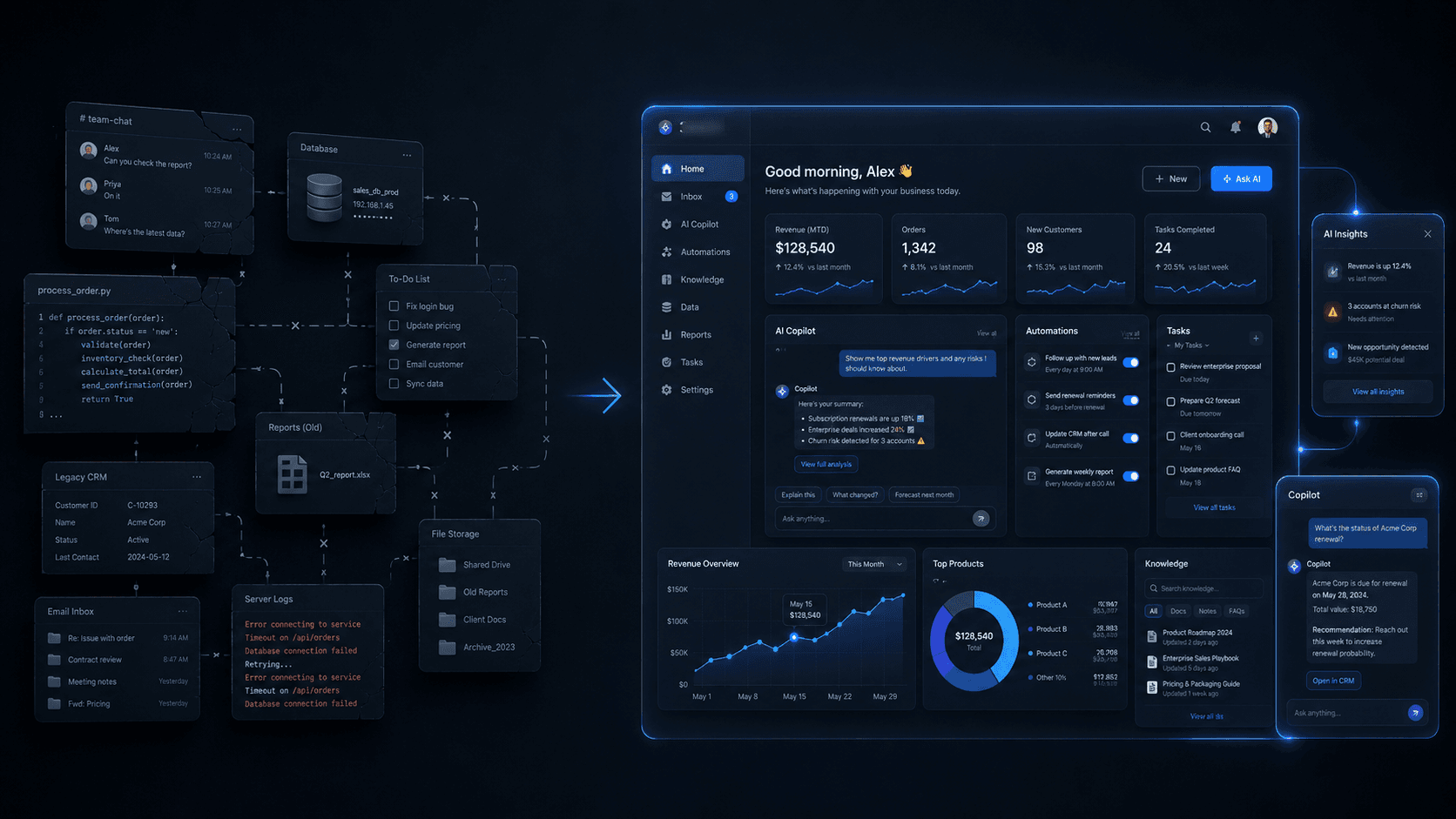
AI-Powered Web Development: How Generative Engineering Ships Production Software 2x Faster
Generative software engineering is not “AI writes your code.” It is AI across the whole lifecycle, with senior engineers reviewing every output. Here is where the 2x speed actually comes from, the trap nobody mentions, and the exact questions a CTO should ask before signing with an AI development partner.

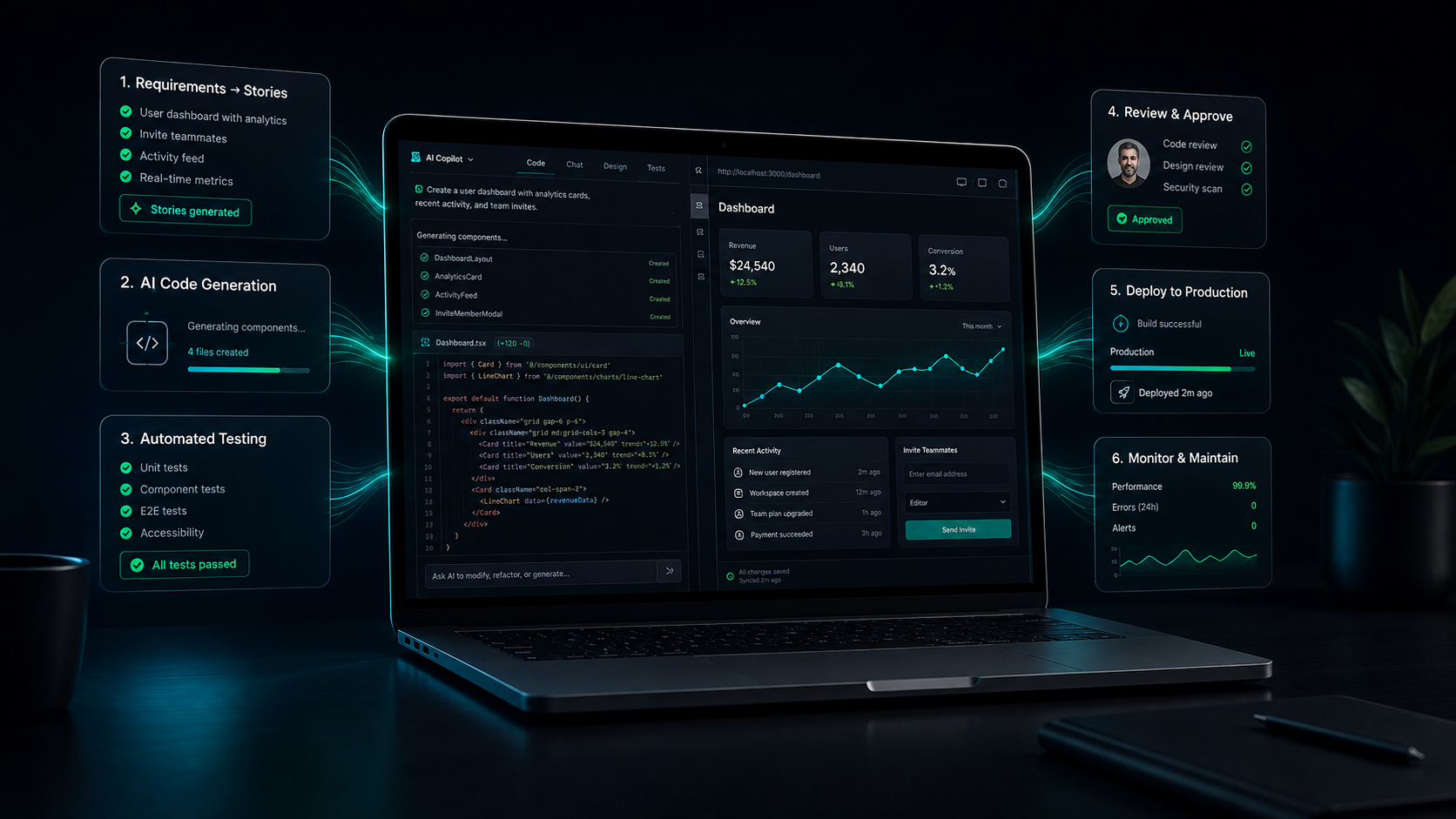
AI-powered web development is the fastest route from an idea to a shipped product. Businesses that adopt it are cutting release cycles in half. Developers who use it well are shipping cleaner code, faster.
This shift has a name: generative software engineering. It blends AI code generation, automated testing, and human oversight into one workflow. The result is production-grade software that ships in weeks, not months.
If you are a founder or a CTO trying to understand this shift, this guide breaks it down. It also tells you exactly what to look for when picking an AI development partner for your next project.
Key Takeaways
- AI-powered web development can cut delivery timelines by 2x to 5x when paired with strong human review.
- Generative AI now touches every stage of the software development lifecycle, from requirement gathering to deployment.
- Speed without oversight is risky. AI-generated code still needs senior engineering judgment before it ships.
- The right AI development partner depends on your use case: MVP building, enterprise agents, healthcare compliance, or computer vision.
- Ahmedabad’s engineering talent pool is becoming a serious hub for agent-first, human-in-the-loop software delivery.
- VectovateAI’s Engineering Team in Ahmedabad provides an agent-first, human-in-the-loop framework built for global scalability.
What Generative Software Engineering Actually Means
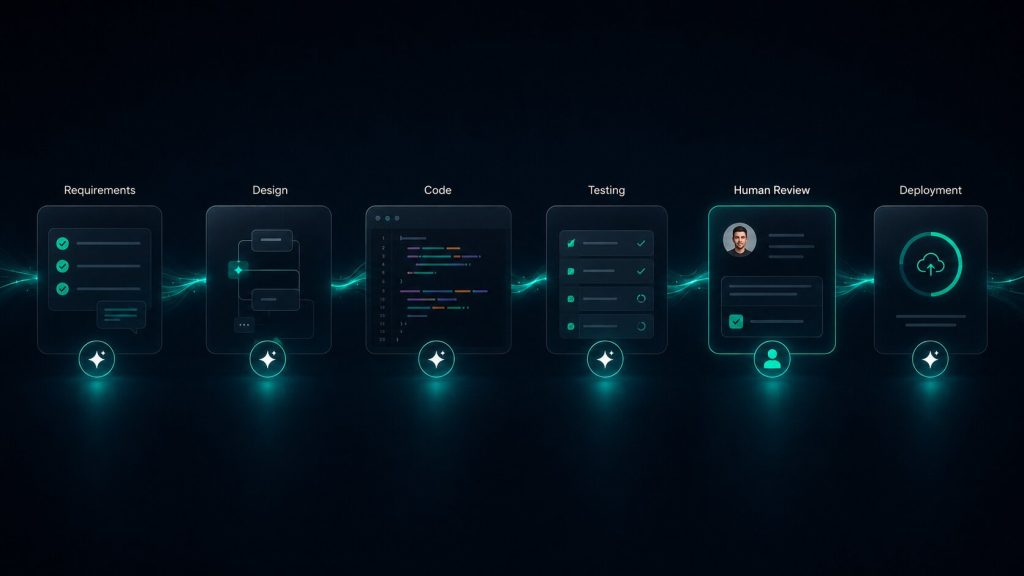
Generative software engineering is not just “AI writes your code.” It is a full-cycle transformation of how software gets built.
Modern AI tools now assist across the entire lifecycle: requirement gathering, design, coding, testing, deployment, and maintenance. Generative AI transforms ideas into requirements, then converts those requirements into user stories, test cases, code, and documentation, all while working alongside human developers.
According to forecasts by Gartner, over 80% of enterprise software engineering teams will integrate generative AI and agentic workflows into their core development lifecycle by 2026.
This is the core idea behind AI product engineering. Instead of treating AI as an autocomplete tool, teams treat it as a collaborator across the whole build process, from architecture decisions to final QA.
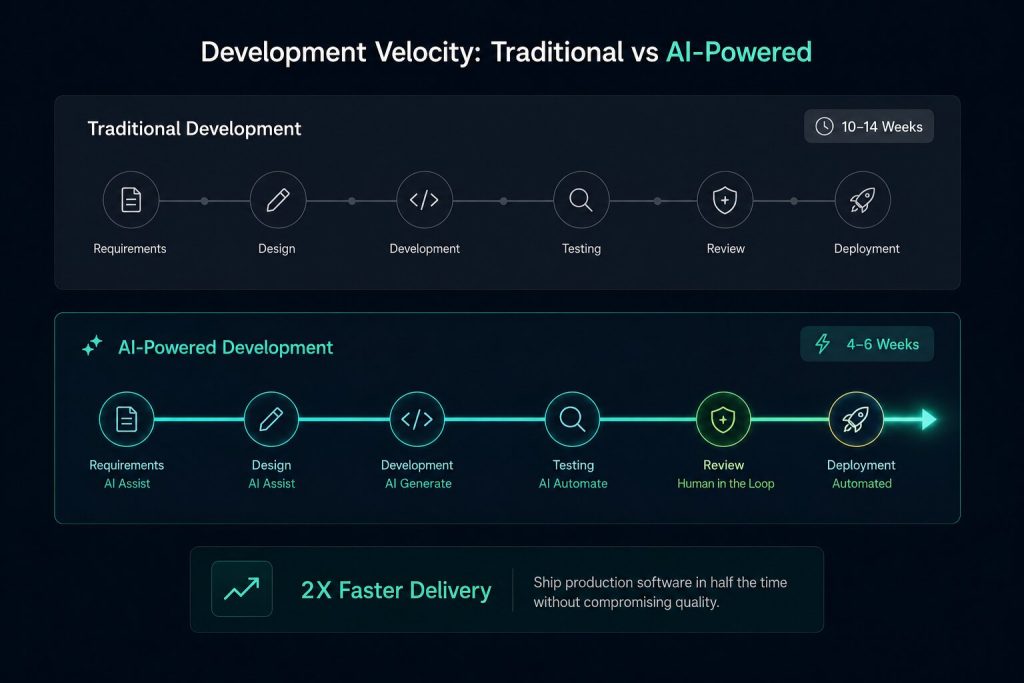
Why AI-Powered Web Development Ships Software 2x Faster?
The speed gain is not hype. It comes from removing friction at every stage.
Empirical research by GitHub and MIT demonstrates that developers using generative AI workflows complete software engineering tasks 55.8% faster than those using traditional manual methods.
Teams using AI-powered coding tools report productivity gains of 2 to 5 times when compared to traditional workflows. A task that once needed a full workday now takes hours.
Here is where the time actually gets saved:
| Development Stage | Traditional Timeline | AI-Powered Timeline |
|---|---|---|
| Requirement to spec | 3-5 days | Same day |
| Boilerplate coding | 2-3 days | Few hours |
| Test case writing | 1-2 days | Minutes to hours |
| Documentation | 1 day | Auto-generated, reviewed same day |
| Bug detection | Ongoing manual QA | Continuous, real-time |
AI tools accelerate coding, reduce human error, and free developers to focus on complex and creative tasks, while AI-driven testing systems generate adaptive test cases and prioritize the most critical ones.
This is why generative software engineering is becoming the default approach for teams that need to ship fast without sacrificing quality.
The Trap Nobody Talks About: Speed Without Understanding
Faster is not always better. This is the part most agencies skip when they pitch AI development.
A developer who documented months of real AI-assisted coding put it plainly: the risk is not that AI writes bad code. The real risk is that AI generates code that looks correct, compiles, and passes basic tests, but quietly encourages the developer to stop thinking.
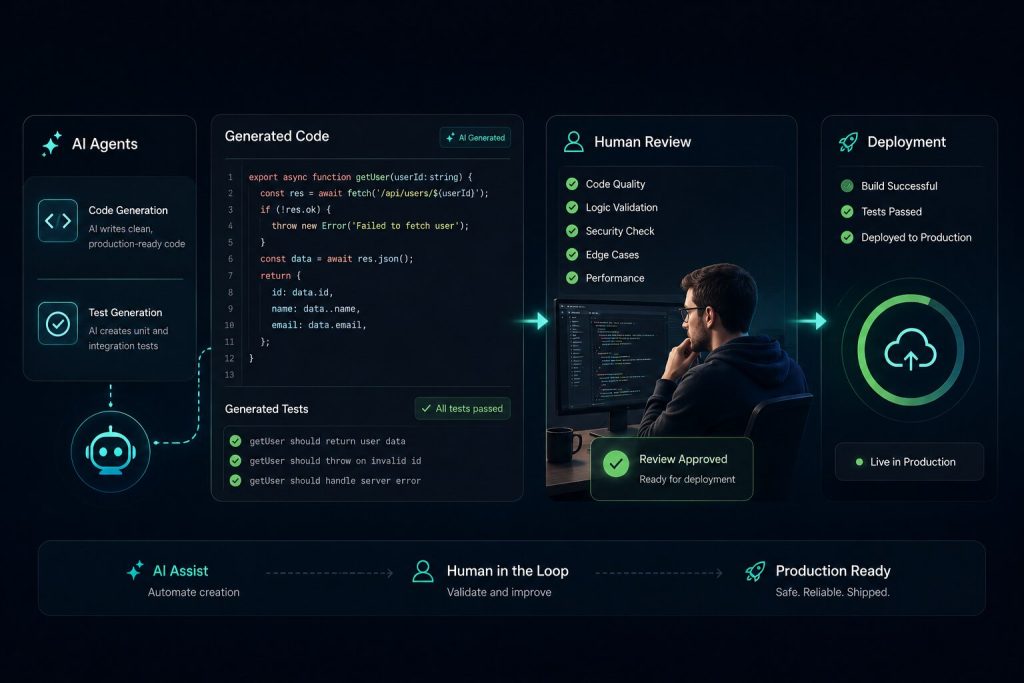
This is exactly why human-in-the-loop review is not optional. It is the difference between an AI development partner who ships fragile code fast, and one who ships resilient production software fast.
AI is also confidently wrong at times. However, peer-reviewed research from Purdue University shows that over 52% of unvetted AI code outputs contain incorrect logic or security vulnerabilities, making senior engineer oversight critical.
It can suggest insecure implementations, outdated libraries, or architectures that fail under real traffic. Senior engineering judgment catches what AI misses. That judgment is what you are actually paying for when you hire an AI development partner.
How to Choose an AI Development Partner?
Not every AI vendor is built for every use case. Here is what to look for, based on what you are trying to build.
| Your Situation | What to Prioritize |
|---|---|
| Creative agency looking for AI development partner | Fast prototyping, design-to-code speed, flexible sprints |
| Criteria for selecting healthcare app development partner AI ML | HIPAA-aware architecture, model explainability, audit trails |
| AI agent development partner for enterprise operations | Workflow orchestration, system integrations, governance controls |
| AI MVP development partner | Lean team, quick iteration, cost-conscious tech stack |
| AI development partner for computer vision | Dataset engineering experience, model tuning, edge deployment know-how |
What to Look for in an AI Development Partner?
Whether you are a founder or a technical decision-maker, use this checklist before signing any contract:
- Proven delivery, not just demos. Ask for a working production case, not a proof of concept.
- Human-in-the-loop process. Every AI-generated module should go through senior review before deployment.
- Transparent AI usage. They should tell you clearly where AI wrote code and where humans did.
- Security-first mindset. AI-generated code needs the same security audits as human-written code.
- Domain fit. A team strong in fintech may not be right for healthcare or computer vision work.
CTO AI Development Partner Evaluation Framework
If you are a CTO evaluating an AI development partner, go beyond the sales pitch. Ask these direct questions:
- What percentage of your delivered code is AI-generated versus human-reviewed?
- How do you handle AI hallucinations in production-critical logic?
- Can you show a rollback plan if an AI-generated module fails in production?
- What is your testing coverage strategy for AI-assisted code?
- How do you train your engineers to review AI output critically, not just accept it?
How to Choose an AI Strategy Development Consulting Partner?
If your need is broader than one project, meaning you want an ongoing AI strategy development consulting partner, look for a team that can do three things well: assess your current tech debt, map a realistic AI adoption roadmap, and staff the roadmap with engineers who actually build, not just advise
How to choose an AI strategy development consulting partner comes down to one test: can they show you a live system where AI and human engineers work together on the same codebase, today, not just in a pitch deck.
Building Software the Right Way: Agent-First, Human-in-the-Loop
Most agencies market AI speed alone. That is an incomplete pitch.
The stronger model is agent-first, human-in-the-loop. AI agents handle the repetitive, high-volume work: generating boilerplate, drafting test suites, flagging vulnerabilities, and writing first-pass documentation. Human engineers handle architecture, security review, and the judgment calls that decide whether software actually survives contact with real users.
This is also where VectovateAI’s engineering talent pool in Ahmedabad comes in. The city has quietly built a strong base of engineers who combine deep technical fundamentals with hands-on AI tooling experience. That combination, technical rigor plus AI fluency, is exactly what generative software engineering demands.
Real-world teams are already proving this model works: solo founders are combining AI tools to cut build timelines from six months down to a few weeks, while agencies are launching client-ready websites in about 48 hours. The gains are real when the process includes proper review, not blind acceptance of AI output.
Final Word
AI-powered web development is not about replacing engineers. It is about giving good engineers a faster path to production, and giving bad shortcuts nowhere to hide.
If you are evaluating an AI development partner, whether for an MVP, an enterprise AI agent system, a healthcare application, or a computer vision product, judge them on their review discipline as much as their speed. The partners who last are the ones who ship fast without ever letting AI think alone.
See what this looks like at scale in our AI-native architecture case study, where a global travel aggregator reached 80% efficiency, and read why bolted-on AI fails where AI-first builds hold up.
Ready to ship production software faster without losing review discipline? Book a Free AI Engineering Review with VectovateAI
Frequently Asked Questions.
Get all your answers here and if something remains ask our AI concierge or Book a call with our consultant.