
The Death of the ‘Standard’ Policy: Generative AI for Behavioral Underwriting & Real-Time Pricing
Generative AI is ending the era of standard, one size fits all insurance policies by enabling real time behavioral underwriting, telematics based pricing, and instant parametric payouts, though insurers must pair this precision with explainability and human oversight to avoid regulatory and ethical pitfalls.


The “one-size-fits-all” insurance policy is dying fast. Insurers built flat pricing on outdated actuarial tables. Today’s customers expect pricing tied to their real behavior. Generative AI insurance models now read data instantly. They convert raw signals into fair, personalized premiums. This shift isn’t hype anymore. It’s the new baseline for competitive insurers.
This blog breaks down how behavioral underwriting actually works. We’ll explore dynamic pricing models, telematics underwriting, and real-time premium adjustment. We’ll also cover the ethics nobody wants to skip.
Key Takeaways
- Behavioral underwriting replaces static rating factors with live behavior data.
- LLM-driven underwriting cuts document processing time by up to 70%, per SmartDev’s underwriting research.
- Usage-based insurance models can reduce claims costs by roughly 20% through better risk segmentation.
- Parametric insurance and policy customization AI are converging into instant, event-triggered payouts.
- Regulators are watching closely. AI risk segmentation must stay explainable, or insurers face compliance risk.
- Hyper-personalization insurance only works when human underwriters stay in the loop.
Why “Standard” Policies No Longer Make Sense
For decades, insurers grouped people into broad risk buckets. Age, ZIP code, and occupation determine your premium. Two safe drivers in the same city often paid identical rates. That model ignored actual behavior completely.
Generative AI changes this equation entirely. It reads unstructured data at scale. Wearables, telematics, and IoT sensors feed live signals. According to V7 Labs’ insurance report, insurance sector spending on generative AI jumped sharply between 2023 and 2024. That’s production money, not pilot budgets.
Insurers now build pricing around individual conduct. This is the foundation of true behavioral underwriting.
How does Generative AI Power Behavioral Underwriting?
Traditional predictive models output a single risk score. Generative models do far more. They read policy wordings, medical notes, and driving logs together. Then they generate context, not just numbers.
This matters for LLM-driven underwriting specifically. An underwriting agent can cross-reference five years of claims history in seconds. It flags inconsistencies human reviewers might miss. SmartDev notes that machine learning models have improved risk prediction accuracy by roughly 25% versus traditional actuarial approaches.
Here’s what changed in the underwriting workflow:
| Traditional Underwriting | AI-Driven Behavioral Underwriting |
|---|---|
| Static demographic rating factors | Live behavioral and telematics data |
| Manual document review (days) | Automated extraction (minutes) |
| Annual policy repricing | Real-time premium adjustment |
| Broad risk pools | Individual AI risk segmentation |
| Rule-based flags | Context-aware anomaly detection |
Underwriters aren’t disappearing here. They’re shifting toward judgment calls. Routine data entry gets fully automated. Complex, borderline cases still need humans.

Telematics Underwriting and Usage-Based Insurance
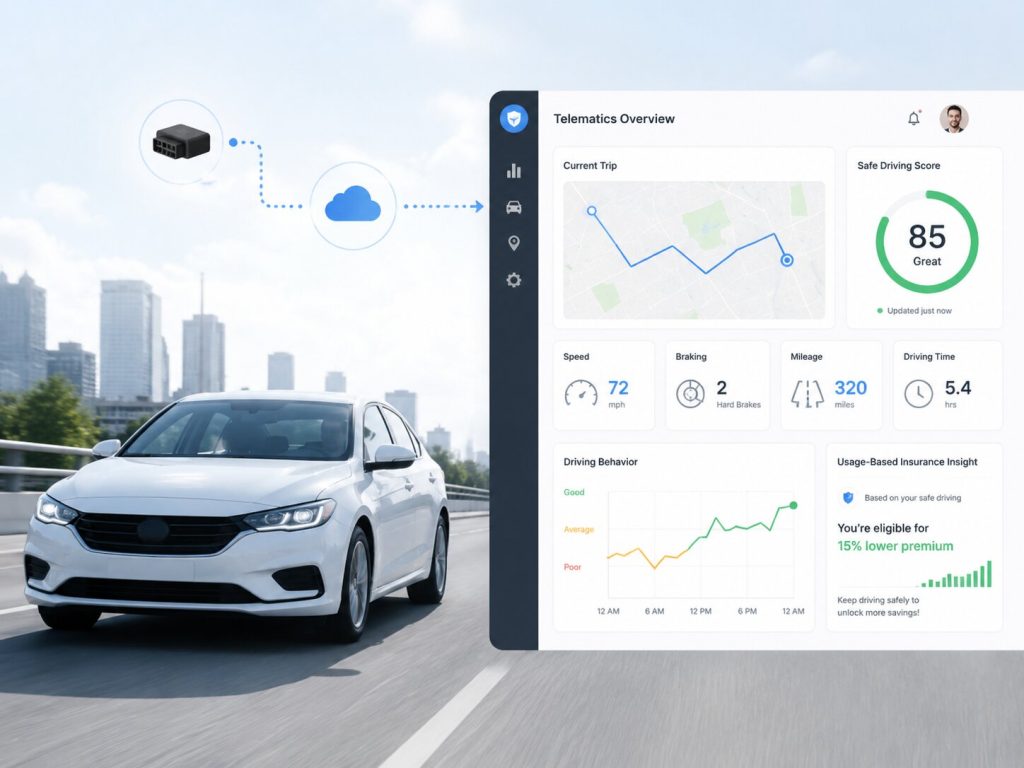
Telematics underwriting is where behavioral pricing became mainstream first. Auto insurers track speed, braking, and driving frequency. GPS devices and mobile apps capture this data continuously. Premiums then adjust based on actual habits.
SmartDev’s industry data shows insurers using telematics-based models. They’ve reduced claims costs by around 20%. Better risk segmentation drives this improvement directly.
Usage-based insurance now extends beyond cars, too. Health insurers use wearable data for premium discounts. Home insurers use smart sensors for leak detection. Each data stream feeds the same core engine: continuous risk reassessment.
This is fundamentally different from annual renewals. A driver’s premium can shift monthly now. Someone improving their habits sees savings faster. That’s the promise of dynamic pricing models done right.
Real-Time Premium Adjustment and Parametric Insurance
Real-time premium adjustment requires infrastructure most insurers lack today. It needs constant data ingestion pipelines. It also needs generative AI to interpret that data instantly. Static rules simply can’t keep pace with live signals.
Parametric insurance takes this further still. Instead of assessing damage after a loss, parametric products trigger automatically. A specific weather event or metric crosses a threshold. Payout happens without a lengthy claims process. Generative AI drafts the policy logic and monitors trigger conditions simultaneously.
Combine this with policy customization AI, and coverage becomes modular. Customers adjust limits, deductibles, and riders dynamically. Pricing recalculates instantly behind the scenes. This is hyper-personalization insurance at its most literal.
AI Risk Segmentation: The Precision Advantage
AI risk segmentation goes beyond simple demographic buckets. It clusters customers by genuine behavioral similarity. Two people with identical ZIP codes can land in completely different risk tiers now.
This precision benefits both sides, actually. Low-risk customers stop subsidizing high-risk ones unfairly. Insurers improve loss ratios through sharper pricing. V7 Labs reports that underwriting error rates dropped roughly 28% among AI-adopting insurers.
But precision segmentation carries real risk too. Overly granular models can drift toward discrimination. This brings us to the section every insurer must read carefully.

Regulatory and Ethical Considerations in Behavioral Pricing
Behavioral pricing sits in genuinely dangerous territory. Granular data can easily encode proxy discrimination. A model trained on biased historical claims data inherits that bias. This isn’t theoretical anymore; regulators are actively scrutinizing it.
SmartDev’s underwriting guide points to a real concern. Certain demographic groups face disproportionate impact from flawed AI models. If training data reflects past discrimination, the algorithm repeats it. Insurers must audit constantly, not just at launch.
Three regulatory pillars matter most right now:
- Explainability: Every pricing decision needs a clear, documented reason. “The algorithm decided” won’t satisfy any regulator.
- Auditability: All behavioral inputs and adjustments must be logged. Regulators need a full trail on demand. Partnering with an AI strategy and consulting team ensures readiness for HIPAA, GDPR, and SOC 2 from day one.
- Human oversight: High-stakes pricing decisions need human sign-off. AI should recommend, never fully replace, judgment.
Frameworks like GDPR already mandate explanations for automated decisions. The EU’s AI Act adds further scrutiny for high-risk use cases. Insurers operating in Dubai, India, or the US face overlapping expectations here. Building governance-as-code from day one avoids painful retrofits later.
Ethical AI isn’t a compliance checkbox either. It’s the foundation of long-term customer trust. Insurers that get this wrong lose their license to operate.
Challenges in Adopting Real-Time Behavioral Pricing
Real-time pricing sounds simple on paper. Execution is genuinely difficult for most insurers. Legacy systems weren’t built for continuous data streams. Retrofitting them takes real time and money.
Here are the biggest hurdles insurers actually face:
- Legacy infrastructure: Most core policy systems run on decades-old architecture. Nearly 65% of insurance firms cite legacy constraints as their top digital transformation barrier, per SmartDev’s analysis.
- Data fragmentation: Telematics, wearables, and claims data often sit in separate silos. Unifying them requires serious data engineering work.
- Model drift: Behavioral models degrade as customer habits change. Continuous retraining and monitoring become mandatory, not optional.
- Customer trust: Many customers still distrust constant behavioral tracking. Clear consent flows and transparency reduce this friction significantly.
- Talent gaps: Few teams combine actuarial expertise with generative AI skills. This combination is rare and expensive to hire.
None of these challenges are dealbreakers, though. They’re implementation details, not blockers. Insurers who plan for them upfront move faster later.
What This Means for IT Leaders and Decision-Makers
If you’re building or buying an underwriting platform, prioritize transparency first. Choose vendors offering explainable AI by design. Avoid black-box scoring systems entirely, regardless of accuracy claims. Our Finance & Insurance practice has seen this shift firsthand across multiple carriers.
For IT students and engineers entering this space, this is a growth frontier. LLM-driven underwriting, parametric insurance, and behavioral pricing engines need serious talent. Understanding both machine learning and regulatory frameworks gives you a real edge.
For business owners, the calculus is straightforward now. Standard policies are becoming commercially unviable. Customers expect pricing reflecting their actual risk. Competitors already offering real-time premium adjustment will win that customer. Personalized policy pricing isn’t a future trend anymore. It’s today’s competitive baseline.
See how this played out in our insurance claims automation case study, where automation cut operational costs by 65%.
Contact VectovateAI for Generative AI Development Services
Building a compliant, scalable behavioral underwriting engine isn’t simple. It requires deep expertise in generative AI, data pipelines, and insurance regulation. VectovateAI specializes in exactly this intersection.
We build LLM-driven underwriting systems with explainability baked in from the start. Our approach keeps humans firmly in the loop. We combine agent-first architecture with rigorous governance-as-code practices.
Whether you need telematics underwriting integration, dynamic pricing models, or full parametric insurance automation, our team can architect it. We design for regulatory scrutiny, not just technical performance.
Reach out to VectovateAI today to discuss your generative AI roadmap. Let’s build underwriting systems that are fast, fair, and future-ready.
Conclusion
The “standard” policy isn’t coming back anytime soon. Customers now expect pricing tied to real behavior. Generative AI insurance makes that expectation technically achievable finally.
But speed alone isn’t the goal here. Behavioral underwriting, real-time premium adjustment, and AI risk segmentation must stay explainable and fair. Insurers who balance innovation with governance will win long-term trust. Those who chase speed alone risk regulatory backlash fast.
The winners in this next decade will combine three things. Strong AI infrastructure, human oversight, and genuine ethical discipline. That combination defines the future of insurance pricing.
Frequently Asked Questions.
Get all your answers here and if something remains ask our AI concierge or Book a call with our consultant.