
AI in Oil & Gas: Transforming Exploration and Production
A dry well costs tens of millions. Here is how AI in oil and gas cuts that risk across exploration, predictive maintenance, and production optimization.


A single dry well can cost an oil and gas company tens of millions of dollars. For decades, that risk was just the cost of doing business.
AI in oil and gas is rewriting that equation. Sensors that once just logged data now predict equipment failure months in advance. Models that once took geologists weeks to build now generate accurate subsurface maps in days.
The companies moving fastest on this aren’t chasing hype; they’re chasing uptime, margin, and safety, and the results are showing up on their balance sheets. This shift in AI in oil and gas industry thinking is no longer optional for operators who want to stay competitive.
This blog breaks down how AI for oil and gas works across exploration, drilling, and production, what results real companies are seeing, and where the industry is headed next.
Key Takeaways
- AI in oil and gas exploration cuts seismic interpretation time from months to weeks and improves the accuracy of drilling targets.
- AI predictive maintenance systems can forecast equipment failures 60 to 120 days in advance, reducing unplanned downtime.
- IBM research shows oil and gas executives report a 27% improvement in production uptime and a 26% improvement in asset utilization through AI adoption.
- BCG projects that AI-first oil and gas companies could see a 30% to 70% increase in EBIT over the next five years.
- Generative AI use cases in the oil and gas industry now extend beyond exploration into supply chain forecasting, compliance reporting, and reservoir modeling.
- Full-scale AI adoption still faces hurdles: legacy SCADA systems, workforce upskilling, and data silos remain the biggest blockers.
What Is Generative AI in Oil and Gas Exploration?
In this context, what is Generative AI in oil and gas exploration refers to AI models that don’t just analyze data; they generate insights, simulations, and predictions from it. Instead of engineers manually interpreting thousands of seismic readings, generative models process massive geological datasets and produce probable subsurface maps in a fraction of the time.
This matters because exploration has always been a high-cost, high-risk game. A single exploratory well can cost tens of millions of dollars. Generative AI narrows down where to drill before a single rig moves, which directly cuts wasted capital.
How Is AI Transforming Exploration?
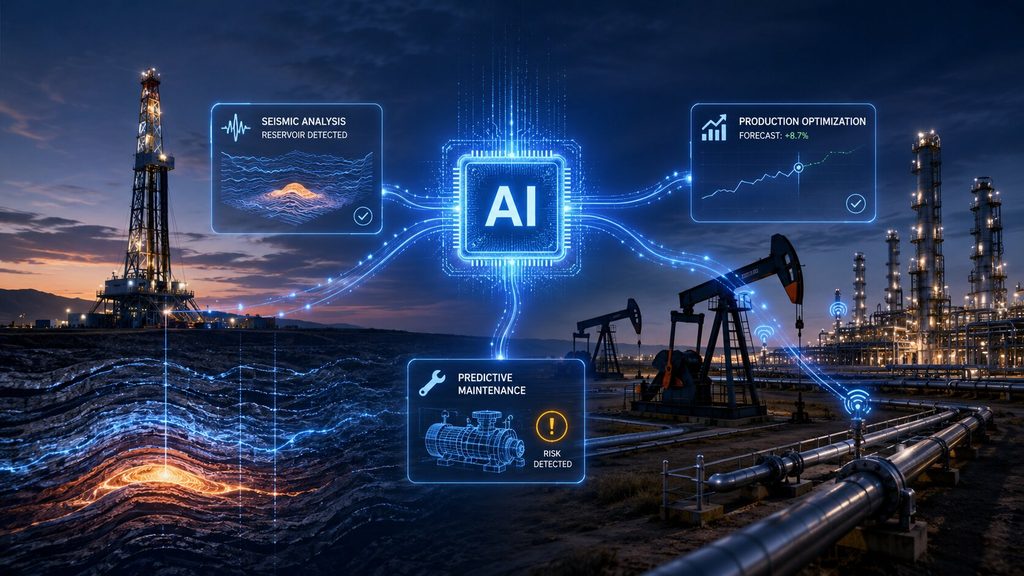
Exploration used to depend heavily on human interpretation of seismic surveys. That process was slow and inconsistent. AI in oil and gas exploration changes this by training models on decades of geological and seismic data to detect patterns invisible to the human eye.
Saudi Aramco offers one of the clearest examples of this shift at scale. At its Khurais field, the company deployed 40,000 sensors to monitor more than 500 oil wells, creating an advanced production system. Aramco also runs TeraPOWERS, its proprietary reservoir and basin simulator, which uses big data to simulate the entire hydrocarbon system of the Arabian Peninsula, with models continuously updated using new drilling and production data.
The scale of data involved is enormous. Aramco alone collects around 10 billion data points daily across its operations. That volume of information is simply not something human teams can process manually. AI makes it usable in real time.
AI Predictive Maintenance: Preventing Failure Before It Happens
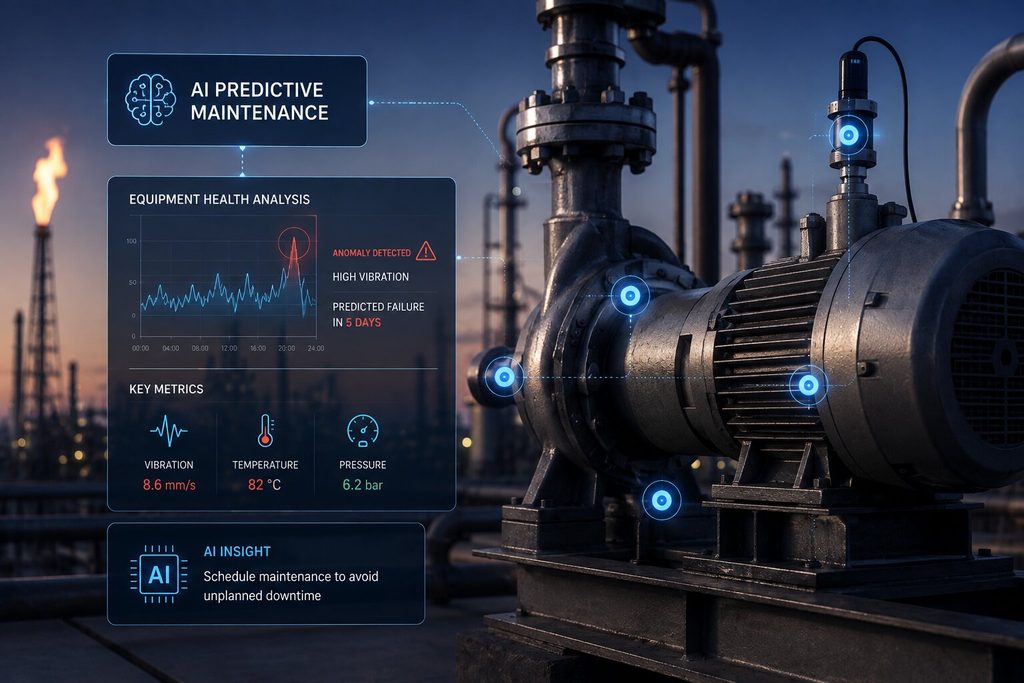
AI predictive maintenance is where oil and gas companies are seeing some of the fastest returns. Traditional maintenance runs on fixed schedules or waits for a breakdown. Both approaches waste money. AI flips this model by reading live sensor data and predicting failures before they occur.
Modern systems analyze vibration signatures, temperature trends, and pressure differentials to forecast issues in compressors, pumps, and heat exchangers 60 to 120 days before failure. That lead time gives maintenance teams enough room to plan repairs during scheduled downtime instead of reacting to emergencies.
Here is how the numbers stack up, based on IBM’s industry research:
| Metric | Improvement Reported |
|---|---|
| Production uptime | 27% improvement |
| Asset utilization optimization | 26% improvement |
| Operational cost reduction | Up to 18% |
| Revenue attributed to AI initiatives | 5% currently, rising to 7%+ in 3 years |
As per IBM, Oil and gas executives report a 27% improvement in production uptime through AI-based predictive equipment maintenance, along with a 26% improvement in asset utilization optimization. Beyond uptime, decreased downtime, automated inspections, and more efficient supply chains are reducing operational costs by as much as 18%. Executives currently attribute around 5% of revenue to AI-driven initiatives, with that figure projected to rise past 7% within three years.
Production Optimization: Getting More From Existing Assets
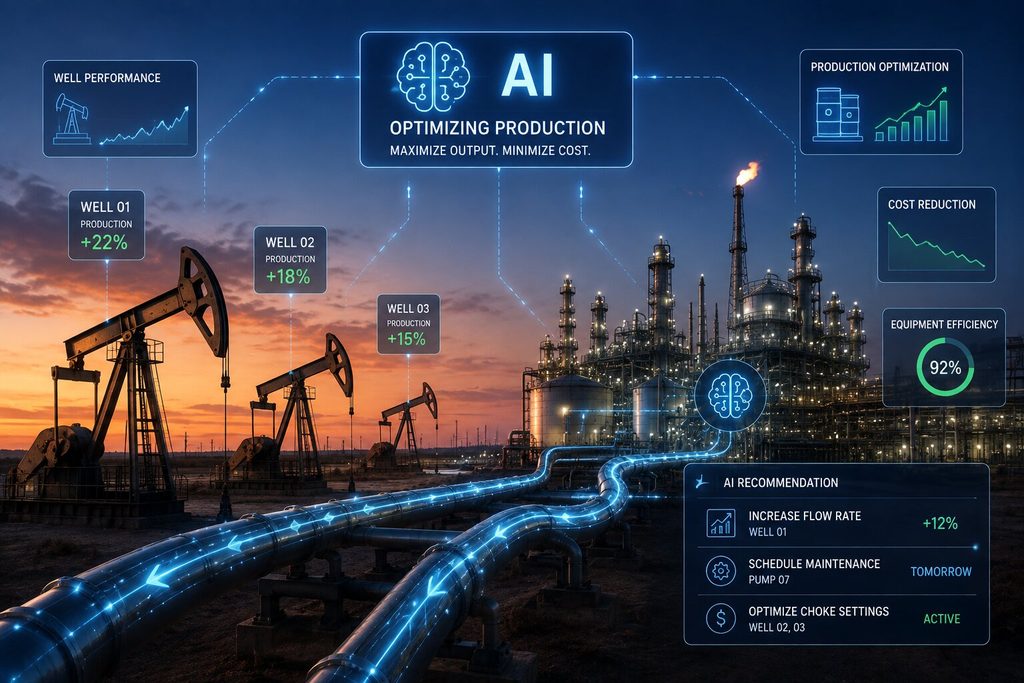
AI applications in oil and gas don’t stop at finding reserves. A large share of the value comes from optimizing what companies already have. AI models continuously adjust drilling parameters, flow rates, and equipment loads to squeeze more output from existing wells without adding new capital expenditure.
Aramco’s flaring reduction program is a strong example. By using big data to visualize its entire gas processing system, the company has maintained an industry-leading flare volume of below 1% of total raw gas production. That is both an operational win and an environmental one, since flaring wastes gas and increases emissions.
These are just two of the many AI use cases in oil and gas that are moving from pilot projects to standard practice across upstream and downstream operations.
BCG’s research backs this up at an industry level. Companies going all-in on AI have streamlined operations, shrunk processes from months to weeks, and cut the cost of operating in harsh environments by roughly a sixth.
Generative AI Use Cases in the Oil and Gas Industry
Generative AI use cases in the oil and gas industry now span the entire value chain, not just the upstream segment. These AI use cases in oil and gas touch everything from seismic modeling to compliance automation.
| Value Chain Stage | AI Use Case |
|---|---|
| Exploration | Seismic data interpretation, reservoir simulation |
| Drilling | Real-time drilling parameter optimization |
| Production | Predictive maintenance, flare and emissions reduction |
| Midstream | Pipeline leak detection, logistics forecasting |
| Downstream | Refining process optimization, demand forecasting |
| Enterprise-wide | Compliance reporting, safety monitoring, autonomous inspection |
According to IBM’s research, adoption is accelerating fast across every stage. Currently, 44% of upstream organizations use AI in oil and gas exploration, with another 45% planning to adopt it within three years. On the downstream side, 41% apply AI in refining, and 52% expect to do so within three years.
AI Adoption in Oil and Gas Industry: Where Things Stand
AI adoption in the oil and gas industry has marked a clear shift over the past few years. Companies stopped treating AI as a side project and started treating it as a core operating strategy. That momentum has only accelerated since.
According to BCG’s executive research, technological progress has made AI and AI agents critical building blocks for oil and gas companies to compete in this new industry landscape. The firm’s analysis suggests AI has the potential to deliver a 30% to 70% increase in EBIT for oil and gas companies over the next five years.
Oil and gas companies AI strategy discussions are also becoming a bigger part of industry gatherings. Every major AI in oil and gas conferences now dedicates significant time to agentic AI, autonomous field operations, and safety-focused deployments, reflecting how central this shift has become to the sector’s roadmap.
Why AI in Energy Sector Investment Matters for Decision-Makers
For business leaders and IT decision-makers, the case for AI in energy sector adoption is now financial, along with the technical. Saudi Aramco alone has spent more than $15 billion since 2018 on big data analytics, automation, industrial IoT, and artificial intelligence, one of the largest digital transformation efforts in the oil and gas sector globally.
That level of investment signals where the industry is headed. Companies that delay AI adoption risk falling behind on cost efficiency, safety compliance, and asset reliability, all of which directly hit the bottom line.
For oil and gas companies, AI is quickly becoming the difference between reactive operations and proactive, data-driven ones. The gap between early adopters and laggards is widening every quarter.
Challenges Companies Still Face
AI adoption in this sector isn’t friction-free. A few recurring roadblocks show up across the industry:
- Legacy infrastructure: Many facilities still run on older SCADA and DCS systems that require careful integration work before AI tools can plug in.
- Data silos: Operational data is often scattered across disconnected systems, making it harder to build accurate predictive models.
- Workforce readiness: Teams need training to trust and act on AI-generated recommendations rather than falling back on manual judgment alone.
- Upfront investment: Predictive maintenance and reservoir modeling systems require real capital before returns show up.
None of these are dealbreakers. They are simply the reason a phased, business-led rollout works better than trying to overhaul everything at once.
Final Thoughts
AI in oil and gas predictive maintenance, exploration, and production optimization is reshaping how the industry operates, from the seismic survey stage all the way to the refinery floor.
For businesses evaluating where to start, the smartest path is usually predictive maintenance and exploration analytics first, since both show measurable ROI fast. From there, scaling into full generative AI use cases in the oil and gas industry becomes a much easier conversation to have internally.
The organizations that treat AI as a core operating strategy today will be the ones setting the pace for the rest of the decade.
VectovateAI helps energy companies design and deploy AI systems built around real operational data, instead of generic dashboards.
If you’re exploring predictive maintenance, exploration analytics, or agentic AI for your production teams, connect with us and see where AI fits into your roadmap first.
Frequently Asked Questions.
Get all your answers here and if something remains ask our AI concierge or Book a call with our consultant.