AI in Logistics: Predictive Supply Chain Optimization
Predictive analytics catches supply chain disruptions before they cost money. Here is what AI in logistics does today, and where agentic AI goes next.


Supply chains break in predictable ways. A supplier misses a shipment. Demand spikes without warning. A truck sits in traffic while a customer waits. Predictive analytics in supply chain management exists to catch these problems before they cost money. Instead of reacting to a stockout or a late delivery, businesses now use AI models that read patterns in demand, inventory, weather, and supplier behavior to act early.
This shift matters because logistics has stopped being a back-office function. It decides whether a company keeps its delivery promises, protects its margins, and keeps customers coming back. Below, we break down what predictive analytics actually does in a supply chain, where agentic AI in supply chain operations is heading next, and how businesses in retail, manufacturing, and healthcare can start using it.
Key Takeaways
- Proactive Forecasting: Predictive analytics for supply chain management uses live and historical data to flag disruptions before they hit.
- Measurable ROI: Manufacturers using AI report measurable gains: 61% see lower costs, and 53% see higher revenue, according to McKinsey research cited by ThroughPut.
- The Agentic Shift: Generative AI in logistics and agentic AI are moving supply chains from predict-and-alert to predict-and-act, automating execution within pre-set business guardrails.
- Start Small: Success depends on clean data, a single initial pilot, and clear operational goals.
What Predictive Analytics in Supply Chain Actually Means?
Predictive analytics in supply chain management is the practice of using machine learning models to study past patterns and current signals so a business can anticipate what happens next. It pulls from multiple data sources, including inventory levels, supplier reliability records, shipping routes, customer demand history, and even weather and traffic data.
The output is a probability based on real numbers. If a supplier has missed delivery windows three times this quarter, the model flags the risk before the fourth miss happens. If weekend sales of a product spike every time temperatures rise, the model adjusts stock levels ahead of the heatwave, not after shelves go empty.
This is different from traditional forecasting, which relies on static historical averages. AI supply chain visibility platforms update continuously, which means the forecast gets sharper the more data flows in.
At its core, this is what supply chain predictions are built on: real signals instead of static averages, updated continuously as new data comes in.
Why Logistics Leaders Are Moving Fast on AI
The numbers explain the urgency. A Bain & Company survey found that 78% of executives across industries now rank AI-driven productivity, including supply chain performance, as a top priority, and 67% of companies are already exploring or actively deploying AI in procurement, logistics, and maintenance.
McKinsey research shows 61% of manufacturing executives report lower costs and 53% report higher revenue after adopting AI in their supply chains, with more than a third seeing total revenue growth above 5%. Looking further out, PwC projects AI applications could add up to $15.7 trillion to the global economy by 2030.
These numbers reflect the core predictive analytics supply chain benefits businesses are chasing: lower costs, fewer disruptions, and faster decisions backed by real data instead of guesswork.
These numbers reflect a simple business reality: supply chains that predict problems spend less money firefighting them.
Core Applications of AI in Logistics and Supply Chain
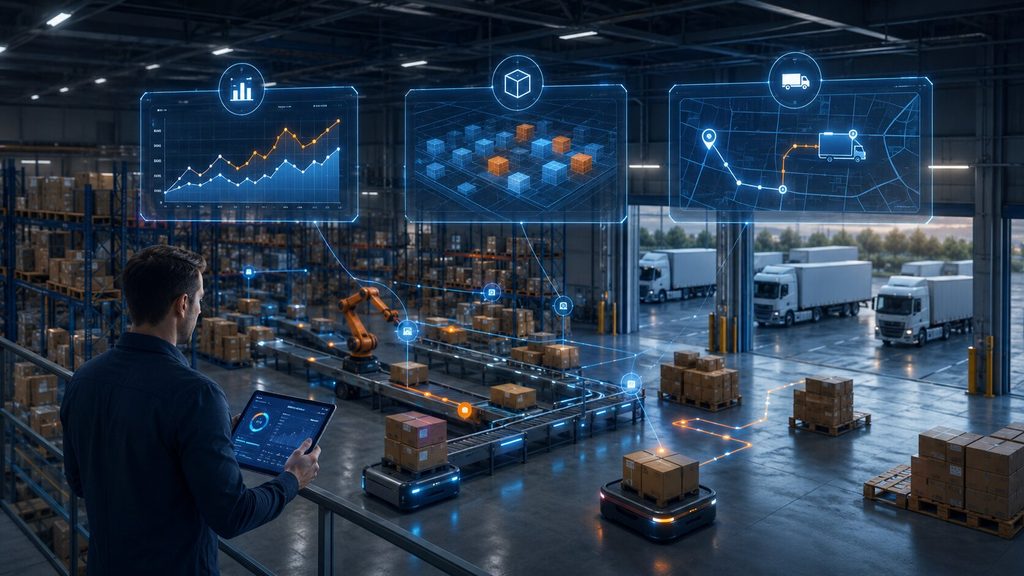
AI-driven supply chain optimization and AI for supply chain optimization show up in a handful of concrete use cases. Here is how each one works in practice.
| Application | What It Does | Business Impact |
|---|---|---|
| Demand forecasting | Analyzes sales history, seasonality, and market signals to predict future orders | Fewer stockouts, less overstock |
| Dynamic inventory management | Adjusts stock levels automatically as demand shifts | Lower carrying costs, better cash flow |
| Route and fleet optimization | Factors in traffic, weather, and fuel data to plan deliveries | Faster delivery, lower fuel spend |
| Supplier risk scoring | Tracks supplier reliability and lead time patterns | Fewer disruptions, stronger sourcing decisions |
| Predictive maintenance | Monitors equipment and vehicle sensor data | Less downtime, longer asset life |
| Warehouse automation | Optimizes picking, packing, and layout | Faster fulfillment, lower labor cost |
Each of these can run independently, but the real value shows up when they connect. A supply chain predictive analytics system that links demand forecasting to inventory and logistics stops treating each department as a silo and starts treating the supply chain as one connected system, which is exactly what SAP points to as the goal of moving from reactive management to intelligent, self-correcting networks.
From Predictive to Agentic: The Next Shift
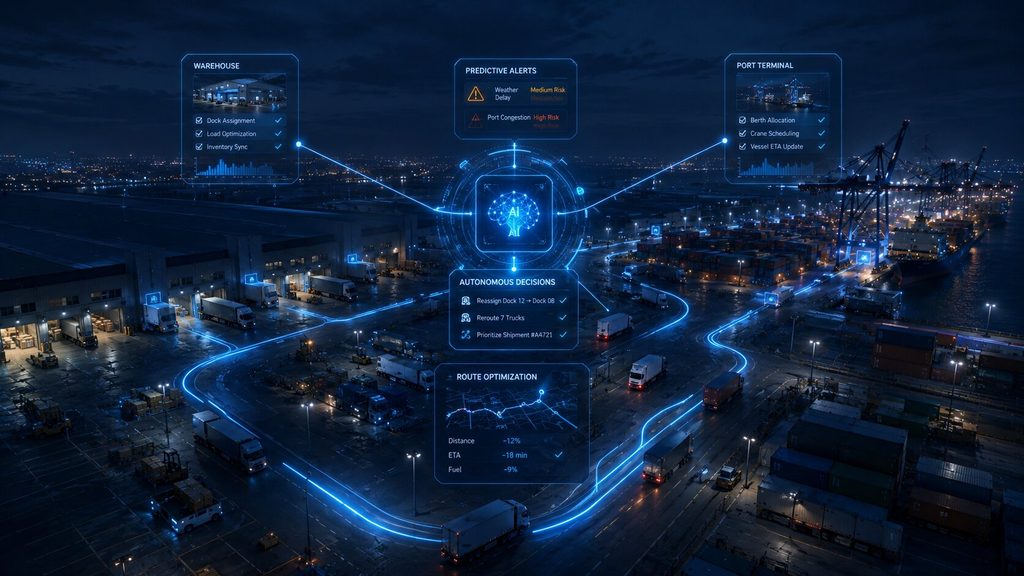
Predictive analytics tells a business what is likely to happen. Agentic AI in supply chain management goes a step further and acts on that prediction without waiting for a person to approve every step.
Picture a warehouse that senses a demand spike three weeks out. A predictive system would flag it and hand the alert to a planner. An agentic system checks supplier capacity, compares shipping costs across carriers, and places a reorder automatically, all within the guardrails a business sets in advance.
This is where generative AI in logistics adds another layer. Instead of static dashboards, teams can ask a system in plain language why a shipment is delayed or what the cost impact of a supplier switch would be, and get an answer built from real-time data rather than a static report.
The businesses getting this right are keeping a human in the loop for judgment calls while letting AI handle the repetitive, data-intensive decisions that used to eat up a planner’s day.
Real Numbers: What Businesses Actually Gain
Skepticism around AI ROI is fair, so here is what the data shows across industry benchmarks:
- 10 to 30% reduction in operational costs
- 20 to 40% improvement in inventory efficiency
- Faster cash cycle turnaround, in some cases up to 90 days quicker
- Measurable revenue growth tied to improved service levels
One retail case cited by ThroughPut saved close to 3.5 million euros a year in logistics costs simply by prioritizing top-performing SKUs with a value demand matrix instead of managing every product the same way. A perishable food producer used near-term demand sensing to cut product wastage by improving forecast accuracy for seasonal and weather-driven demand shifts.
We recently helped a supply chain innovator slash operating costs by 60% and boost ETA accuracy by 70% by replacing legacy dispatching with autonomous route orchestration.
Under the Hood: What an AI-Native Architecture Looks Like
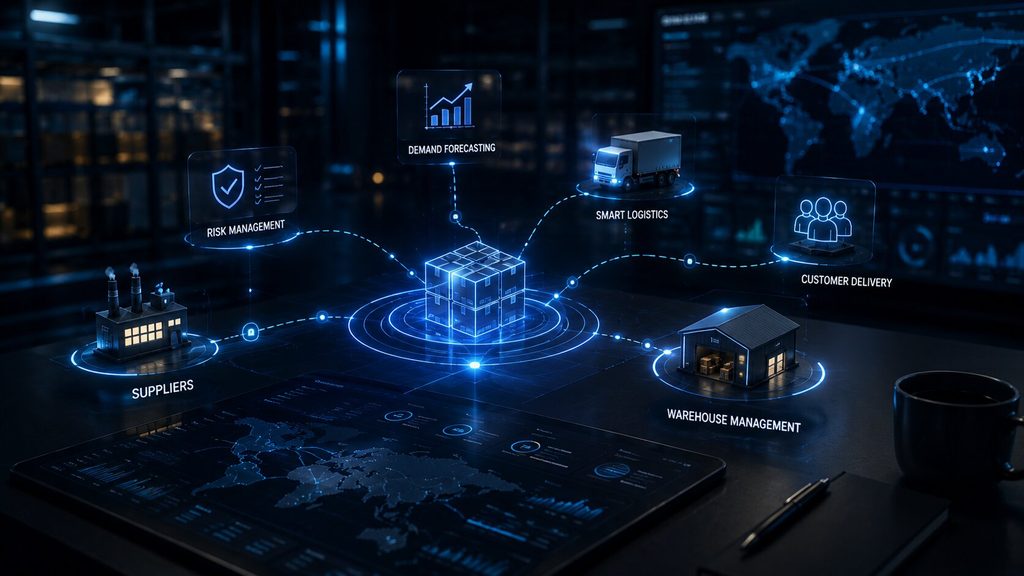
Let’s be real — most logistics firms run on rigid, legacy ERP systems processing data in batches overnight. If you want a supply chain that predicts and acts in real time, you can’t just slap a chatbot on top of an old database.
Here is what a modern architecture actually requires:
- Real-Time Data Ingestion: Using event-driven pipelines (like Kafka or streaming APIs) to pull live telemetry from IoT sensors, carrier APIs, and WMS platforms instead of waiting for overnight batch syncs.
- Multivariate Time-Series Models: Moving beyond static spreadsheets with models trained on historical seasonality and live exogenous variables (weather, traffic gridlock, labor constraints) to generate continuous risk probabilities.
- Agentic Middleware & Guardrails: Implementing a deterministic orchestration layer via custom event loops or agentic frameworks so autonomous systems can trigger purchase orders or route adjustments safely within hard-coded financial limits.
Where Businesses Get Stuck
AI adoption in logistics rarely fails because the technology does not work. It fails for more ordinary reasons.
- Messy data: Inaccurate or scattered data produces unreliable predictions, no matter how good the model is.
- Legacy systems: Older ERP and warehouse systems often do not talk to newer AI tools without real integration work.
- Skill gaps: Teams need training to trust and act on AI recommendations instead of ignoring them.
- Unclear ownership: Without a defined goal like cutting delivery times by 15%, AI projects drift without showing results.
None of these are reasons to avoid predictive analytics. They are reasons to plan the rollout properly.
How to Start: A Practical Path
Businesses do not need to overhaul their entire supply chain on day one. A phased approach works better and shows results faster.
- Audit Operations: Find where manual bottlenecks and delays hurt most.
- Clean Data: Centralize inventory, supplier, and logistics data sources.
- Set a Goal: Pick one measurable target, like reducing order errors by 15%.
- Run a Pilot: Test on a single process, such as demand forecasting for a top product line.
- Scale Gradually: Expand modules once the first pilot proves clear ROI.
Industry Snapshots
AI supply chain optimization looks different depending on the industry:
- Retail: Prevents overstock and shortages by tracking sales trends across seasons and product categories.
- Food and beverage: Manages perishable inventory by predicting demand for short shelf life goods.
- Healthcare: Tracks medicine and device flow to keep hospitals stocked with critical supplies.
- Automotive: Coordinates global supplier networks so plants get parts without holding excess inventory.
- Manufacturing: Applies predictive maintenance to avoid unplanned equipment downtime.
Conclusion
Supply chains that wait for failures always pay a premium to fix them. Predictive analytics in supply chain management flips that model. It gives businesses the ability to see a stockout, a supplier delay, or a demand spike coming, and act before it turns into a cost. The shift toward agentic AI in supply chain operations takes this further, moving teams from reading alerts to running systems that predict and act within the boundaries a business sets.
If your business is ready to move from reactive logistics to predictive, agent-driven supply chain operations, VectovateAI builds AI native systems designed around exactly this approach: agent-first, with a human always in the loop. Talk to our expert and find out what predictive supply chain optimization is better for your operations.
Frequently Asked Questions.
Get all your answers here and if something remains ask our AI concierge or Book a call with our consultant.