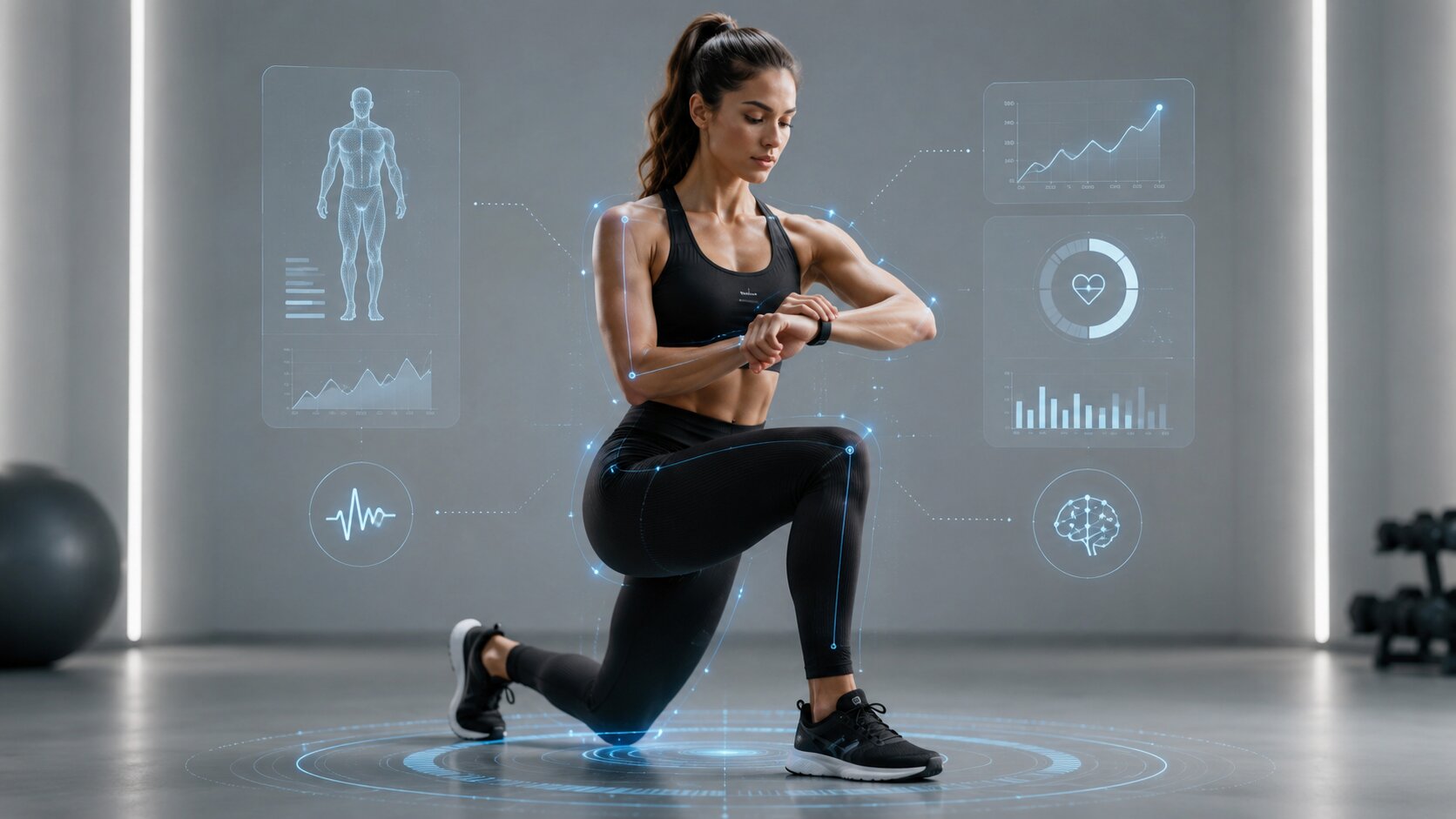
AI-Powered Personal Trainers: Transforming Fitness Apps in 2026
AI personal trainers have moved past workout generators into software that coaches you mid-set: counting reps, adapting when you report pain, and scaling back after a bad night of sleep. Here is what separates real coaching apps from glorified exercise libraries, how AI stacks up against a human trainer, and why the winning 2026 products keep a human in the loop.

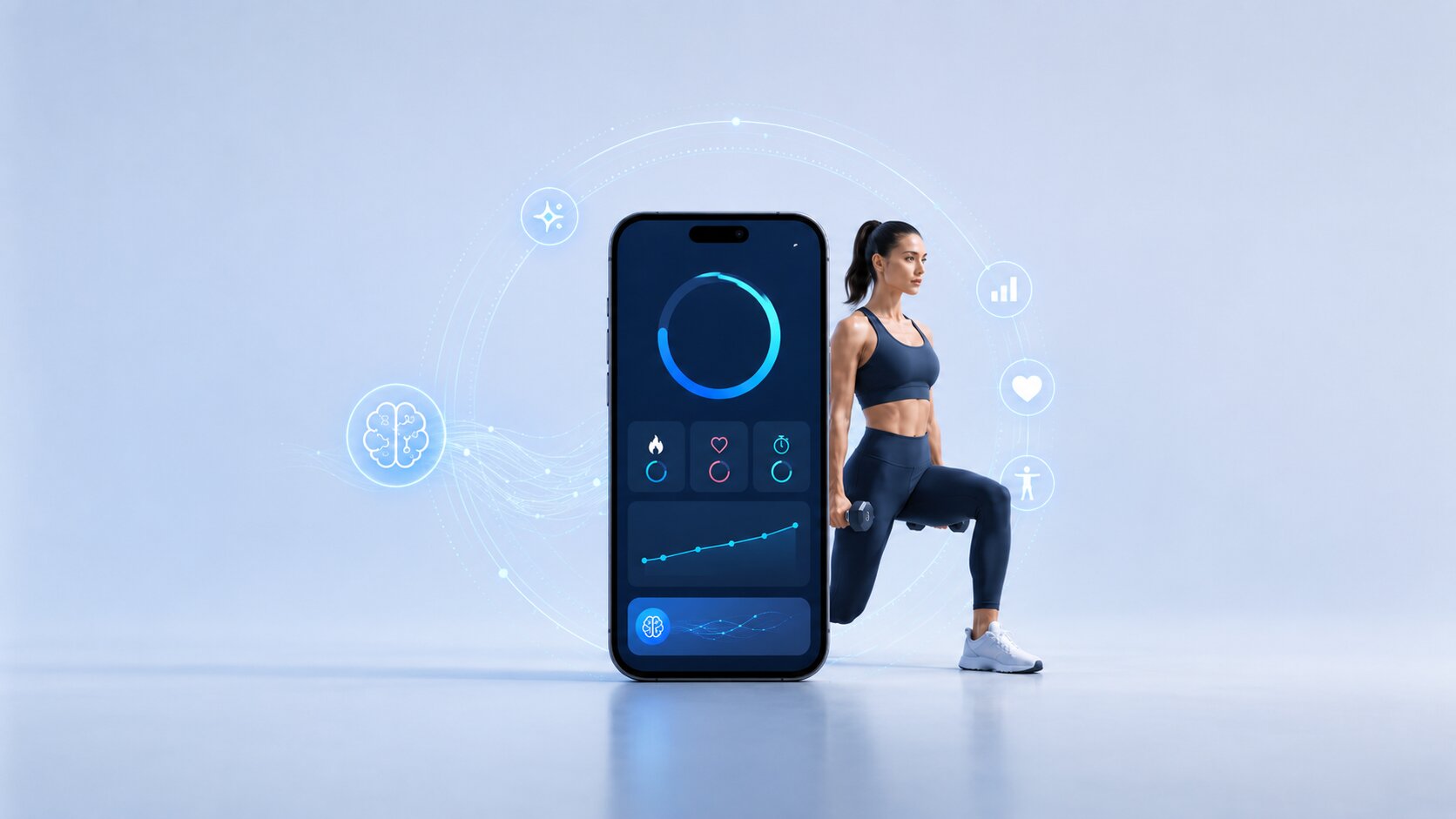
Picture this: it’s 6 AM, you have no time for a gym commute, and your usual trainer is booked out for a week. A decade ago, that meant skipping the workout entirely. In 2026, it means opening an app that talks you through every rep, counts your reps automatically, and adjusts the plan the moment you say your shoulder hurts.
This shift isn’t hype anymore. It’s a real product category with real money behind it. The AI personal trainer market has moved past clunky workout generators into something that behaves like an actual coach, and business owners, app developers, and IT decision-makers building in this space need to understand exactly what’s driving that shift before they build their next product or pitch their next investor.
Key Takeaways
- The global AI in fitness and wellness market is projected to grow from $10.68 billion in 2025 to $57.80 billion by 2035, and this growth is being driven almost entirely by coaching apps, not just tracking apps.
- A true AI personal trainer now means real-time voice coaching and mid-workout adaptation, not just a generated workout list.
- Only 24.2% of US adults meet basic activity guidelines, which shows how big the personalization gap in fitness still is.
- The best AI workout apps in 2026 win on decision quality during “bad days” — missed sessions, poor sleep, travel, and equipment changes — not on library size.
- Business owners building fitness apps should design for a hybrid model: AI handles data and consistency, humans handle judgment and trust.
What Is an AI Personal Trainer, Really?
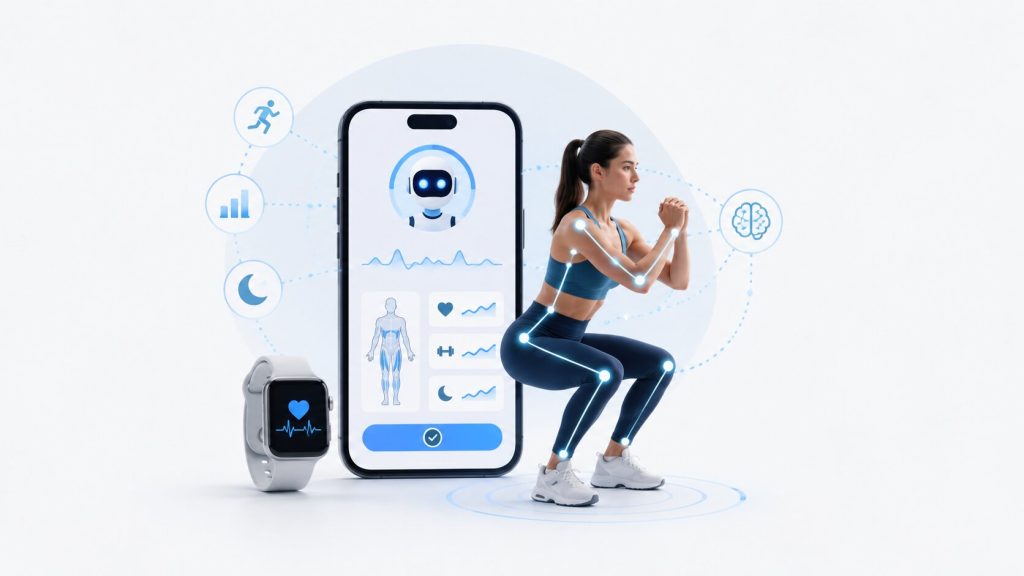
An AI personal trainer is not a workout generator with a chatbot bolted on. It is software that coaches you while you train, counting reps, adjusting difficulty, and responding to how your body feels in the moment.
Most people still confuse two very different product categories. One type builds you a plan and leaves you alone once the workout starts. The other stays present through the entire session, the same way a real trainer would.
This distinction matters for 2026 builders. Users increasingly search for an AI powered personal trainer app that talks them through the set, not one that hands them a PDF. Apps that lead with voice guidance, computer vision rep counting, and live feedback loops are pulling ahead of apps that only generate static plans.
Why This Category Is Exploding in 2026?
The market data backs this shift. The global AI fitness and wellness market sat at $10.68 billion in 2025 and is expected to reach $57.80 billion by 2035, according to InsightAce Analytics’ market analysis reported by Forbes. That is more than 5x growth in a decade.
The reason is simple economics. Working with a human trainer 2-3 times a week typically costs somewhere between $320 and $1,200 a month, while a strong AI personal trainer app costs a fraction of that, usually under $20 a month. For price-sensitive users and IT professionals with unpredictable schedules, that gap is decisive.
But cost is only part of the story. CDC surveillance data shows just 24.2% of US adults meet the WHO’s combined aerobic and strength-training guidelines. That gap between “knowing what to do” and “actually doing it consistently” is exactly what a good AI workout generator is supposed to close.
The Feature That Actually Separates Winners in 2026
Here’s what most fitness-app product teams get wrong: they compete on exercise library size. In 2026, that is not where the real battle is.
| Feature | Static Workout App | True AI Personal Trainer App |
|---|---|---|
| Workout creation | Generates a list upfront | Generates plan + adapts live |
| During-workout support | None | Voice coaching, rep counting |
| Feedback handling | Ignored until next session | Adjusts immediately (pain, fatigue, difficulty) |
| Missed sessions | Pushes plan forward by date | Preserves progression logic |
| Poor sleep/recovery | No change | Adjusts training dose |
| Accountability | Passive notifications | Active, conversational check-ins |
Adaptive coaching quality now matters more than exercise-database size. This is a big shift for anyone building or evaluating a best AI personal trainer app: the moat isn’t content, it’s decision-making under real-world constraints.
What Makes a Great AI Workout App Worth Using
Four capabilities consistently separate genuine coaching apps from glorified workout libraries:
- Real-time voice guidance: coaching that continues through the set, not just before it
- Automatic rep counting via computer vision, removing the need to check a phone mid-set
- Live adaptation: instantly modifying an exercise when a user reports pain, fatigue, or difficulty
- Recovery-aware programming: adjusting intensity based on sleep, HRV, or missed sessions rather than blindly following the calendar
Research also backs the recovery-awareness piece specifically. A systematic review found HRV-guided training produced a meaningfully positive effect on VO2max compared to fixed progression plans. Sleep matters just as much; partial sleep restriction has been shown to reduce maximal lifting strength by roughly 10-20% in experimental settings, and adolescent athletes sleeping under 8 hours showed 1.7 times higher injury risk in one study. An app that ignores these signals and prescribes the same intensity regardless is only cosmetically personalized.
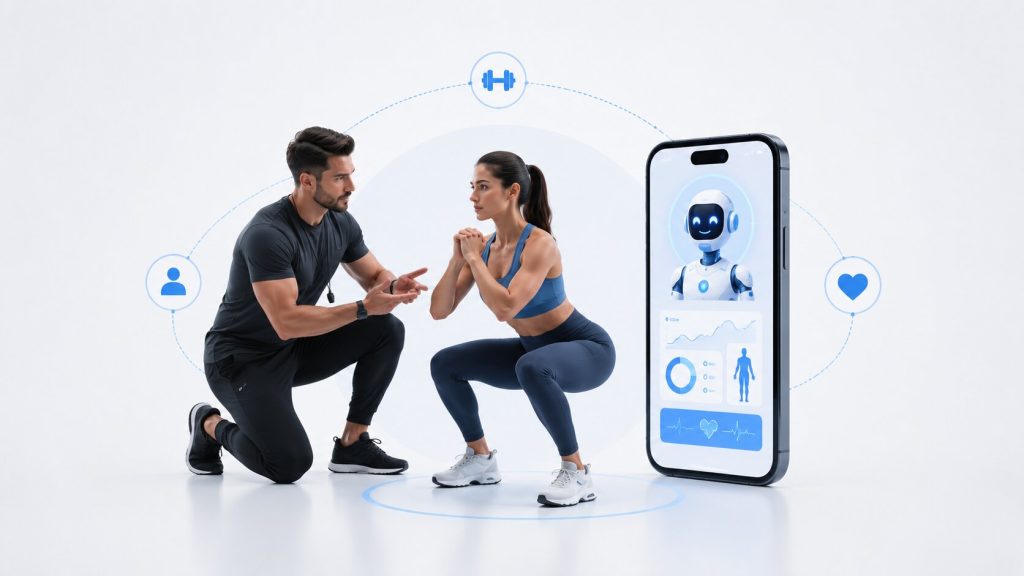
AI Trainer vs. Human Trainer: An Honest Comparison
Business owners weighing whether to build an AI-only product, a hybrid, or a human-coaching marketplace need to understand where each model genuinely wins.
| Factor | AI Personal Trainer | Human Trainer |
|---|---|---|
| Monthly cost | ~$10–20 | $250–1,800+ |
| Availability | 24/7, on-demand | Scheduled sessions only |
| Consistency | Perfect memory of every workout | Varies by trainer |
| Physical form correction | Visual/voice cues only | Hands-on correction |
| Emotional judgment | Limited | High — reads “how the athlete actually feels” |
| Cost to scale (for a business) | Low, software-driven | High, human-hours-limited |
An endurance coach interviewed by Forbes made an important point: data is meant to inform decisions, not dictate them, and most AI tools haven’t fully learned that distinction yet. Another coach in the same piece noted that AI is good at flagging when something looks off in the numbers, but it doesn’t ask the athlete why or help them work through it the way a human would.
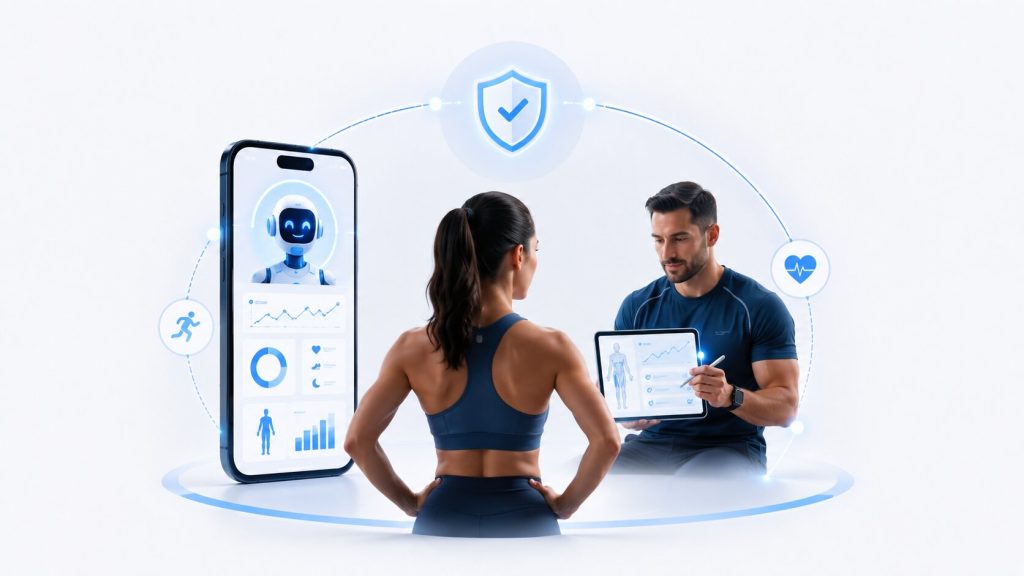
This is exactly why the smartest fitness-tech businesses in 2026 aren’t positioning AI as a full replacement. They’re positioning it as the layer that makes human coaching scalable and affordable, automating the data-heavy grunt work so trainers can spend their time on judgment calls that actually need a human.
What Users Actually Want From an AI Personal Trainer App?
Real user feedback across app stores reveals a consistent pattern: people want to press play and be guided, not think through their own programming. This is the exact insight that should shape product decisions for anyone building an AI personal trainer and nutritionist app or a standalone workout coach.
Users specifically respond to:
- Coaching that requires zero setup, thinking — “just open it up, press play”
- Adaptation that happens during the workout, not only between sessions
- Non-punitive handling of missed workouts, adjusting the plan instead of guilt-tripping the user
- Equipment-flexible programming that works at home, in a hotel gym, or at a full gym
Where AI Coaching Still Falls Short — And Why That’s an Opportunity
No serious content strategy on this topic should oversell AI. The honest gaps are where the real product opportunity sits for 2026 builders.
Experienced coaches point out that data-only coaching misses what one endurance athlete called “perceived exertion awareness” — the ability to read your own body before a metric confirms it. This self-knowledge takes years to build, and beginners following a pure AI workout plan never get the chance to develop it if the app does all the thinking for them.
There’s also a real safety consideration. One elite athlete who has spoken openly about a past eating disorder noted that AI platforms only know what a user tells them, and struggling users are often the least likely to be honest about their state. This is a critical design consideration for anyone building fitness AI: an AI personal trainer app free of human oversight for vulnerable users can be risky, not just imperfect.
The practical takeaway for product teams: build in human-in-the-loop escalation paths, not just smarter algorithms.
The 2026 Playbook: Agent-First, Human-in-the-Loop
The strongest fitness-tech products emerging in 2026 aren’t choosing between AI and human coaching; they’re combining both deliberately.
- AI handles the volume work: tracking, pattern recognition, rep counting, recovery flagging, and day-to-day plan adjustments
- Humans handle the judgment work: interpreting the “inner life” of an athlete, building trust, and stepping in when something doesn’t add up numerically but feels off
- The business benefit is real: one coach interviewed in the Forbes piece compared this shift to the arrival of ATMs in banking; the total number of coaching relationships a business can support goes up, not down, when AI absorbs the repetitive data work
For founders and decision-makers building in this space, this is the model worth architecting around: an AI personal fitness trainer engine as the always-on layer, with human oversight built in for edge cases, safety flags, and users who need more than an algorithm can give.
Frequently Asked Questions.
Get all your answers here and if something remains ask our AI concierge or Book a call with our consultant.